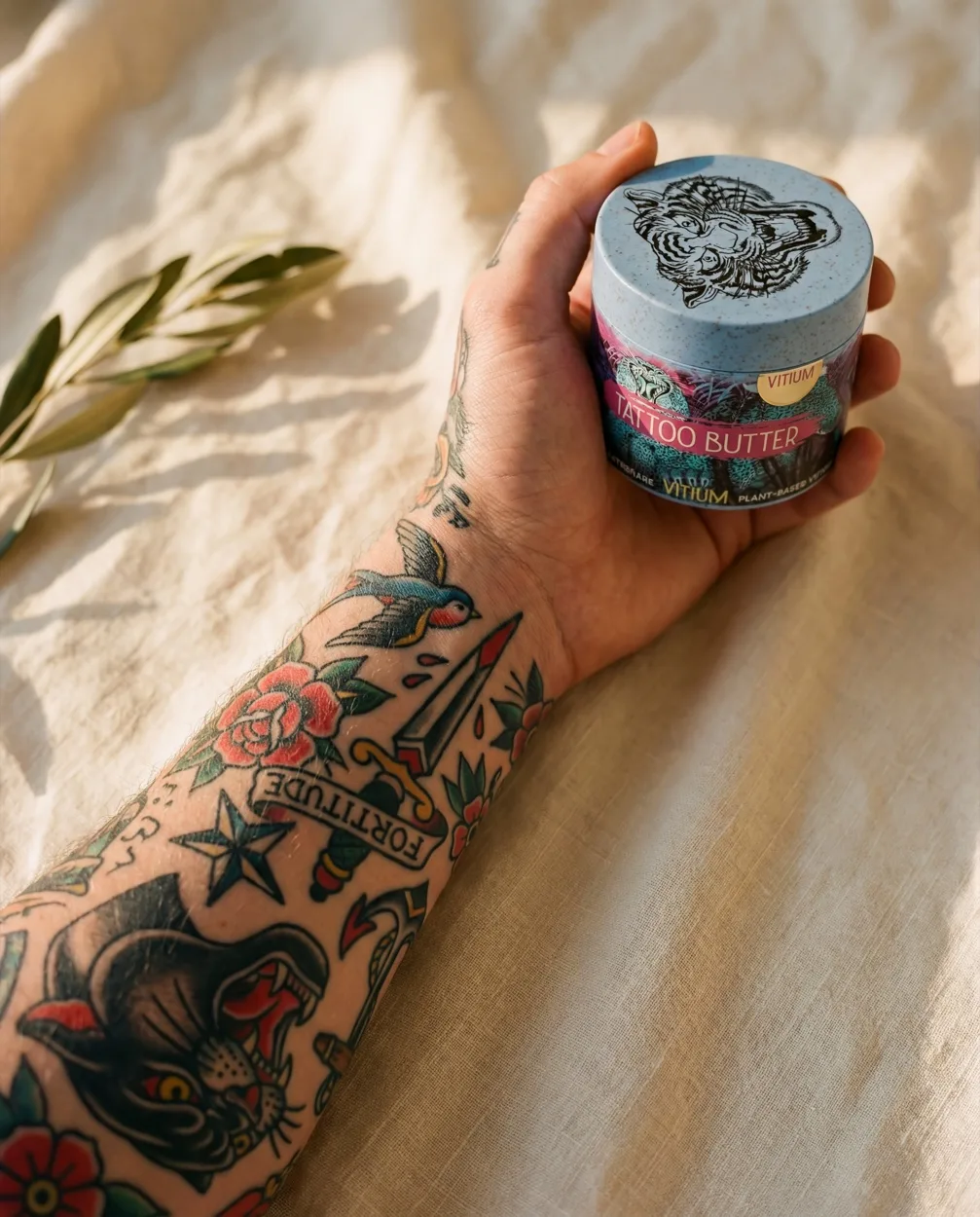
Tattoo Butter: What It Is, How to Use It, and How to Choose One
A fresh tattoo is an open wound with a picture held inside it. For the first two to four weeks, the skin is doing two jobs at once: closing the wound and locking the pigment into the dermis. What you put on it during that window decides how the piece reads for the next ten years.
Most people reach for whatever is in the bathroom cabinet. That is usually the wrong move. The product you choose changes how fast the skin settles, how cleanly the scabs lift, and how sharp the colour stays once the healing is done.
This guide covers what tattoo butter actually is, how it differs from a lotion or an ointment, what belongs in a good one, and how to use it without smothering the work. No hype. Just what holds up behind the machine.
What tattoo butter actually is
Tattoo butter is a thick, balm-style aftercare made from plant butters and oils that conditions a healing tattoo without sealing it shut. It melts on contact with skin, sits in a thin breathable layer, and gives the surface the fatty acids it needs to repair while the wound closes underneath.
That last part matters more than it sounds. Healing skin needs moisture and air at the same time. A good butter holds moisture in the upper layers while still letting the wound breathe. A heavy seal does the opposite — it traps everything, including heat and plasma, and that is where healing goes sideways.
The technical word for that problem is occlusion. A fully occlusive layer locks moisture, heat, and the fluid a wound naturally weeps underneath it, which softens scabs unevenly and gives bacteria somewhere warm to sit. A butter applied thin is only lightly occlusive: enough to hold moisture, open enough to let the skin work. Thickness, not the jar it came in, is what tips a good butter into a bad seal.
A butter is not a generic body moisturiser with a tattoo label on the front. A body moisturiser is built to vanish fast into healthy skin. Healing skin needs something that stays long enough to do work, applied thin enough that it never suffocates. The texture is the whole point.
Tattoo butter vs lotion, cream, and ointment
People search “tattoo cream,” “tattoo balm,” and “tattoo butter” as if they are the same thing. They are not. The base each one is built on changes how it behaves on a wound.
Lotion and cream are water-based. They feel light, they absorb in seconds, and they evaporate almost as fast. On healthy, healed skin that is fine — the American Academy of Dermatology notes that a light water-based lotion is a reasonable way to keep dry tattooed skin moisturised. The trouble is that many of them are thin enough to need constant reapplying on a fresh piece, and the cheaper ones carry stinging additives a raw tattoo does not want.
Balm and butter are oil-and-butter based. They carry more conditioning per layer, they last longer between applications, and applied thin they support the skin barrier without drowning it. This is the category most working artists hand their clients.
Ointment is the one to think hard about. Petroleum jelly and other petroleum ointments form an airless seal over the skin. The same dermatology guidance is blunt about it: petroleum-based products can cause the ink to fade. There is a second reason artists keep it off the bench. During a long session, petroleum on the skin makes the wipe drag, and that friction pulls fresh pigment straight back out. Hours of shading can end up on a paper towel.
This is where the most common bathroom-cabinet default comes in. Aquaphor is petroleum-based, and plenty of people reach for it because a shop recommended it years ago. It is not the worst thing you can do — a thin film keeps the skin from drying out. But it was built as a general skin protectant, not for tattooed skin, and the same fade and over-seal trade-offs apply. If you use it at all, keep the film sparing and stop once the skin begins to flake. A breathable plant butter sidesteps the problem from the start.
So the real divide is not butter versus lotion. It is breathable conditioning versus airless sealing. The enemy is petroleum and over-application — not the texture you happen to prefer.

What belongs in a good tattoo butter
Turn the jar over. The ingredient list tells you more than the front label ever will. A butter worth using is built on a short stack of plant butters and botanical oils, and you can read the quality straight off the INCI.
These are the five hero ingredients that earn their place in a serious formulation:
- Shea Butter (Butyrospermum parkii) — a rich plant butter carrying the fatty acids and natural allantoin that support skin-barrier repair. It is the workhorse of the base.
- Mango Butter (Mangifera indica) — conditions and helps the skin around the tattoo stay supple instead of cracking as it tightens.
- Calendula (Calendula officinalis) — a botanical used in European skin care since the Middle Ages for how it helps skin feel calm and comfortable.
- Vitamin E — an antioxidant that helps the surface stay conditioned while the colour underneath settles. Its position on the INCI matters: meaningful in the first dozen ingredients, decorative if it is buried near the bottom.
- Hypericum (Hypericum perforatum, St John’s Wort) — a botanical oil traditionally macerated in olive oil for weeks before use, valued for its conditioning, comforting feel on healing skin.
One honest note: a real formulation has more than these five. There are carrier oils, a plant-based emulsifier, and a preservation system holding the whole thing stable. The five above are the hero ingredients — the ones doing the visible work. The rest is the engineering that keeps them stable in the jar.
The reason the base matters comes down to chemistry. Plant butters and oils are lipophilic — they sit in the skin’s own oil layer and reinforce it, which is exactly what a healing barrier is trying to rebuild. Petroleum sits on top instead, a film the skin cannot absorb or use. That is the difference between feeding the barrier and sealing over it, and it is why two products that both look greasy in the jar behave nothing alike on a wound.

Here is how to read a label in ten seconds.
Look for:
- Plant butters high on the list — shea or mango near the top means the jar is mostly conditioning base, not water and filler.
- Latin botanical names on the INCI — Calendula officinalis, Hypericum perforatum. They signal a supplier that bothered to source real botanicals.
- Vitamin E inside the first dozen ingredients — meaningful concentration, not a token.
- Vegan and cruelty-free — and no lanolin if you want to keep it fully plant-based.
Avoid:
- Petrolatum, mineral oil, or paraffin — the petroleum family that seals the skin and can dull the ink.
- Parabens and sulfates — cheap preservation and harsh cleansers a healing wound does not need.
- A long unreadable list fronted by water — a thin product padded out to feel like more.
A quick word on scent, because people get this backwards. Fragrance itself is not the red flag. Cheap masking scent stacked on top of a petroleum base is the red flag. A real, well-made fragrance over a clean plant base is a different thing entirely — and it is one of the reasons a butter can feel like part of the ritual instead of a chore.
How to use tattoo butter — day by day
The two most common mistakes are starting too early and using too much. Get those two right and the rest is easy.
Leave the artist’s wrap on as long as they told you — usually a few hours, sometimes overnight. The skin needs that first stretch to stop weeping before anything goes on top of it.
Day 0 (the day you get it): Once the wrap comes off, wash gently with lukewarm water and a mild, fragrance-free soap. Pat dry with a clean paper towel, not a cloth — cloth carries bacteria. Leave it bare to breathe for now.
Days 1–2: Keep washing two to three times a day. Some clear fluid, redness, and tightness are normal. Start a whisper-thin layer of butter once the surface feels dry and taut. Thin. I mean thin. If it looks glossy ten minutes later, you used too much — wipe the excess off.
Days 3–7: This is when it itches and starts to flake. The dermatology guidance is clear that itching, flaking, and light scabbing are part of normal healing — so do not pick, and do not scratch. A thin layer of butter twice a day keeps the flaking soft so it lifts on its own. If the skin is going tight and dry around day five, that is the moment butter earns its keep.
Week 2: The heavy flaking eases. The colour may look cloudy or milky as a fresh layer of skin forms over it. This is normal — keep the routine light and steady. Whether you dry-heal or use a wrap method, the principle is the same: clean, thin, patient.
Weeks 3–4: The surface looks healed. According to NHS guidance, the colour usually settles fully around four to six weeks, and you should keep a new tattoo out of swimming pools until any scabbing has gone. Keep conditioning daily through this stretch.
If you want the full breakdown, the week-by-week healing timeline walks each stage in detail. And if a patch ever heals raised, shiny, or pitted, read up on scarring and what causes it — that is usually a sign of trauma or infection during healing, not the butter.
A few habits do more harm than any product choice. Picking or peeling scabs early lifts pigment out with them and leaves the colour patchy. Re-wrapping the tattoo overnight after the first day traps moisture against the wound. Switching products halfway through because healing feels slow only confuses the skin — choose one clean butter and stay with it. And soaking a fresh tattoo in a bath, a pool, or the sea before it has closed is the fastest way to fade and infect good work.

Tattoo butter on old and healed tattoos
Butter is not only for fresh work. A healed tattoo is still ink sitting under skin, and skin dries, dulls, and ages. A thin daily layer keeps the surface conditioned so the colour underneath reads bright instead of grey.
The biggest long-term threat to tattoo colour is the sun. Research on tattoo aftercare consistently flags ultraviolet exposure as a primary cause of fading, and dermatologists recommend a broad-spectrum SPF 30 or higher over any healed tattoo you take into daylight. Butter conditions; sunscreen protects. You want both.
How a piece holds up over a decade also depends on the work itself — line weight, ink density, the style and how it ages. Aftercare cannot save a poorly placed tattoo. But honest daily care is the cheapest thing you can do to protect one you love.
There is no real end date to this. Skin keeps drying and renewing for as long as you have it, and the ink underneath only ever looks as good as the skin on top of it. A jar lasts a long time at a thin daily layer, which makes year-round conditioning close to effortless. Treat it the way you treat the tattoo itself — a small repeated act of care, not a one-time fix.
How to choose the right one
By now the checklist writes itself. A good tattoo butter is built on a real plant-butter base, not water and filler. Its ingredient list is short enough to read and honest enough to name its botanicals in full. It is vegan if that matters to you, and it comes in packaging that respects the product inside it — a plant-based, sugarcane-derived jar is a small sign a maker cares about the details.
Price is the part people argue about. You spent good money on the tattoo. Spending five pounds on petroleum to protect it is a strange way to treat a thing you will wear for life. A real butter costs more because the base costs more — that is the whole story.
One last thing if your skin runs sensitive: patch-test anything new on a small area a day before you put it on a fresh piece. Real botanicals are gentle for most people, but every skin is its own. Test first, then trust it.
FAQ
What is tattoo butter and what does it do? Tattoo butter is a thick, balm-style aftercare made from plant butters and botanical oils. It conditions a healing tattoo and supports the skin barrier while the wound closes, without forming the airless seal that petroleum products do. Applied in a thin layer, it keeps the surface moisturised so scabs stay soft and lift cleanly, which helps the colour settle evenly. It is also used on healed tattoos to keep the skin conditioned and the ink looking sharp.
Is tattoo butter the same as tattoo cream? No. The difference is the base. A cream or lotion is water-based — light, fast-absorbing, and quick to evaporate, which means more frequent reapplying on a fresh tattoo. A butter is oil-and-butter based, so it carries more conditioning per layer and lasts longer between applications. Both can work on healed skin. For a fresh piece, a thin layer of a clean plant butter gives more barrier support than most thin water-based creams.
Is petroleum jelly or Vaseline bad for a new tattoo? It is best avoided on fresh work. Petroleum jelly forms an airless seal over the skin, which traps heat, moisture, and plasma underneath and can lead to uneven scabbing. Dermatology guidance also warns that petroleum-based products can cause tattoo ink to fade. Working artists avoid it during sessions for a separate reason: the friction of wiping over a petroleum layer pulls fresh pigment back out of the skin. A thin, breathable plant butter avoids both problems.
How long should you use tattoo butter on a new tattoo? Through the full healing window, which is usually two to four weeks, with the colour settling around four to six weeks. Apply a thin layer two to three times a day once the skin has stopped weeping, washing gently before each application. After it has healed, you do not need to stop — many people keep using a thin daily layer on old tattoos to keep the colour conditioned and bright.
Can you use tattoo butter on old, healed tattoos? Yes, and it is one of the best things you can do for them. Healed ink dulls as the skin above it dries and ages. A thin daily layer keeps that surface conditioned so the colour reads brighter and sharper. Pair it with a broad-spectrum SPF 30 or higher whenever the tattoo is in the sun — ultraviolet light is the single biggest cause of long-term fading, and conditioning alone will not stop it.
How do you choose a good tattoo butter? Read the ingredient list, not the front label. Look for plant butters such as shea and mango near the top, real botanicals named in full, and Vitamin E within the first dozen ingredients. Avoid petrolatum, mineral oil, paraffin, parabens, and sulfates. Vegan and cruelty-free are easy wins if they matter to you. A short, honest, plant-led list in respectful packaging beats a long one fronted by water and filler every time.
I am not going to pretend I am neutral about this. My partners and I spent two years formulating a plant-based tattoo butter in Sicily, working with a respected Italian cosmetic manufacturer to get the base right — premium-grade shea and mango, the five hero ingredients above, no petroleum and nothing that seals the skin shut. It is called VITIUM Tattoo Butter, and you can see what went into it if you want the full ingredient story.
But honestly, whether you buy ours or another real plant-based butter, the principles in this guide are what matter. Read the label. Apply it thin. Skip the petroleum. Keep it out of the sun. Do that, and the piece you paid for will still look like the piece you paid for in ten years.
Your tattoo deserves better than whatever is in the bathroom cabinet.
— Gabriele B. Tattoo artist · Co-founder, VITIUM