Why Your Tattoo Feels Dry: A Complete Healing Guide
Around day five of healing, most fresh tattoos start feeling tight, looking flaky, and worrying their owners. The skin lifts in small translucent pieces. The colour underneath looks temporarily dull. The instinct is to panic — and the panic response usually makes things worse.
This guide explains what’s actually happening to the skin during the dry phase, what to avoid, what works, and how to think about tattoos on skin that was already dry before the session even began. The mechanisms are simple once they’re laid out. The mistakes most people make are predictable. And almost all the dryness people worry about resolves on its own — provided nothing makes it worse in the meantime.
Two different “dry tattoos” — and why most articles confuse them
There are two completely separate situations the internet calls “dry tattoo skin,” and they need different answers.
The first is the most common: a new tattoo is healing, and around day five or six the area starts feeling tight, looking flaky, and worrying its owner. This is dryness as a healing symptom. It’s almost always normal. It needs a small adjustment, not a panic response.
The second is older: someone with naturally dry skin wants to know whether they can get tattooed and how to keep the colour from suffering. This is dryness as a constitutional condition. It needs a longer plan, starting before the session and continuing for months after.
Most articles treat both situations the same way. They can’t. The mechanism is different, the timeline is different, and the right answer is different. The rest of this guide handles both — separately.
Why your new tattoo feels dry — the mechanism
When the needle drives ink into the dermis, the body responds the way it responds to any wound: plasma rises to the surface, white cells move in, and over the next two to three weeks a layer of new skin closes over the area. Around day five to ten, that new skin reaches its tightest, driest stage. The old surface lifts off in flakes. The fresh tissue underneath isn’t fully developed yet. The result feels dry because, mechanically, it is — the outer hydration layer has been temporarily replaced by something less robust.
Most of the dryness people panic about lives in this exact window. Day six. Day eight. The flakes are not ink falling off — they’re spent skin shedding, the same way a sunburn peels. The colour underneath is intact. The dryness is the renovation, not the damage.

What turns normal healing dryness into a problem isn’t the dryness itself. It’s what gets done in response to it. People overcorrect. They reach for the wrong product. They scratch. The next two sections are about exactly that.
The dry-healing debate — what it actually means
There’s a long-running argument in tattoo aftercare between two camps. One side says use a thin balm or butter through the healing window. The other says use nothing at all — let the skin scab and shed naturally, no products, just clean water and patience. The second approach is called “dry healing.”
Both camps have their reasons. Here is what’s actually true on each side.
Dry healing isn’t unreasonable in a narrow set of cases. A small, low-friction tattoo, on a part of the body that doesn’t rub against clothing, on someone with skin that runs slightly oily, in a low-humidity environment without allergens — that tattoo can heal cleanly with nothing more than water and time. The pro-dry-healing argument is also fair on one point: introducing any product carries a small risk of contamination, irritation, or allergic reaction.
But that narrow set of cases is exactly that — narrow. Most tattoos aren’t small and low-friction. Most people don’t live in stable, allergen-free environments. Most skin runs neutral to dry rather than oily. Telling those people to dry-heal usually means signing them up for a worse itch, a thicker scab, and a higher chance of cracking — without giving them the tool that would have made the healing more comfortable.
The mainstream recommendation among working tattoo artists today is a thin layer of plant-based butter, applied two to three times a day, through the first three weeks. Not because dry healing is wrong in principle. Because it’s the wrong default for the majority. The right product, applied thin, doesn’t add risk. It removes friction.
A longer breakdown of this comparison lives in the wet vs dry healing method guide.
What to avoid when a tattoo is dry — the two big mistakes
There are two predictable mistakes that turn manageable healing dryness into a real problem. Take only these two things from this article and the rest is detail.
1. Piling on more product
When a tattoo starts looking dry, the reflex is to add more cream. More. Thicker. More often. This is exactly what makes dryness worse.
Here’s the mechanism. When skin senses a thick, occlusive coating on the surface, it slows its own moisture-regulation response. The sebaceous glands underneath produce less oil because they’re being told, chemically, that hydration is being handled externally. Take the cream off — and the skin is now more dependent on it than before. The skin has been taught to be lazy. Combined with healing tissue that’s already in its driest phase, the result is a tattoo that feels permanently dry no matter how much gets applied.
The fix is counterintuitive: apply less, not more. A thin layer, two or three times a day. If the product is still visible on the skin ten minutes after application, it was too much. A good butter is meant to feed the renewing skin with nutrients and then disappear, not to coat.
This matters even more for delicate work. Fine line tattoos blur fastest when they are over-moisturised, because thin lines have almost no pigment to spare — see the dedicated guide to fine line tattoo aftercare.
2. Reaching for petroleum jelly when panic sets in
The other reflex is the household standby — the clear, waxy ointment most people grew up associating with healing. On a fresh tattoo in its driest phase, that’s almost always the wrong move.
Petroleum jelly creates an airless seal on the surface. Underneath it, the healing skin can’t breathe. Plasma and sweat get trapped. The new tissue softens unevenly. On long-running pieces, petroleum-treated areas often heal looking softer — the lines slightly less crisp, the colour slightly less defined. There is also a friction issue: wiping petroleum jelly off pulls at skin that’s still settling, and it pulls ink with it.
If a product’s first ingredient is “petrolatum” or “mineral oil,” it doesn’t belong on a fresh tattoo. Especially during the dry phase. It treats the symptom in a way that worsens the cause.
What actually works on dry tattoo skin
After the two things to skip, here is what to actually do.
Use a plant-based butter, applied thin. Thin. Thin. The good ones are built on real plant fats — Butyrospermum parkii (shea), Mangifera indica (mango), Theobroma cacao (cocoa) — and they melt on body heat and sink into the skin within minutes. The bad ones sit on the surface, glossy and unmoving, an hour later. Look for a butter that disappears.

Look for the five hero ingredients that actually do work on healing skin. These are the five most commonly cited by working tattoo artists when recommending a plant-based aftercare:
- Shea butter (Butyrospermum parkii) — the structural foundation. Premium-grade unrefined shea, not commodity. Vitamins A and E, fatty acids, and a small amount of natural allantoin that supports skin-barrier repair.
- Mango butter (Mangifera indica) — lighter than shea, higher in polyphenols, with a small natural SPF that earns its place even though it’s not sunscreen. Gives the butter its elasticity on skin.
- Calendula (Calendula officinalis) — marigold flower infused into a carrier oil. Used in European wound care for centuries. Reduces redness, accelerates surface healing.
- Vitamin E — the pigment preservative. Neutralises the free radicals that would otherwise break down ink molecules over time. Look for it inside the first dozen ingredients on the INCI list, not tucked at the bottom with the preservatives.
- Hypericum (Hypericum perforatum) — Saint John’s Wort, macerated traditionally in olive oil for forty days in a south-facing window until the oil turns rust-red. Almost no aftercare brand bothers because doing it properly is slow and expensive. It’s one of the most effective skin-regenerating compounds in the European herbal tradition.
A serious formulation has more than these five — carrier oils, a natural emulsifier, a preservation system, and a couple of Vitamin E forms. The five above are the heroes. The rest is the engineering that holds the heroes together.

Apply at the right times. Two to three times a day in the first week. Twice a day in weeks two and three. Once a day from month one onward, indefinitely, as part of a regular skin routine. A tattoo that gets regular moisture for its full life looks visibly sharper at year five than one that doesn’t.
Day-by-day — what dry tattoo skin looks like at each stage
Every tattoo is a little different. Skin type, piece size, immune response. But the general arc is consistent.
Day 0–2
Rarely dry yet. The plastic film or second-skin is still on. The surface is sealed.
Day 3–5
The wrap comes off. First washes. The area starts feeling tight in the evening. This is normal. A thin layer of butter, twice a day, handles it.
Day 6–10
Peak dryness. This is the window most people panic about. Flakes lift off. The colour underneath looks temporarily dull — it isn’t fading, it’s covered by a thin layer of translucent new skin you can see through. Do not scratch. Do not pick. A scab pulled off too early is exactly how colour patches get lost in week three.

Day 11–21
The surface closes. Flaking stops. Tightness fades. The skin underneath is still finishing its repair, so keep applying the butter once or twice a day — what it now needs is conditioning, not healing.
Month 1 onward
Surface fully healed but the deeper tissue continues to settle for months. Dryness shouldn’t return at this stage unless the skin is naturally dry, moisturising has stopped entirely, or there’s been heavy sun or chlorine. Daily butter, daily care. For the full healing arc, the natural tattoo aftercare guide walks through it week by week.
Tattooing on chronically dry skin — what to do before the session
The second kind of dry tattoo skin lives outside the healing window. It’s the situation where someone has naturally dry skin year-round and wants to get tattooed without that dryness compromising the result. The healing process for that situation looks different — and the prep starts a week before the session.
The week before: moisturise the area twice a day with a plant-based butter or balm. Drink more water than usual. Skip exfoliants entirely. The goal is to walk into the session with a hydrated, supple skin surface, not a parched one. A dry-skin canvas takes ink less evenly than a hydrated one — the artist is fighting the canvas the whole session.
Tell the artist before sitting down. A good artist will adjust their technique on dry skin — slower passes, more frequent wipe-downs with a plant-based lubricant rather than a petroleum-based one, attention to the spots most likely to crack. If the conversation gets brushed off, that’s information about the artist.
After the session: the same aftercare principles apply, but with a slightly heavier application frequency. Three times a day rather than two, for the first ten days. Watch the edges of the piece — they’re where dry-skin clients most often see uneven healing.
When dry tattoo skin is actually a warning sign
Most dryness is normal. Some of it isn’t. The patterns worth taking seriously:
- Cracking that bleeds, not flakes. Healing skin flakes; damaged skin opens.
- Persistent dryness past week four. The repair phase should be over by then. If it isn’t, something is interfering.
- Dry patches that get raised, red, or itchy in a way that goes beyond the normal healing itch. That’s a reaction, not a healing stage.
- Dryness localised to one specific part of the piece while the rest healed normally. Often a sign of an aftercare product reaction or a piece of tape adhesive that irritated that section.
If any of these show up, stop with whatever product is in use, switch to plain lukewarm water washes for a couple of days, and if it doesn’t settle in 48 hours see a dermatologist with experience treating tattoos. This isn’t catastrophising — most of these issues resolve quickly with the right adjustment. But the worst outcome of ignoring them is permanent scarring or pigment loss, and at that point it’s not fixable.
Frequently asked questions
Why is my tattoo so dry after moisturising?
Because the tattoo is probably being moisturised too much. When skin senses a thick, persistent layer of product on the surface, it slows down its own oil and moisture production. The dryness becomes self-perpetuating. The fix is to use less product, less often, in thinner layers — and to pick a butter that absorbs into the skin within ten minutes rather than sitting on top of it.
Is dry skin normal during tattoo healing?
Yes. Between roughly day five and day ten of healing, a tattoo reaches its driest phase — tight, flaky, sometimes itchy. This is the spent outer layer of skin lifting off as new tissue forms underneath. The colour beneath the flakes is intact, even if it looks temporarily dull. It’s normal and resolves on its own as the surface closes, usually by the end of week two.
Can you tattoo on dry skin?
Yes — with preparation. If the skin runs dry, start a moisturising routine with a plant-based butter or balm one week before the session, twice a day. Tell the artist before sitting down so they can adjust their technique. Dry skin takes ink less evenly than hydrated skin, and small adjustments to slip, wipe frequency, and pass speed make a meaningful difference to how the finished piece looks.
What does a dry tattoo look like?
A normally dry healing tattoo has tight, flaky surface skin, often paler than the surrounding skin, with visible peeling between roughly day five and day twelve. The lines underneath remain crisp and the colours intact when the skin is gently stretched. A problematically dry tattoo has cracks that open and bleed, persistent redness past the second week, or raised patches that itch beyond normal healing — those need attention beyond aftercare.
What happens if my tattoo gets too dry?
Excessive dryness during healing can lead to cracking, slower repair, deeper scabbing, and in worst cases small patches of pigment loss where the skin opened. The skin under a healing tattoo is meant to flake gently — when it cracks instead, ink trapped in the upper layers can be pulled out as it lifts. The fix is gentle reintroduction of a thin plant-based butter, not heavy occlusive product, and a strict no-scratching rule.
How long does dry skin last after a tattoo?
Healing dryness peaks between day five and day ten and resolves by the end of week two for most people. People with naturally dry skin can see dryness return periodically for the first month or two as the deeper tissue continues to settle — that’s normal and responds to daily moisturising. If the area is still drying out beyond month two, the underlying skin type is doing the talking and long-term aftercare needs to account for it.
What I actually use on my own clients
I’m not going to pretend I’m neutral. My partners and I spent two years formulating a plant-based tattoo butter in Sicily, working with one of the most respected cosmetic manufacturers in southern Italy. We use premium-grade unrefined shea and mango, not the deodorised commodity grades most aftercare brands rely on. We macerate the hypericum traditionally — forty days in a south-facing window until the oil turns rust-red. We put Vitamin E inside the first dozen ingredients on the INCI list, in meaningful concentration, because that’s the form-and-position that actually does work on healing skin.
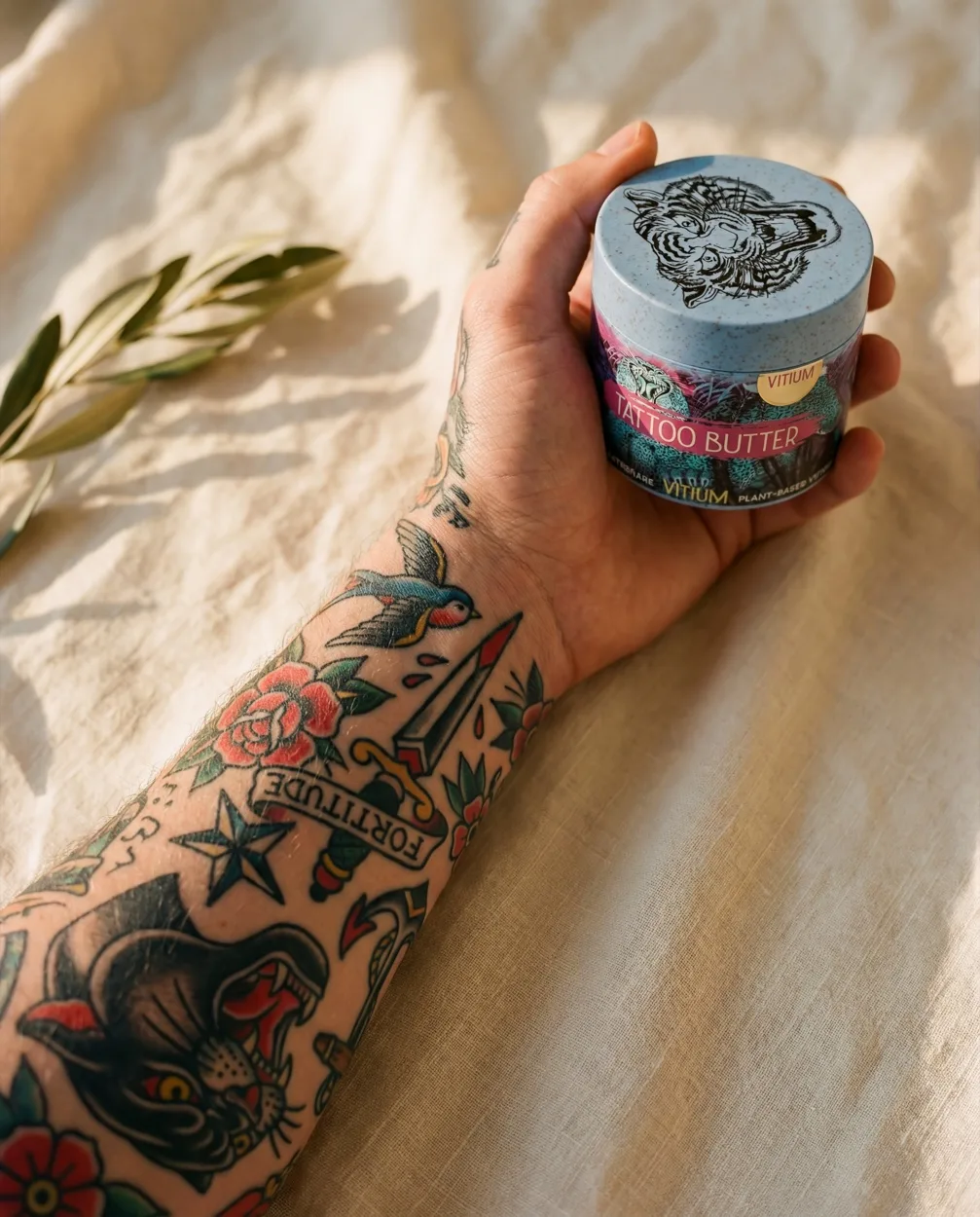
It’s called VITIUM Tattoo Butter. It’s made in Italy, sold through Amazon in the US and UK, and it’s what I put on every fresh tattoo I do in my own studio — and the reason it suits dry-skin clients particularly well comes down to four things. The plant butter base delivers the fatty acids that compromised dry skin needs to rebuild its barrier. The Vitamin E concentration protects fresh ink against the oxidative stress dry skin is more prone to. The hypericum accelerates cell regeneration on the parts most likely to crack. And there’s no petroleum anywhere in the formulation, so the skin’s own moisture-regulation response keeps working instead of being suppressed by an occlusive seal.
If you want to try it, the product page has everything you need.
But honestly, whether you buy ours or another real plant-based butter, the principles in this article are what matter. Skip the petroleum. Apply thin. Be patient through day five to ten. Talk to the artist if your skin runs dry. Treat the canvas with the respect the ink deserves.
Your tattoo deserves it.
For the full picture on what to put on dry, healing skin, read our guide to tattoo butter.
— Gabriele B. Tattoo artist · Co-founder, VITIUM