How to Revive a Faded Old Tattoo (Without a Touch-Up)
Most “faded” tattoos aren’t as faded as they look.
A tattoo that has gone dull, greyish, a little lifeless under the skin, is one of the most common things people bring to a studio hoping for a touch-up. And a good share of the time, the ink underneath is fine. What has changed is the skin on top of it. Before you book a needle back over decade-old work, it is worth understanding what actually happens when a tattoo looks old, because the fix is usually cheaper and gentler than re-tattooing, and a lot simpler than people expect.
Here is what is really going on, and what genuinely brings the colour back.

Where your tattoo actually lives
Your tattoo is not on your skin. It is in it.
When you get tattooed, the pigment is deposited in the dermis, the deeper, living layer, and it stays there for life. Sitting on top of the dermis is the epidermis, the surface layer your body constantly renews. You do not see the ink directly. You see it through that surface layer, the way you see a coin at the bottom of a pond through the water above it. Change the water and the coin looks different, even though the coin has not moved.
That surface layer is the whole game. When it is healthy and hydrated, it is more translucent, and the ink beneath reads dark and saturated. When it is dry and thick with dead cells, it scatters light before that light ever reaches the pigment. The colour underneath is unchanged. The window in front of it has gone cloudy.
This is not a folk theory. Research on skin moisturisation shows that hydrating the surface layer reduces the light it scatters and lets more light pass into the deeper layers, so the skin looks more translucent and the tone reads darker and richer. A dry tattoo and a moisturised one can be the same tattoo, minutes apart, looking like two different ages of ink.
The four reasons old ink looks dull
Not every faded-looking tattoo has the same cause. There are four, and they are not equally serious.
Dead-skin buildup. The surface layer sheds and renews on a rough monthly cycle, but dead cells accumulate faster than most people slough them off, especially on legs, arms, and anywhere clothing rubs. That buildup is the grey film. It is the single most common reason old ink looks tired, and it is completely reversible.
Dehydration. Skin that is low on water is a poor optical window. It looks matte and flat. This is why your tattoo can look sharp right after a shower and dull again by evening; the ink hasn’t changed, the water content of your skin has.
Sun exposure. This one is real damage. Ultraviolet light breaks down tattoo pigment at the molecular level over years, and unlike the first two causes, it does not come back with care. The American Academy of Dermatology is blunt about it: UV light fades tattoo ink, and the damage is cumulative and permanent.
Natural settling. Over many years, a small amount of pigment is carried off by the body’s own immune cells, and fine lines soften as skin moves and stretches. This is slow and usually minor next to the other three.
Notice the split. Two of these, dead skin and dehydration, are about the window, and you can fix them at home. Two of them, sun and settling, are about the ink itself. Telling which problem you actually have is the whole decision.

The honest test: is it dead skin, or real fading?
You can find out with about four weeks and no money.
For four weeks, be consistent about three things: a gentle exfoliation once a week, moisturiser every day, and keeping the tattoo out of direct sun whenever it is uncovered. Then look again in good daylight.
If the tattoo has visibly deepened, the problem was the window: dead skin and dehydration, now cleared. Most people are genuinely surprised here, because the change can be dramatic and they had assumed the ink was gone. If four honest weeks produce little or no change, the fading is in the pigment itself, and no cream will bring it back. That is the point where a touch-up is the right answer, and now you know it is worth the money instead of guessing.
Run the test before you book anything. It costs nothing and it settles the question.
What actually brings the colour back
Three habits do almost all the work. None of them are exotic.
Gentle exfoliation, once a week. The goal is to lift the dull film of dead cells, not to scrub the skin raw. Once a week, in the shower, use a soft washcloth or a fine, mild exfoliant and work in slow circles for a moment. That is enough. Daily scrubbing does the opposite of what you want, because it irritates the surface and makes it thicken defensively.
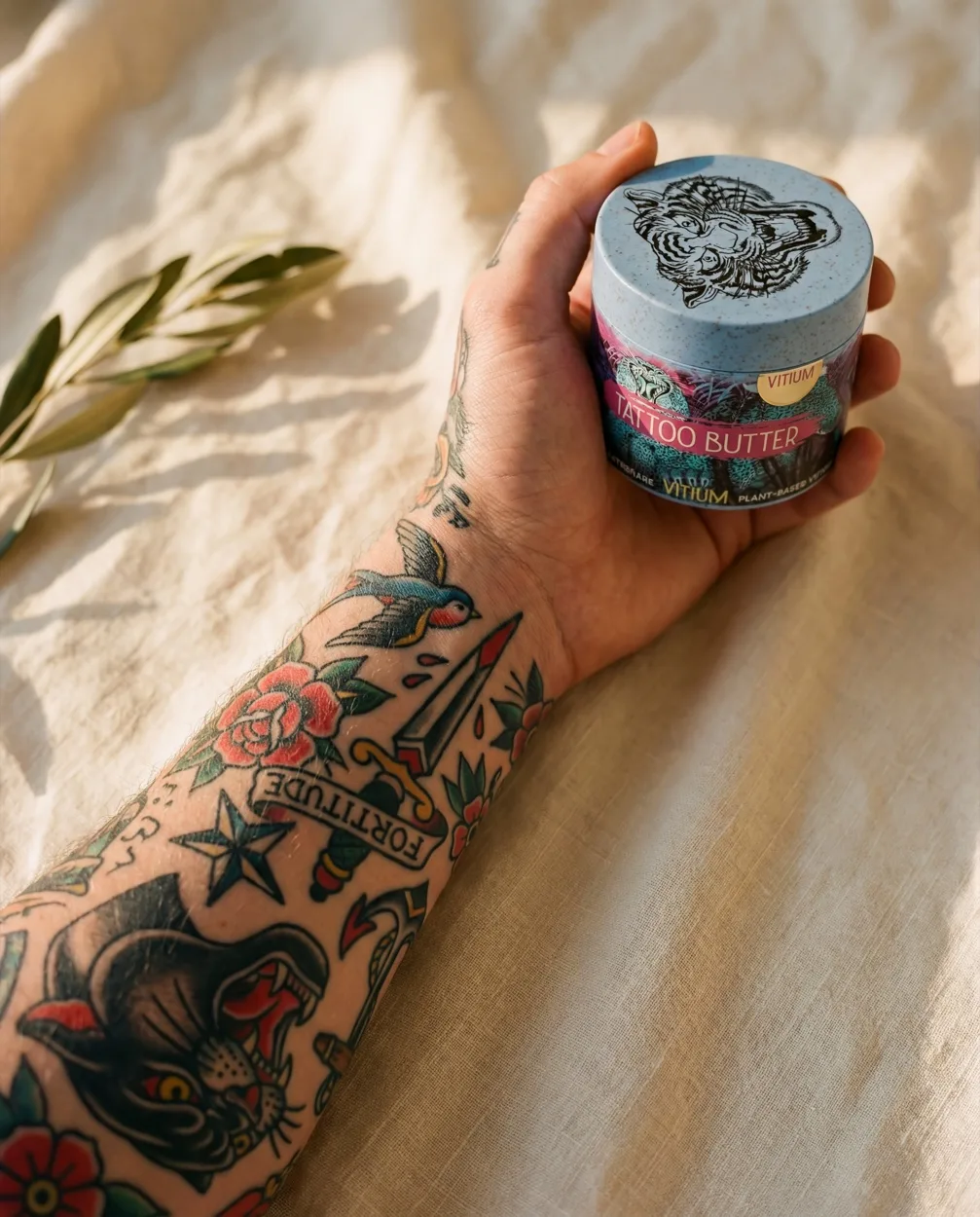
Daily hydration. This is the habit that carries the visible result, and it has to be daily to hold. Well-chosen plant butters and oils sink into the surface layer and keep it supple and translucent, which is exactly the optical effect the research above describes. A good plant-based aftercare balm built on ingredients like mango seed butter for conditioning and Calendula officinalis for calm, with Vitamin E among its five hero ingredients, does this without the petroleum that the AAD warns can fade ink. A real formula carries carriers and a preservation system alongside those heroes; the heroes are simply the parts doing the visible work. Whatever you choose, the rule is the same: thin layer, every day, not a thick coat once a week.
Daily sun protection. This is the one that decides whether you ever have to do this again. Once a tattoo is healed, broad-spectrum SPF 30 or higher over it, every time it sees daylight, is the difference between ink that holds for decades and ink that greys out in a few summers. The fading you prevent here is the permanent kind. If you want the deeper detail on formulas and when fresh ink can first meet sun, our guide to sun protection for tattoos covers it.
Do these three and most “faded” tattoos come back over two to four weeks. You haven’t restored any lost pigment; you’ve cleared and hydrated the window in front of it.

What not to do
Enthusiasm ruins more old tattoos than neglect does.
Skip the harsh scrubs. Salt, coarse sugar, and stiff loofahs feel like they are doing more, but they tear the surface and leave it inflamed, which reads as duller, not brighter. Skip petroleum jelly as a daily moisturiser; it sits as a heavy film and, per the dermatology guidance above, is associated with fading ink rather than protecting it. And do not pick at the tattoo or over-exfoliate out of impatience. The skin answers aggression by thickening, and that thicker layer just clouds the view again.
There are also times to leave the exfoliation alone entirely. If the tattoo is still healing, or the skin over it is broken, irritated, or sunburnt, do not exfoliate it. If you live with eczema, psoriasis, or any condition that already disrupts the skin barrier, be far gentler than this article suggests and check with a professional first. This is general guidance for healthy, fully healed skin, not medical advice for compromised skin.
When a touch-up really is the answer
Sometimes the ink genuinely is gone, and that is worth respecting too.
If you have run the honest four-week test and seen no change, the pigment has faded and only a needle will restore it. The same is true when fine black lines have blurred and spread with age, which is a structural change in how the ink sits, not a surface-film problem. A skilled artist can re-line crisp black work and re-saturate faded colour, and a fresh outline alone can make an entire old piece read as new again.
When you go back, go to someone who respects the original work. Bring photos of how it looked when it was fresh if you have them. A good artist will tell you honestly whether you need a full re-colour or just a few lines tightened, and the honest answer is often less work than you feared.
Keeping your next tattoo vibrant from day one
Everything above is a rescue. The easier version is never letting it get there.
The habits that revive an old tattoo are the same ones that keep a new one sharp: hydrate daily, exfoliate gently and occasionally, and protect it from the sun for life. A tattoo cared for this way from the start rarely needs reviving at all. If you want the full daily approach for fresh ink, our tattoo butter guide walks through it, and if you are weighing which aftercare to keep on the shelf, the balm comparison here lays out the options.
The work your artist did is still down there in the dermis. Most of the time, reviving it is just a matter of taking better care of the skin standing in front of it.
Frequently asked questions
Why does my old tattoo look faded and dull? Usually because of the skin on top of it, not the ink inside it. Dead-skin buildup and dehydration make the surface layer cloudy, so it scatters light before it reaches the pigment in the dermis, and the tattoo reads grey and flat. Hydrating and gently exfoliating that surface layer often brings the colour back within a few weeks. Only sun damage and slow natural settling cause true, permanent fading of the pigment itself.
Can you revive a faded tattoo without a touch-up? Often, yes, if the dullness is caused by dry, built-up surface skin rather than lost pigment. A four-week routine of weekly gentle exfoliation, daily moisturising, and sun protection clears and hydrates the outer layer, which can noticeably deepen the tattoo’s appearance. If four consistent weeks produce no change, the pigment has genuinely faded and a professional touch-up is the only way to restore it.
Does moisturising really make a tattoo look brighter? Yes, and there is a physical reason. Hydrated surface skin scatters less light and lets more of it reach the pigment below, so the skin looks more translucent and the ink reads darker and richer. The effect is real but temporary, which is why hydration has to be a daily habit to hold, not a one-off.
How often should I exfoliate an old tattoo? Once a week is plenty for healthy, fully healed skin. The aim is to lift the dull film of dead cells gently, not to scrub hard. Daily or aggressive exfoliation backfires, because it irritates the skin and makes the surface layer thicken, which makes the tattoo look duller rather than brighter.
Can a faded tattoo be fully restored to how it looked when new? It depends on why it faded. Dullness from dead skin and dehydration can usually be reversed almost completely with care. True pigment loss from years of sun exposure cannot be undone at home and needs a professional re-colour or re-line to restore. The four-week care test tells you which situation you are in.
What is the best thing to put on an old tattoo to keep it vibrant? A daily plant-based moisturiser that hydrates without heavy petroleum, plus broad-spectrum sunscreen whenever the tattoo is exposed. The moisturiser keeps the surface layer translucent so the colour shows through; the sunscreen prevents the permanent kind of fading. Thin, daily, and consistent beats thick and occasional every time.
I have re-lined and re-coloured a lot of old work over sixteen years in Sicily, and I have also talked plenty of people out of a touch-up they did not need, because a week of proper care would have done the same job for free. My partners and I spent two years building a plant-based aftercare butter for exactly this kind of daily upkeep, made with a respected manufacturer in southern Italy. It is called VITIUM, and you can find it on our product page.
But honestly, whether it is ours or another real plant-based butter, the principle is what matters: take care of the skin, and the ink takes care of itself. Your tattoo is still in there. Give the skin in front of it a reason to show it off.
— Gabriele B. Tattoo artist · Co-founder, VITIUM