Best Sunscreen for Tattoos: What to Look For & How to Use It
If you do one thing for the long life of your tattoo, make it this: keep it out of the sun, and when it can’t be, cover it in sunscreen. UV light is the single biggest cause of faded, blurred, washed-out tattoos — bigger than your aftercare butter, bigger than the ink, bigger than your artist’s technique once the piece has healed. A tattoo you protect from the sun looks sharp in ten years. One you don’t can look tired in three.
The good news is that protecting it is simple and cheap. The catch is that not all sunscreen is equal for tattooed skin, and the timing matters more than people realise — putting sunscreen on at the wrong stage of healing does more harm than good. So this is the honest, practical version: how UV actually fades ink, what to look for in a sunscreen, when your fresh tattoo can finally see daylight, and how to use it so the colour you paid for stays.
Why the sun fades tattoos
Start with the mechanism, because it explains everything else.
Tattoo ink sits in the dermis as tiny particles of pigment. Ultraviolet light penetrates the skin and carries enough energy to break those pigment particles apart. Once a particle is fragmented, your immune system treats the pieces as waste and slowly carries them away — the same housekeeping process that very gradually lightens every tattoo over a lifetime. Sun exposure pours fuel on it. Every unprotected afternoon outdoors accelerates the breakdown and the clearing, and the colour quietly drains out year over year.
Some colours surrender faster than others. Bright, lighter shades — yellows, light blues, soft reds — fade first because their pigment particles are more vulnerable to UV. Black and dark grey hold longest. And shallow, delicate work is more exposed than deep, dense work, which is why fine line tattoos fade faster than bold pieces and need sun protection most of all. None of it is avoidable through ink choice alone. The only real defence is blocking the UV.
Why “any sunscreen” isn’t the whole answer
Any broad-spectrum sunscreen is far better than none. But tattooed skin — especially newly healed skin — has two extra needs, and that’s what separates a good tattoo sunscreen from a random bottle.
First, it has to be broad-spectrum and high enough SPF to actually block the rays that fade ink. UVA is the deep-penetrating, pigment-breaking culprit, and not every cheap sunscreen covers it well. Second, it shouldn’t irritate. Tattooed skin, particularly in the months after healing, reacts more than you’d expect, and a sunscreen loaded with cheap fragrance and harsh actives can leave it red and itchy. The aim is strong UV protection that the skin over your tattoo will actually tolerate every day.

Mineral vs chemical sunscreen
This is the question people ask most, so here’s the straight version.
Chemical sunscreens absorb UV and convert it to heat. They’re light, rub in clear, and are easy to wear daily. The downside for tattooed skin: they sink into the skin to work, and their active ingredients are the ones most likely to sting or irritate sensitive, freshly healed skin.
Mineral sunscreens (also called physical) sit on top of the skin and use zinc oxide or titanium dioxide to physically reflect and scatter UV. They start protecting immediately, they’re far gentler on reactive skin, and zinc oxide in particular is excellent broad-spectrum cover. The trade-off is a faint white cast and a slightly heavier feel, though modern tinted mineral formulas have mostly solved the white-cast problem.
For tattoos, mineral is usually the safer default — gentler on healed skin, immediate protection, strong UVA cover. If you prefer the feel of a chemical sunscreen and your skin tolerates it, a good broad-spectrum one still does the job. The best sunscreen is ultimately the one you’ll actually reapply.
What to look for
When you’re reading a label, this is the short list that matters for tattooed skin:
- SPF 30 to 50. Thirty is the sensible floor for tattoos; fifty for long, direct exposure. Above fifty the extra benefit is marginal.
- Broad-spectrum. Non-negotiable — it has to block UVA as well as UVB. UVA is the wavelength that does most of the fading.
- Water-resistant. If you’ll swim or sweat, this is what keeps the protection on long enough to matter.
- Gentle on reactive skin. The usual irritants are cheap fragrance stacked with harsh actives; if your skin reacts to scent, pick a lightly scented or unscented formula and patch-test first.
- Mineral (zinc oxide / titanium dioxide) for sensitive or recently healed skin. Gentler, immediate, strong UVA cover.
- Non-greasy and non-comedogenic. So you’ll actually wear it daily without it clogging or sitting heavy.
When can a fresh tattoo go in the sun?
This is the part people get wrong, so it gets its own section: do not put sunscreen on an unhealed tattoo, and do not expose a fresh tattoo to direct sun at all.
A healing tattoo is an open wound. Direct sun on it can burn the damaged skin, blister it, fade the fresh ink before it’s even settled, and ruin the result. And sunscreen — mineral or chemical — is made for intact skin, not open wounds; on a healing tattoo it can irritate and introduce ingredients the raw skin shouldn’t meet. So for roughly the first four to six weeks, while the tattoo heals, the rule is simple: keep it out of the sun entirely, and cover it with loose clothing if you’ll be outdoors.
Once the tattoo is fully healed — surface closed, no flaking, no tenderness — sunscreen becomes your permanent habit. From that point on, apply it to the tattoo every time it will see real sun, for the rest of the tattoo’s life. (For more on that healing window, our aftercare guide walks through the full timeline.)
The two mistakes that cost people their colour
If you take two things away, take these.
1. Sunscreen on skin that isn’t healed yet. Covered above, and worth repeating because the instinct to “protect” a fresh tattoo with sunscreen is exactly backwards. Before it’s healed, the protection is clothing and shade, not lotion.
2. Applying once and forgetting. Sunscreen wears off — it rubs, sweats, and washes away. A single morning application is gone by early afternoon. On a tattoo you care about, reapply every two hours in real sun, and again after swimming or heavy sweating. The people whose tattoos still look vivid after a decade aren’t using a magic product. They’re just the ones who reapply.

Everyday protection, not just beach days
The fade doesn’t only happen on holiday. Incidental daily sun (the drive to work, the walk at lunch, a forearm resting on a windowsill) adds up over years on any tattoo that’s regularly uncovered. You don’t need to coat yourself daily for a tattoo under clothing. But for exposed pieces like forearms, hands, necks and lower legs, a quick layer of SPF as part of your morning routine on sunny days is the quiet habit that separates a tattoo that ages well from one that doesn’t. Pair it with keeping the skin conditioned, because well-moisturised skin holds ink more crisply, and you’ve covered both halves of long-term tattoo care. This matters even more for colour and dark-skin tattoos, where UV both fades the pigment and can affect the surrounding skin tone.
Sunscreen, moisturiser, and the order to apply them
A common practical question: if you moisturise your tattoo and wear sunscreen, which goes first? Moisturiser first. Let a thin layer of your plant-based butter or balm absorb fully, then apply sunscreen as the final layer on top, because sunscreen is designed to sit on the surface where it can intercept UV. Give the moisturiser a couple of minutes to sink in first, so you’re not diluting the SPF. And keep the two jobs separate in your head: the butter conditions and feeds the skin, the sunscreen blocks the rays. Neither one replaces the other.
Warning signs the sun is winning
Catch UV damage early and you can slow it. The signs that a tattoo isn’t being protected enough:
- Overall lightening — the whole piece looks paler and less saturated than it did.
- Blurring of fine detail — crisp lines going soft, small gaps closing up.
- An “ashy” or flat look — the colour loses its depth and reads dull.
- The lighter colours disappearing first — yellows and pale blues going before the blacks.
If you’re seeing these, step up the sun protection now and book a touch-up with your artist to re-saturate what’s faded. Sun damage doesn’t reverse on its own — but you can stop it getting worse.
Frequently asked questions
Why does a tattoo need special sunscreen instead of regular sunscreen?
It doesn’t need a “tattoo-only” product, but it does need the right features. Any sunscreen used on a tattoo should be broad-spectrum, SPF 30 or higher, and ideally mineral for skin that’s recently healed. If your skin is sensitive to fragrance, a lightly scented or unscented formula is the safe pick — patch-test before wearing it daily. Tattooed skin can be more reactive, and the goal is strong UVA protection (the wavelength that fades ink) without irritation. Plenty of standard sunscreens fit that description — you’re choosing by feature, not by a special “tattoo” label.
How do UV rays actually fade tattoo ink?
UV light penetrates the skin and breaks tattoo pigment particles apart. Once fragmented, the immune system treats the pieces as waste and gradually clears them, which lightens the tattoo over time. Sun exposure dramatically speeds up both the breaking and the clearing. Lighter colours fade first because their pigments are more UV-vulnerable, while black and dark grey last longest. Blocking UV with sunscreen and clothing is the only way to meaningfully slow the process.
What features should a good tattoo sunscreen have?
Look for broad-spectrum protection (UVA and UVB), SPF 30 to 50, and water resistance if you swim or sweat. For recently healed or sensitive skin, a mineral formula with zinc oxide or titanium dioxide is gentler and protects immediately. A light, non-greasy formula your skin tolerates is the one you’ll actually wear daily, which matters because consistency is what actually protects the ink. If fragrance bothers your skin, factor that in when you choose. The single most important feature is broad-spectrum cover — without it, SPF alone won’t stop fading.
How often should you reapply sunscreen on a tattoo?
Every two hours in direct sun, and again immediately after swimming or heavy sweating. A single morning application wears off through the day via rubbing, sweat, and water, leaving the tattoo unprotected by the afternoon. Water-resistant formulas last longer but still need reapplying. Consistent reapplication, not the specific product, is what keeps colour vivid over years.
How long after a tattoo can you go in the sun?
Keep a fresh tattoo out of direct sun for roughly the first four to six weeks, until it is fully healed — surface closed, no flaking, no tenderness. Direct sun on a healing tattoo can burn the skin, blister it, and fade the ink before it settles, and sunscreen shouldn’t go on an unhealed tattoo either. Until it’s healed, protect it with loose clothing and shade. Once healed, apply sunscreen every time it sees real sun, permanently.
Should a fresh tattoo be covered from the sun?
Yes, completely. A fresh tattoo is an open wound, and sun exposure can damage the skin and ruin the healing ink. Do not use sunscreen on it either, since sunscreen is formulated for intact skin, not open wounds. For the first four to six weeks, keep the tattoo out of direct sun entirely and cover it with loose, breathable clothing when you’re outdoors. Save the sunscreen for after it has fully healed.
What else besides the sun makes tattoos fade faster?
Sun is the biggest factor, but not the only one. Dry, poorly moisturised skin makes a tattoo look duller, so regular conditioning helps. Friction from clothing on high-rub areas, harsh exfoliation, and significant weight change can all affect how a tattoo ages. Petroleum-based products during healing can pull pigment, and poor aftercare in the first weeks costs colour permanently. But day to day, over years, UV exposure does more damage than everything else combined.
What I tell my own clients
I’m not going to pretend I’m neutral about aftercare — I’ve tattooed for sixteen years on Ortigia Island in Sicily, where the summer sun is no joke, and I’ve watched it quietly wreck beautiful tattoos that were healed perfectly. The clients whose work still looks sharp years later all have one boring habit in common: sunscreen, reapplied, every sunny day.
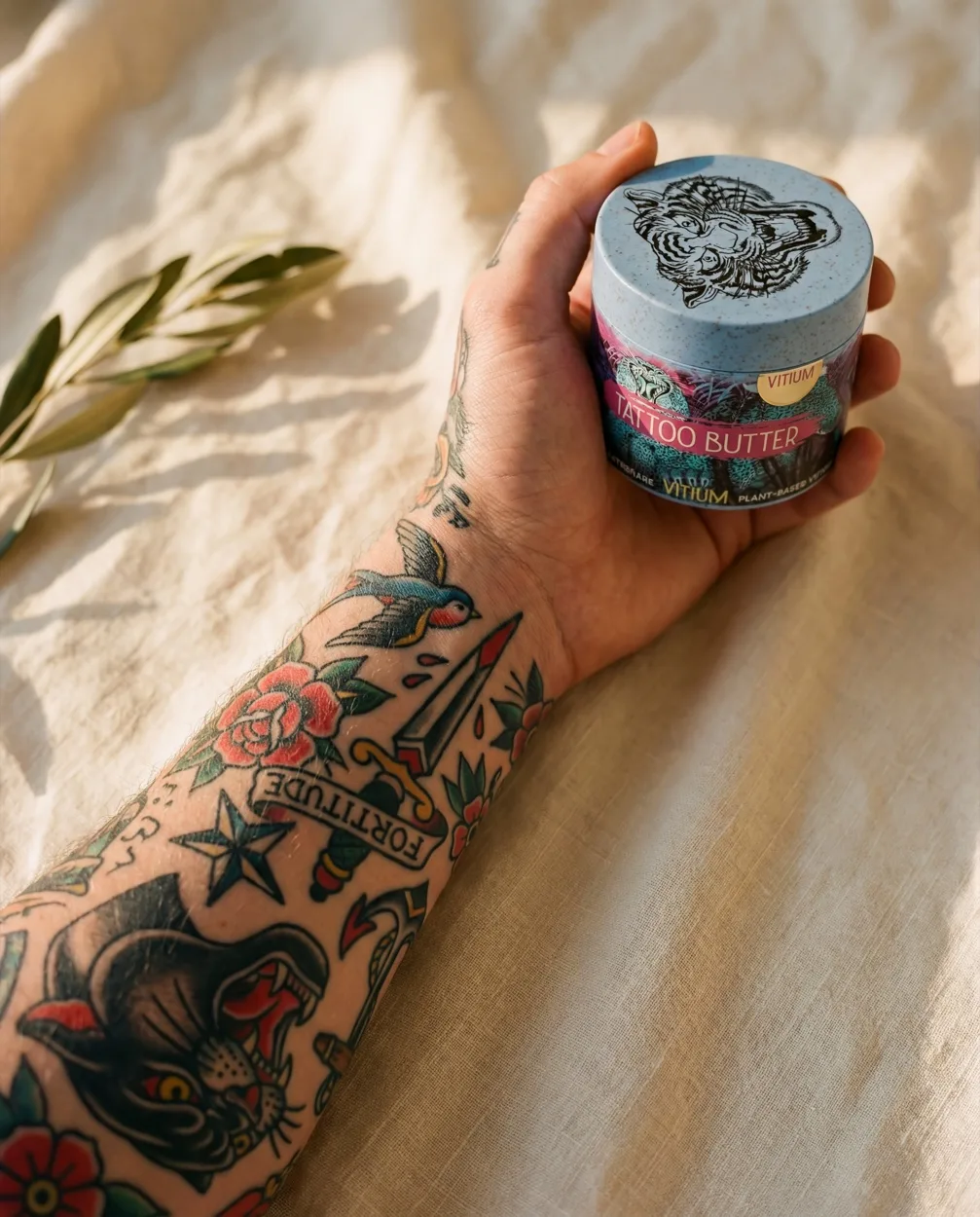
We don’t make a sunscreen — we make a plant-based tattoo butter, VITIUM, for the healing and daily-conditioning side, with real Vitamin E that helps skin hold pigment. Sun protection is the other half, and it’s a separate product: a good broad-spectrum SPF you’ll actually reapply. Use both and your ink keeps its depth for decades. The product page has the butter if you want it, but honestly, the most important thing in this article is free advice: cover it, or wear SPF. Every time.
Your tattoo deserves it.
— Gabriele B. Tattoo artist · Co-founder, VITIUM