Tattoos on Dark Skin: Colour Selection & Care Guide
There’s a stubborn myth that dark skin can’t take colour — that the only real option is black, and anything brighter will disappear. It’s wrong, and it has been wrong the whole time. Melanin-rich skin takes vivid, saturated colour beautifully. What actually decides the result isn’t your skin. It’s contrast, saturation, and the skill of the artist holding the machine.
That distinction matters, because the myth has quietly cost people good tattoos. Plenty of artists who never learned to work confidently on deeper skin tones found it easier to blame the skin than to admit the gap in their own experience. So the honest starting point for this guide is this: on dark skin, the limiting factor is almost always the artist, not the canvas. Choose well, design for contrast, and the range open to you is enormous.
Here’s how to pick colours that sing on dark skin, how to find an artist who genuinely knows how to work with melanin-rich skin, and how to heal the result so the colour stays true.
How melanin affects what you see
Start with the mechanism, because it explains every recommendation that follows.
Tattoo ink sits in the dermis, below the surface layer of skin. On any skin tone you’re effectively viewing that ink through the layers above it. On melanin-rich skin, that upper layer carries more pigment of its own, so it acts like a warm, deep filter over the ink underneath. The result isn’t that colour vanishes — it’s that low-contrast, low-saturation colours get quietly absorbed into the depth of the skin, while bold, saturated colours hold their own and read clearly.
This is why the whole conversation is really about contrast. A pale, washy pastel has little contrast against deep skin, so it fades into it. A densely saturated jewel tone has plenty, so it stands out. The “only black works” rule is just a clumsy oversimplification of a real design principle: choose colours and saturations that carry enough contrast to be seen. Once you understand that, the colour wheel opens back up.

The colours that actually work
The strongest performers on dark skin are high-saturation jewel tones and warm earth tones — colours with enough depth and intensity to read through the skin’s natural filter.
- Deep reds and warm oranges. Among the most reliable. Rich, warm, and high-contrast, they hold beautifully on most deep skin tones.
- Emerald and forest greens. Saturated greens read clearly and age well. Lighter, mintier greens are weaker — keep them as accents.
- Royal and deep blues. Strong, saturated blues are dependable. Like greens, the deeper and more saturated, the better they hold.
- Purples. Rich purples — especially on the blue side — are an underrated standout on dark skin.
- Yellows and golds. Trickier, but warm golden yellows can work as bright accents and highlights, especially layered over or beside darker tones for contrast.
- White. Best treated as a highlight, not a base. White ink over dark skin is subtle and tends to soften over time, so use it for small accents rather than expecting it to glow.
Colours to use sparingly
Pastels are the main thing to approach with caution — soft pinks, baby blues, pale lavenders. As the base of a whole piece they tend to disappear into deep skin because they carry so little contrast. That doesn’t mean never: a skilled artist can place small pastel accents for effect. Just don’t build the foundation of a tattoo on them.
Choosing an artist who knows melanin-rich skin
This is the single most important decision you’ll make, more important than the colours themselves.
An artist experienced with deeper skin tones knows how to adjust saturation, layer pigment for contrast, and pack colour at the right depth so it reads true and heals clean. An artist who hasn’t built that experience may under-saturate out of caution, work at the wrong depth, or talk you out of colour entirely. The skin didn’t fail there — the experience did.
What to look for, and what to ask:
- Healed work on dark skin, not fresh. This is the whole game. Fresh colour looks vivid on anyone; ask to see healed photos on skin tones close to yours, weeks or months after the session. Healed examples are the only honest proof.
- A portfolio with range. Several pieces across deeper skin tones, in colour, not one token example.
- Straight answers in the consultation. Ask directly: “How would you adjust this design for my skin?” A confident artist will talk specifics — saturation, contrast, colour swaps. Vague reassurance or pushing you toward black-only is a flag.
- Willingness to design for contrast. The best artists will gently steer a design toward the palette and contrast that will actually look incredible on you, rather than executing something that won’t.
If you can, bring reference images to the consultation — and look specifically for healed colour work on skin tones close to yours, not just designs you like in the abstract. It gives the artist a concrete target, and it tells you quickly whether your expectations line up. A good consultation for colour on dark skin should feel collaborative: the artist proposing palette and contrast adjustments, you asking how each choice will look once it has settled. If you leave with a clear, specific plan for your skin rather than vague reassurance, you have found the right person.
Contrast and technique
Beyond colour choice, two technical things separate a tattoo that holds from one that muddies — and both sit with the artist.
The first is saturation done right. Colour on dark skin needs to be packed densely and evenly so it reads through the skin. That takes a confident hand. The second is depth. Ink driven at the correct, consistent depth heals clean and stays true; passes that are too shallow tempt the artist to overwork the area, and overworking is exactly what raises the risk of patchy healing and pigment that sits unevenly. Confident, even passes at the right depth beat repeated tentative ones every time. This is, again, an experience question — which is why the artist matters more than any colour chart.
Healing, and keeping the colour true
Healing melanin-rich skin well comes down to the same principles as any skin, with two points worth extra attention: gentle care and sun protection.
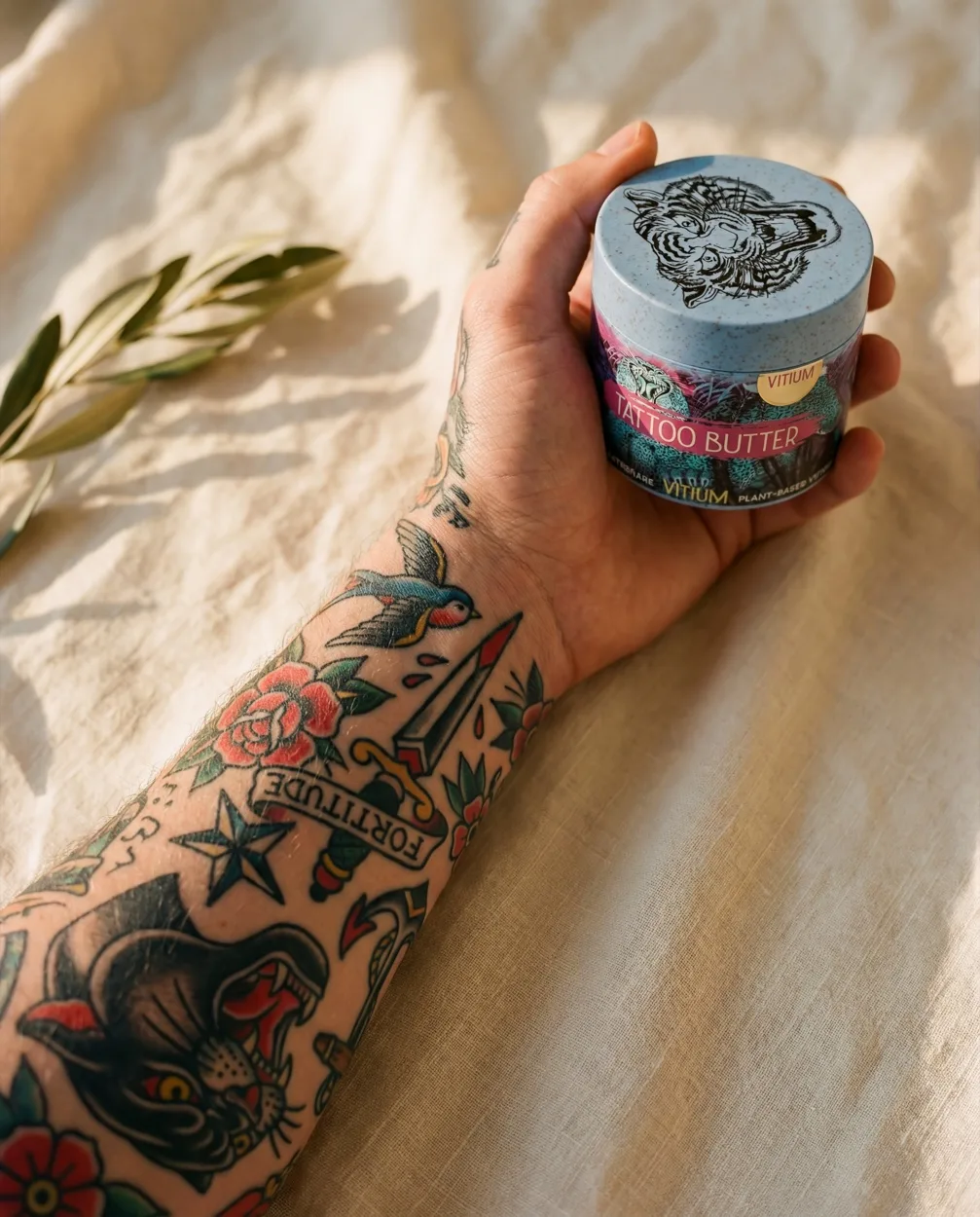
Deeper skin tones can be more prone to post-inflammatory hyperpigmentation — darkening of the skin after it’s been inflamed or irritated. The way you reduce that risk is by keeping the heal calm: clean the tattoo gently, keep it lightly moisturised so it never dries and cracks, and never overwork or scrub it. A thin layer of a light plant-based butter two or three times a day keeps the surface supple without suffocating it — skip petroleum-based ointments, which seal the skin and can make healing harder. Look for a butter with meaningful Vitamin E, which helps protect pigment from oxidative fading over time.
Then there’s the sun. UV exposure is the biggest long-term threat to colour on any skin, and protecting healed dark-skin tattoos from it can also help reduce the risk of hyperpigmentation. Once the tattoo is fully healed, use a high-SPF sunscreen on it whenever it’s in real sun. This is the single most effective habit for keeping colour sharp for years.
A careful word on keloids
Some people, and this is more common in deeper skin tones, have a genetic predisposition to keloid or raised scarring. It’s worth being clear-eyed and not alarmist about this: keloids caused by professional tattooing are rare, and when raised scarring does happen it’s usually tied to infection, poor aftercare, or inexperienced work rather than the ink itself. If you have a personal or family history of keloids, the right move is simple — tell your artist before you book, and consider a quick conversation with a dermatologist. An experienced artist will factor it into placement and technique.

How colour ages, and touch-ups
Give any tattoo the full six to eight weeks to heal before you judge the colour — this matters on every skin tone and especially on dark skin, where the settled result looks different from the fresh one. Once healed, well-saturated colour on dark skin ages well, though the lightest accents (whites, pale highlights) are the first to soften. A touch-up a year or two in can refresh those highlights and re-saturate anything that’s settled lighter than you’d like. Keep the piece conditioned and sun-protected and you’ll need those touch-ups far less often.
Frequently asked questions
Do coloured tattoos show up well on dark skin?
Yes. Coloured tattoos work beautifully on dark skin — the idea that they don’t is a myth. What matters is contrast and saturation: bold, densely saturated colours read clearly through melanin-rich skin, while pale, washy colours can fade into it. With colours chosen for contrast and an artist experienced in deeper skin tones, the range available is wide. The limiting factor is almost always the artist’s skill and the design choices, not the skin itself.
Which tattoo colours work best on dark skin?
High-saturation jewel and warm earth tones perform best: deep reds, warm oranges, emerald and forest greens, royal and deep blues, and rich purples. These carry enough depth and intensity to stand out against melanin-rich skin. Warm golden yellows can work as accents, and white is best used as a small highlight rather than a base. The common thread is saturation and contrast — the bolder and deeper the colour, the more reliably it reads and ages.
Are there colours that are harder to see on darker skin?
Yes — pastels and very pale, low-saturation colours are the hardest to see on deep skin, because they carry little contrast against it. Soft pinks, baby blues, and pale lavenders tend to disappear when used as the base of a piece. They aren’t off-limits entirely: a skilled artist can place small pastel accents or highlights for effect. The advice is simply not to build the foundation of a tattoo on low-contrast colours.
Why does the artist’s experience matter so much for dark skin?
Because technique, not skin, decides the result. An artist experienced with melanin-rich skin knows how to saturate densely, layer for contrast, and work at the correct depth so colour reads true and heals clean. An inexperienced artist may under-saturate, work at the wrong depth, or steer you away from colour unnecessarily. Always review healed examples of their work on skin tones close to yours — healed photos, not fresh ones, are the honest proof of skill.
Does dark skin need a different tattoo technique?
The fundamentals are the same, but experienced artists make specific adjustments: denser, more even saturation so colour reads through the skin, careful attention to contrast in the design, and precise, consistent needle depth. Overworking the skin is the main thing to avoid, as it raises the risk of uneven healing and post-inflammatory hyperpigmentation. None of this is exotic — it’s standard skill applied with experience, which is exactly why choosing the right artist matters.
Is there a higher risk of scarring or keloids on dark skin?
Some people in deeper skin tones have a higher genetic predisposition to keloid or raised scarring, but keloids caused by professional tattooing are rare. When raised scarring does occur, it’s usually linked to infection, poor aftercare, or inexperienced work rather than the tattoo itself. If you have a personal or family history of keloids, tell your artist before booking and consider speaking with a dermatologist. This guidance is general information, not medical advice.
How often do tattoos on dark skin need touch-ups?
Well-saturated colour on dark skin holds for years with good care. The first elements to soften are pale highlights and white accents, which a touch-up after a year or two can refresh. Bold jewel and earth tones generally age well. The biggest factors in how often you’ll need touch-ups are sun protection and keeping the skin conditioned — a sun-protected, moisturised tattoo fades far more slowly than a neglected one, on every skin tone.
What I tell clients across every skin tone
I’m not going to pretend I’m neutral. I’ve tattooed for sixteen years on Ortigia Island in Sicily, on clients across the full range of skin tones, and the lesson has been the same every time: the skin is rarely the problem. Good contrast, honest saturation, the right depth, and patient aftercare give a beautiful result on deep skin as reliably as on any other. When a colour tattoo on dark skin goes wrong, it’s almost always a choice that was made — usually before the needle ever started.
My partners and I spent two years formulating a plant-based tattoo butter in Sicily for the healing stage of exactly this — light enough to keep the skin calm and supple without suffocating it, with real Vitamin E to help hold colour. It’s called VITIUM Tattoo Butter, and the product page has the details. But honestly, whether you use ours or another real plant-based butter, the principles here are what matter. Choose an artist with the experience. Design for contrast. Protect it from the sun.
Your tattoo deserves it.
— Gabriele B. Tattoo artist · Co-founder, VITIUM