Natural Tattoo Aftercare: What Actually Works on Fresh Ink (From an Italian Tattoo Artist)
I’ve tattooed for over a decade in Sicily. In that time, I’ve watched more perfect pieces get ruined by bad aftercare than by bad technique. A tattoo I spent six hours on, lines I drew with care, shading I layered by feel — and then a client goes home, smears petroleum jelly on it, and three weeks later the colour looks like it’s been through a wash cycle.
Here’s what I learned, reluctantly, behind the machine: your aftercare matters almost as much as the artist you chose. A great tattoo with careless healing becomes a mediocre tattoo. A well-done tattoo with patient, honest aftercare stays sharp for decades.
This is the guide I give my own clients. It’s written for people who care about their ink — not just in week one, but in year ten. If you want the short version: use something plant-based, keep it thin, keep it clean, and stop treating your skin like a surface to be sealed. If you want the long version, keep reading.
What tattoo aftercare actually does (and doesn’t)
There’s a lot of mythology around healing a tattoo. Most of it is wrong.
When a needle drives ink into your dermis, your body reacts the way it always reacts to a wound: plasma rises to the surface, white cells rush in, and for the next two to three weeks your skin does a slow, layered repair job. No cream accelerates this process. Your body is not waiting for you to buy the right balm.
What good aftercare actually does is remove obstacles. It keeps the area clean so bacteria don’t get in. It keeps moisture in the outer layer so a scab doesn’t form too thick and crack. It feeds the regenerating skin with nutrients it already likes (vitamins, fatty acids, plant compounds). And — this part is rarely said out loud — it keeps you from picking, scratching, and obsessing over a healing piece.
Bad aftercare, on the other hand, adds obstacles. It traps moisture and bacteria under a waxy seal. It introduces cheap fragrance or alcohol to already-inflamed skin. It breaks down the fresh pigment with harsh surfactants. A bad aftercare product, used diligently, can do more damage than no aftercare at all.
The goal is simple: give your skin what it needs, and nothing it doesn’t. That’s the principle. Everything below is the practice.
The two things I tell every client to avoid
If you take one thing away from this article, let it be this.
1. Petroleum jelly and petroleum-based ointments
You know the products I’m talking about. Thick, clear, slightly waxy, sold for the last hundred years as the cure for everything from chapped lips to diaper rash. They feel protective. They seal the skin. And on a fresh tattoo, they are almost always the wrong choice.
Petroleum jelly is a by-product of oil refining. It’s not harmful in itself — your lips can handle it. But on an open wound like a fresh tattoo, it creates an airless barrier that traps sweat, plasma, and bacteria underneath. The skin can’t breathe. The scab forms unevenly. I’ve seen clients come back with their line work looking soft and spread, the way paint looks when you’ve pressed cling film on a wet canvas.
There’s another reason artists dislike it: it wipes the ink. During a long session, if you use petroleum-based products on the skin, the friction of wiping literally pulls pigment back out. Your artist is watching hours of work come off on a paper towel.
The European cosmetic regulation has tightened restrictions on petroleum-based ointments for good reason — the refining process can leave polycyclic aromatic hydrocarbon (PAH) residues if the grade isn’t high enough. In the US the standards are looser. Neither standard is designed with a healing tattoo in mind.
If a product’s ingredient list starts with “petrolatum” or “mineral oil,” put it down.
2. Cheap mass-market fragrance
This one surprises people. Fragrance is everywhere in aftercare — the sweet, vaguely vanilla smell of drugstore tattoo balms, the menthol sharpness of cheaper creams, the baby-lotion softness of the “gentle” ones. Almost all of it comes from the same commodity aroma houses that make scents for laundry detergent and candles, sold by the kilo to hundreds of brands at once. On broken skin it’s a small chemical assault.
Cheap fragrance comes from commodity aroma houses — stock blends sold by the kilo to hundreds of brands at once. It smells bright, obvious, and one-dimensional from across a room. It's stable, cheap, and notorious for causing irritation on already-inflamed skin. A healing tattoo is about as reactive as skin gets.
I’m not against fragrance. I’m against cheap fragrance. Most drugstore balms use the lowest-cost aroma mixes on the market — the ones formulated for candles and laundry detergent, then repurposed for skincare because they’re stable and abundant. You smell them immediately: sweet, cloying, one-dimensional.
The butter I formulated with my partners uses a bespoke fragrance composed by a top Italian perfumer — real perfumery, the kind practised by the fragrance houses behind the luxury brands you’d actually pay for. It’s a layered composition built around patchouli essential oil with a warm, sensual character. The cost per kilo is forty to a hundred times more than a commodity fragrance mix. What you get in exchange is scent with skin compatibility, restraint, and longevity on the body that cheap fragrance can’t touch.
If your aftercare smells like a candle shop, that’s the cheap stuff talking. A properly composed fragrance is quieter. It doesn’t announce itself — it lives on your skin.
What to actually look for in a natural tattoo aftercare product
Enough about what to avoid. Here’s what good looks like.
A plant-based base. Not water-based, not petroleum-based. A butter or balm built on real plant fats — shea, mango, cocoa — that hold moisture in the skin without sealing it airtight. The good stuff melts when it hits your skin and disappears within minutes. The bad stuff sits on top, shiny and sticky, still visible hours later.
An ingredient list where every entry earns its place. The best formulations aren't the shortest — they're the ones where you can read each line and understand why it's there. Plant butters, named botanical oils, a sensible set of soothing extracts, a professionally composed fragrance, Vitamin E in meaningful concentration. When you see a label with twenty-five unfamiliar chemical names, you're looking at a formulation that prioritised shelf stability over skin. That's fine for a hand cream. It's not fine for a fresh tattoo.
Real botanicals with known anti-inflammatory properties. Calendula, chamomile, hypericum (St. John’s Wort), aloe. These aren’t trendy additions. They’ve been used medicinally across Europe for centuries because they actually calm irritated skin and speed healing.
Vitamin E in meaningful concentration. Look for it inside the first dozen ingredients on the INCI list — not tucked at the bottom with the preservatives. Vitamin E is one of the most effective antioxidants at preserving pigment — it slows oxidative fading, which is why a five-year-old tattoo with good aftercare still looks crisp while one without looks faded. Cheap aftercare puts in the bare minimum to claim the ingredient. Serious formulations commit to it.
Vegan and cruelty-free, genuinely. Some tattoo balms contain beeswax or lanolin (wool grease), which isn’t vegan. If that matters to you, check. Cruelty-free certifications (Leaping Bunny, PETA) are the easiest way to verify.
Eco-conscious packaging. Sugarcane-derived or other plant-based materials. Not because the packaging touches your skin, but because anyone serious about clean skincare is usually serious about the full supply chain. It’s a reasonable proxy for attention to detail.
Works during and after the session. A lot of artists still use Vaseline during a session because nothing else slides correctly under the needle. The newer generation of plant-based butters — the ones with a good slip and a natural glide — can be used during tattooing too. Ask your artist. If they’re open to it, bring them one.
A day-by-day healing timeline (what to expect, what to do)
Every tattoo is a little different — the piece, your skin, your immune response. But the general arc is the same. Here’s what I tell my clients on the day they walk out of the studio.
Day 0 (the day of the tattoo)
You leave the studio with plastic film or second-skin over the fresh tattoo. Leave it on for the time your artist tells you — usually 2 to 4 hours for film, up to 3 days for second-skin. Don’t peek under it, don’t prod it.
Day 1–2
Remove the wrap. Gently wash with lukewarm water and a mild, plain soap. Don’t scrub. Pat dry with a clean paper towel (not a cloth — cloth carries bacteria). Apply a thin layer of plant-based butter. Thin. I mean thin. If it’s glistening ten minutes later, you used too much.
Repeat 2–3 times a day. That’s it. The tattoo will ooze a little plasma and ink — that’s normal. It’s not “bleeding out” your colour. Your artist packed the ink deep; what’s coming to the surface is just the excess.
Day 3–7
The area tightens. It starts to feel stiff and itchy. This is the worst week. Do not scratch. Do not pick scabs. If your skin is itching, apply another thin layer of butter — the itch is usually dryness. A scab that’s picked off too early is how you lose colour patches.
Week 2
Peeling begins. Long flakes of dead skin come off, often carrying traces of ink with them — this is normal and not a sign anything is wrong. The colour underneath will look temporarily dull because there’s a layer of translucent new skin on top. Don’t panic. It comes back within another week or two.
Week 3–4
The surface is closed. Deeper tissue is still healing but you can return to most normal activities — swimming, sun exposure, heavy workouts. Keep moisturising with a plant-based butter indefinitely; tattoos that are regularly moisturised look sharper in year five than ones that aren’t.
Months 2–12
This is the longevity phase. The skin is fully healed, but the ink is still settling. Sun is the enemy now. UV exposure is the #1 cause of tattoo fading, full stop. Wear SPF 30+ on tattoos you care about. Your butter is your daily routine; your sunscreen is your decade-from-now insurance.
If your work is especially delicate — single-needle script or fine-line botanicals — those thin lines fade faster and blur more easily than bold work, and they ask for a slightly different routine. Here is the full guide to fine line tattoo aftercare.
The five hero ingredients that actually matter
Every plant-based aftercare has its pet ingredient list. These are the five I built my own formulation around, and the reasons for each.
Shea Butter (Butyrospermum parkii)
The backbone of any serious plant-based aftercare. Rich in vitamins A and E, fatty acids (oleic, stearic), and a small amount of natural allantoin. It seals moisture into the skin without creating the airtight petroleum barrier. The grade matters enormously — there’s a tenfold difference between commodity shea and premium unrefined African shea. Cheap aftercare uses the former. Serious aftercare uses the latter.
Mango Butter (Mangifera indica)
Lighter than shea, higher in antioxidants, and with a natural SPF factor around 4 (not enough to protect tattoos from sun, but every bit helps). Mango butter gives the formulation its elasticity — it’s why a good butter melts smoothly on body heat rather than sitting clumpy on the skin.
Calendula Oil (Calendula officinalis)
Marigold flowers, infused into a carrier oil. Used in European wound care since the Middle Ages. Calms inflammation, reduces redness, accelerates surface healing. If you’ve ever seen grandma use calendula on a scraped knee, you’ve seen real medicine — it just wasn’t marketed that way.
Vitamin E
The pigment preservative. Vitamin E neutralises free radicals in the skin that would otherwise break down ink molecules over time. A tattoo that gets daily Vitamin E in year one looks noticeably sharper in year ten than one that doesn’t. Where brands differentiate is in how much Vitamin E they actually include: cheap aftercare puts in the bare minimum required to print “contains Vitamin E” on the front; serious formulations pack a meaningful concentration into the mid-section of the INCI list. Look for it in the first twelve ingredients, not the last three.
Hypericum Oil (St. John’s Wort)
This is the ingredient most aftercare brands skip because it’s expensive and needs to be macerated for weeks to be effective. In Italy it’s been used for skin regeneration for centuries — we make it by soaking the flowers in olive oil in a sunny window for 40 days until the oil turns deep red. It’s an ancient remedy that happens to be excellent for accelerating cell renewal on fresh skin.
Note that a real formulation has additional ingredients beyond these five — carrier oils, a natural emulsifier, a preservation system, sometimes trace vitamins. The five above are the hero ingredients, the ones doing the visible work. The rest is the engineering that holds the hero ingredients together.
When should you apply aftercare?
The short answer: every time the tattoo feels tight, dry, or itchy. In practice that’s 2–3 times a day for the first 3 weeks.
The longer answer depends on what stage of healing you’re in.
During the session — most artists in Italy now use plant-based butters to lubricate the skin while they tattoo. It’s a generational shift. The old generation used petroleum; the new generation uses a thin butter. If your artist still uses petroleum during sessions, it’s worth a conversation. A good plant-based butter has enough slip to wipe cleanly without dragging pigment.
The first 72 hours — 2 to 3 times a day. Keep it thin. Your goal is a slight sheen that absorbs in a few minutes, not a visible coating.
Week 1 to 3 — twice a day is usually enough. If the skin feels tight or itchy between applications, that’s the signal for an extra one.
Month 1 onwards — once a day, as part of your moisturising routine. You don’t need to stop moisturising a tattoo. Ever. A tattoo you keep moisturised for its entire life looks better than one you don’t.
Frequently asked questions
Can I use regular body lotion on a new tattoo?
No, not in the first few weeks. Most commercial body lotions are water-based, contain cheap fragrance, and have preservatives designed for shelf life rather than healing skin. Use a plant-based aftercare butter or balm until the surface has fully closed (usually end of week 2), then you can transition to a gentle body lotion if you prefer — patch-test it first if your skin reacts to fragrance.
Can I use tattoo aftercare on old tattoos, or only on fresh ones?
Both — and you should. A tattoo that’s regularly moisturised looks visibly sharper in year ten than one that isn’t. The same plant-based butter you used during the first three weeks of healing works as a daily conditioner for old tattoos too. Apply once a day, or before sun exposure, or whenever the skin over an old piece looks a little dry or dull. The colour won’t “come back” if it’s already faded — no product can rebuild pigment — but further fading slows dramatically. Think of it as maintenance, the same way you’d maintain a leather jacket you planned to keep for twenty years.
How do I know if my aftercare product is actually natural?
Read the ingredient list. Real plant-based aftercare dominates the top of the INCI with recognisable botanical names — shea (Butyrospermum parkii), mango (Mangifera indica), sunflower, rice bran, calendula — and a composed fragrance earning a high position because it's the most expensive line item in a premium formulation. What it won't contain anywhere: "petrolatum," "mineral oil," "paraffin," or silicone derivatives. Certifications like EcoCert, Soil Association, or USDA Organic are additional signals.
How long should a plant-based aftercare jar last me?
For a single medium-sized tattoo (forearm, calf), a 100ml jar lasts roughly 4 to 6 weeks of active healing, then it becomes your daily moisturiser indefinitely. If you’re a collector with multiple pieces in rotation, a 150ml jar is more economical.
Can I use coconut oil as tattoo aftercare?
Straight coconut oil is too simple and too occlusive on its own — it can clog pores and doesn’t contain the anti-inflammatory botanicals your skin needs while healing. It’s better than petroleum, but a proper plant-based aftercare is better than straight coconut oil.
What does “plant-based” actually mean on a tattoo product?
In the cleanest sense, plant-based means the active ingredients come from plant sources (botanical oils, butters, extracts) rather than from animals or petroleum. Many brands call themselves “natural” while still building their formulation on a mineral-oil base with a sprig of something botanical on top. Plant-based, properly used, is the stricter term.
What I actually use on my own clients
I’m not going to pretend I’m neutral. My partners and I spent two years formulating a plant-based tattoo butter in Sicily, working with a top Italian perfumer and one of the most respected cosmetic manufacturers in southern Italy. We use the premium grade of shea and mango butter — not the commodity grade most aftercare brands use. We use real hypericum oil, macerated the traditional way. The fragrance was composed for this product alone, not pulled from a catalogue.
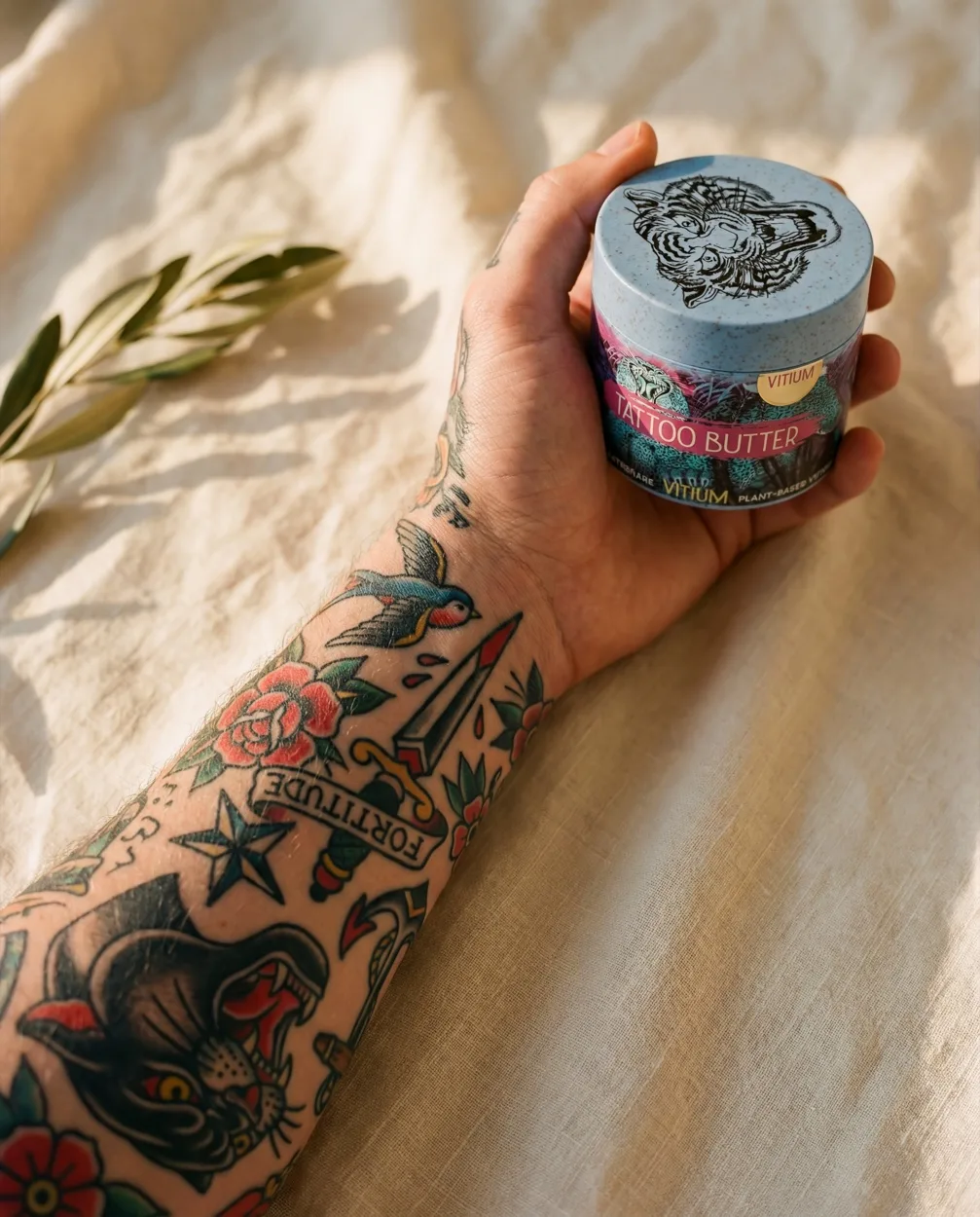
It’s called VITIUM Tattoo Butter. It’s made in Italy, sold through Amazon in the US and UK, and it’s what I put on every fresh tattoo I do in my own studio. If you want to try it, the product page has everything you need.
But honestly, whether you buy ours or another real plant-based butter, the principles in this article are what matter. Skip the petroleum. Skip the cheap fragrance. Keep it thin. Keep it clean. Respect your own ink enough to treat the skin that holds it like the canvas it is.
Your tattoo deserves it.
— Gabriele B. Tattoo artist · Co-founder, VITIUM