Fine Line Tattoo Aftercare: Why Thin Lines Blur First (and How to Stop It)
A fine line tattoo is the hardest kind of tattoo to keep looking the way it did the day you got it. Not because the work is fragile in the chair — because of what happens over the next three weeks, at home, when nobody is watching. Thin lines are unforgiving. A hairline script, a single-needle floral, a small fine-line portrait: these pieces show every mistake that bold traditional work hides.
The healing rules you read for a regular tattoo are not wrong for fine line. They are just not enough. Fine line work is deposited shallower and sparser than bold work, which means it has less margin for error at every stage. Get the aftercare slightly wrong on a bold blackwork sleeve and you might not notice. Get it slightly wrong on a fine line piece and the detail you paid a specialist for starts to soften.
This guide explains what blurring actually is at the level of the skin, the two habits that cause it most often, and a week-by-week plan built specifically for delicate work. The goal is simple: keep the lines as crisp in year five as they were on day one.
Why fine line tattoos heal differently
Fine line and single-needle work uses fewer needles, less ink, and a shallower, more precise deposit than traditional bold tattooing. That precision is the whole point. It is also the whole problem during healing.
A bold tattoo packs a dense column of pigment into the dermis. There is so much ink per square millimetre that the design has redundancy built in. If a little pigment shifts or a scab takes some with it, the line is wide enough to absorb the loss. You do not see it.
A fine line tattoo has no redundancy. A single-needle line might be a third of a millimetre wide, holding a fraction of the pigment of a bold line. Every particle counts toward the visible result. When something goes wrong in healing, there is no reserve to hide it. The line does not get a little lighter — it gets a little wider, a little softer, a little less certain. That is what people mean when they say a fine line tattoo “blurred.”

Thin lines also sit closer to the surface, which matters enormously for sun exposure later. We will come back to that.
What “blurring” actually is at the skin level
No other guide explains this part, so read it slowly. “Blurring” is not the ink fading. It is the ink moving, or the skin around it distorting. Three mechanisms cause it, and all three are made worse by aftercare mistakes.
Skin maceration. When skin stays wet for too long, the outer layer over-hydrates and softens. You have seen this on your own fingertips after a long bath — pale, swollen, wrinkled. That softened state is called maceration. A macerated layer of healing skin around a fresh fine line can no longer hold the shallow pigment deposit cleanly. The structure that keeps a thin line thin goes slack.
Sebum suppression. Your skin produces its own oil, sebum, to regulate moisture. When you coat a healing tattoo in a thick, airless layer of product, the glands underneath sense the artificial barrier and slow down. The skin becomes dependent on what you are putting on it, then dries and tightens between applications. That cycle of soggy-then-tight is hard on fine detail.
Pigment migration. This is the one that ruins fine line work specifically. In an over-hydrated, macerated dermis during the vulnerable first two weeks, the small ink particles of a thin line can shift microscopically inside the softened tissue. On a bold tattoo, micro-migration is invisible — there is too much pigment for a tiny shift to register. On a fine line, where a single particle’s position defines the edge of the line, that same shift reads as spread. The line “bleeds” outward by a hair, and a hair is all it takes.
Notice what connects all three: too much moisture, trapped too long. The single biggest cause of fine line blurring is not neglect. It is over-care.
The two things to avoid
Pick two habits to control and you have controlled most of the risk. These are the two.
1. Over-moisturising
This is the fine line tattoo’s signature mistake, and it is the opposite of what most people expect. With bold work, the usual sin is letting the tattoo dry out and crack. With fine line work, the usual sin is drowning it.
A healing fine line needs a thin film of moisture, applied a few times a day, allowed to absorb completely before the next application. What it does not need is a thick, permanent coating reapplied every time you think about it. Over-application keeps the skin in the macerated, soggy state that lets thin lines spread. The “more is better” instinct that feels caring is exactly the instinct that softens your detail.
The rule for fine line is a pea-sized amount, two to three times a day, and not one application more. If the tattoo looks shiny or feels slick an hour after you applied, you used too much. Wipe the excess gently and use less next time. A fine line tattoo that is slightly under-moisturised heals sharper than one that is over-moisturised. Err on the dry side.
2. Petroleum-based products
The thick, clear, waxy ointments sold for a century as the cure for everything are the wrong choice for any fresh tattoo, and they are especially wrong for fine line work.
Petroleum jelly creates an airless seal over the skin. It traps sweat, plasma, and bacteria underneath, and it holds the area in precisely the over-hydrated state that lets pigment migrate. The scab forms unevenly. The skin cannot breathe. On a thin line with no pigment to spare, that is how soft, spread, washed-out detail happens.
There is a second reason fine line artists avoid petroleum even during the session: it wipes the ink. The friction of wiping a petroleum-coated skin pulls shallow pigment back out — and fine line pigment is the shallowest there is. If a product’s ingredient list starts with “petrolatum” or “mineral oil,” put it down. Look instead for a light, non-occlusive plant-based butter that absorbs in minutes and lets the skin regulate itself.
What to actually use
Fine line work needs a product that hydrates without smothering. That rules out heavy occlusive ointments and water-based drugstore lotions in equal measure. What works is a light plant-based butter — one built on real plant fats that melt into the skin and disappear, rather than sitting on top in a film.
The reason is mechanical. A whipped plant butter delivers fatty acids and antioxidants to the regenerating skin, then absorbs, leaving the surface free to breathe and the sebaceous glands free to do their own job. It supports the barrier without forcing the macerated, waterlogged state that thin lines cannot survive. These are the same principles of natural aftercare that apply to any tattoo — fine line work just punishes you faster for ignoring them.
When you read an aftercare label, the absence of petrolatum, mineral oil, and paraffin matters more for fine line than for anything else, because those are the ingredients that trap moisture against the skin. A meaningful position for Vitamin E on the ingredient list matters too, for reasons that become clear in the longevity section below.
The five hero ingredients that matter for fine detail
Plant-based aftercare comes down to a handful of ingredients doing the visible work. These are the five that earn their place on healing fine line skin.
- Shea Butter (Butyrospermum parkii) — the backbone. Rich in fatty acids and a little natural allantoin, it holds moisture in the skin without the airtight petroleum seal. Premium unrefined grade absorbs cleanly; commodity grade sits greasy on the surface, which is the last thing thin lines need.
- Mango Butter (Mangifera indica) — lighter than shea, higher in antioxidants. It gives a butter its melt, so the product sinks in fast rather than pooling in the line. Fast absorption is exactly what fine line work wants.
- Calendula Oil (Calendula officinalis) — marigold infused into a carrier oil, used in European wound care since the Middle Ages. It calms inflammation and reduces redness. Less inflammation in the healing window means less of the swelling that distorts thin lines.
- Vitamin E — the pigment preservative. It neutralises the free radicals that break ink molecules down over time. On a fine line, where there is little pigment to begin with, slowing oxidative fading is the difference between crisp at year five and ghostly at year five.
- Hypericum Oil (Hypericum perforatum, St. John’s Wort) — macerated the traditional way, the flowers soaked in olive oil in a sunny window for 40 days until the oil turns deep red. It supports cell renewal on fresh skin. Most brands skip it because it is slow and expensive to make properly.
A real formulation has more in it than these five — carrier oils, a natural emulsifier, a preservation system, sometimes trace vitamins. These are the hero ingredients, the ones doing the visible work. The rest is the engineering that holds them together.

Day-by-day timeline for a fine line tattoo
Every piece and every body heals a little differently. But fine line work follows an arc you can plan around — and it runs longer than people expect.
Day 0 — the chair
You leave with film or a second-skin bandage over the fresh piece. Many fine line artists favour a second-skin for the first few days because it holds the area stable and clean. Leave it on for exactly as long as your artist tells you. Do not peek. Do not prod.
Day 1–2
Remove the wrap when instructed. Wash gently with lukewarm water and a mild, plain soap, using only your fingers. Do not scrub. Pat dry with a clean paper towel, not a cloth. Apply a pea-sized layer of light plant-based butter, then leave it alone. Thin lines need less product than you think.
Day 3–7 — peak vulnerability
This is the window where fine line work is most easily damaged. The skin tightens and starts to itch. Do not scratch. Do not pick. A scab lifted early from a thin line takes pigment with it, and a thin line has none to lose. If it itches, that is usually dryness — tap gently around the area or apply a thin layer, and resist the urge to do more.
Week 2 — the over-moisturise trap
Peeling begins, and the colour underneath looks temporarily dull beneath a layer of new skin. Do not panic, and do not respond by piling on more product. Week two is exactly when over-moisturising blurs fine detail. Stay disciplined: pea-sized, two to three times a day, fully absorbed between applications. If you have already pushed into soggy, dry-flaky territory, ease off the product and let the skin recover — the fix for over-care is less care, not a different cream. (More on that balance in our guide to dry, flaky tattoo healing.)

Week 3–4 — surface healed
The surface closes and the lines reappear crisp if you have done the work. You can return to most normal activity. Keep moisturising once a day, lightly. The surface being healed does not mean the tattoo is finished.
Months 2–3 — deep healing
Here is what bold-tattoo guides do not tell fine line clients: the deeper layers take six to eight weeks, and full integration can take up to three months. Thin lines sit shallow, so the surface fools you into thinking it is done. Keep protecting it. The pigment is still settling into its final position, and the choices you make now decide how sharp it looks for the next decade.
Sun protection: why thin lines fade first
UV exposure is the single biggest cause of tattoo fading, and fine line work loses to the sun faster than any other style. Two reasons. First, thin lines hold less pigment, so any UV-driven breakdown removes a larger proportion of what is there. Second, fine line ink sits shallower in the skin, closer to the surface UV reaches most strongly. Bold, deep work has pigment to spare and depth to hide behind. A hairline tattoo has neither.
Do not put sunscreen on a tattoo that has not finished healing — wait until the surface is fully closed, usually four to six weeks for fine line. After that, sunscreen is the most important long-term habit you have. Use SPF 30 or higher on any visible fine line piece, every time it sees real sun, for the life of the tattoo. A few seconds of application is what stands between a crisp line and a faded smudge ten summers from now. Our breakdown of the best sunscreen for tattoos covers which formulas work without leaving a film.
Year 2, year 5, year 10
A fine line tattoo is a long-term relationship with your own skin. Treated well, a delicate piece holds its character for many years. Treated carelessly, it can look tired within two or three.
The variables are not mysterious. Sun is the first. Hydration is the second — skin that is kept conditioned holds ink more sharply than skin left to dry out and roughen over the years. The third is simply the nature of fine line work: it was always going to soften a little faster than bold work, because physics. Knowing that, you protect it harder, not less.
A fine line tattoo that is sun-protected and lightly conditioned for its whole life looks sharper at year ten than a neglected one does at year three. The work your artist did is only the first half. The second half is yours.
When to schedule a touch-up — and how to tell
Even with perfect aftercare, some fine line pieces benefit from a touch-up — and that is not a failure, it is the nature of delicate work. The honest signs that a touch-up is worth booking:
- A line has visibly softened or widened compared to how it healed. Not a faded patch — a loss of crispness along the line itself.
- A section dropped out during healing, usually because a scab was lost early. Common on high-friction spots like fingers, feet, and the inner wrist.
- The piece is two to five years old and the overall design reads less sharp than it did, despite good sun habits.
Talk to the artist who did the original work first. A good fine line specialist expects the occasional touch-up on delicate pieces and will often build it into the original price or offer it at a reduced rate within the first year. Bring the piece in healed and clean, and let them assess it in person — phone photos flatten exactly the detail a touch-up decision depends on.
Frequently asked questions
How long does a fine line tattoo take to fully heal?
The surface heals in about two to four weeks, but the deeper layers of skin take six to eight weeks, and full integration of the ink can take up to three months. Fine line tattoos sit shallower than bold work, so the surface closes and looks done while the deeper healing is still going on. Keep up gentle aftercare and sun protection through the full three-month window, not just the first few weeks, to give thin lines the best chance of staying crisp.
Can I use regular body lotion on a fine line tattoo?
No, not while it is healing. Most body lotions are water-based and lack the barrier-repair fatty acids healing skin needs — and the extra water content encourages the over-hydration that blurs thin lines. Use a light plant-based butter or balm until the surface has fully closed, usually the end of week three. After that, a gentle body lotion is fine for daily maintenance, though a light plant butter remains the better choice for keeping fine detail conditioned.
Why do fine line tattoos fade faster than bold tattoos?
Fine line tattoos fade faster for two structural reasons. They hold far less pigment per line than bold work, so any fading removes a larger share of what is visible. And the ink sits shallower in the skin, closer to the surface that UV light reaches most strongly. There is no redundancy to hide loss. This is why diligent sun protection matters more for fine line work than for any other style — thin lines show UV damage first and most.
Is over-moisturising really worse than under-moisturising for fine line?
Yes. Over-moisturising is the most common cause of blurred fine line tattoos. Too much product keeps the healing skin in a soft, over-hydrated state called maceration, which lets shallow pigment shift and thin lines spread. A slightly under-moisturised fine line heals sharper than a drowned one. Use a pea-sized amount two to three times a day, let it absorb completely, and stop. If the tattoo still looks shiny an hour later, you used too much.
How do I know if my fine line tattoo needs a touch-up?
Look for a line that has genuinely softened or widened rather than simply lightened, or a section that dropped out during healing — often on high-friction areas like fingers and feet. A touch-up is also reasonable on a two-to-five-year-old piece that has lost overall crispness despite good sun habits. Always consult the original artist first; many fine line specialists offer touch-ups free or reduced within the first year, since delicate work occasionally needs it.
Can I use sunscreen on a healing fine line tattoo?
Not until it is fully healed. Sunscreen on broken or peeling skin can irritate the tattoo and interfere with healing. Keep a healing fine line out of direct sun and covered with loose clothing for the first four to six weeks. Once the surface is completely closed, apply SPF 30 or higher every time the tattoo sees real sun. For fine line work, lifelong sun protection is the single most effective thing you can do to keep the detail sharp.
What I actually use on my own clients
I’m not going to pretend I’m neutral. I’ve tattooed for sixteen years on Ortigia Island in Sicily, and a fair share of that work is fine, delicate, detailed pieces that live or die on aftercare. I watched too many of them soften at home before I did anything about it.
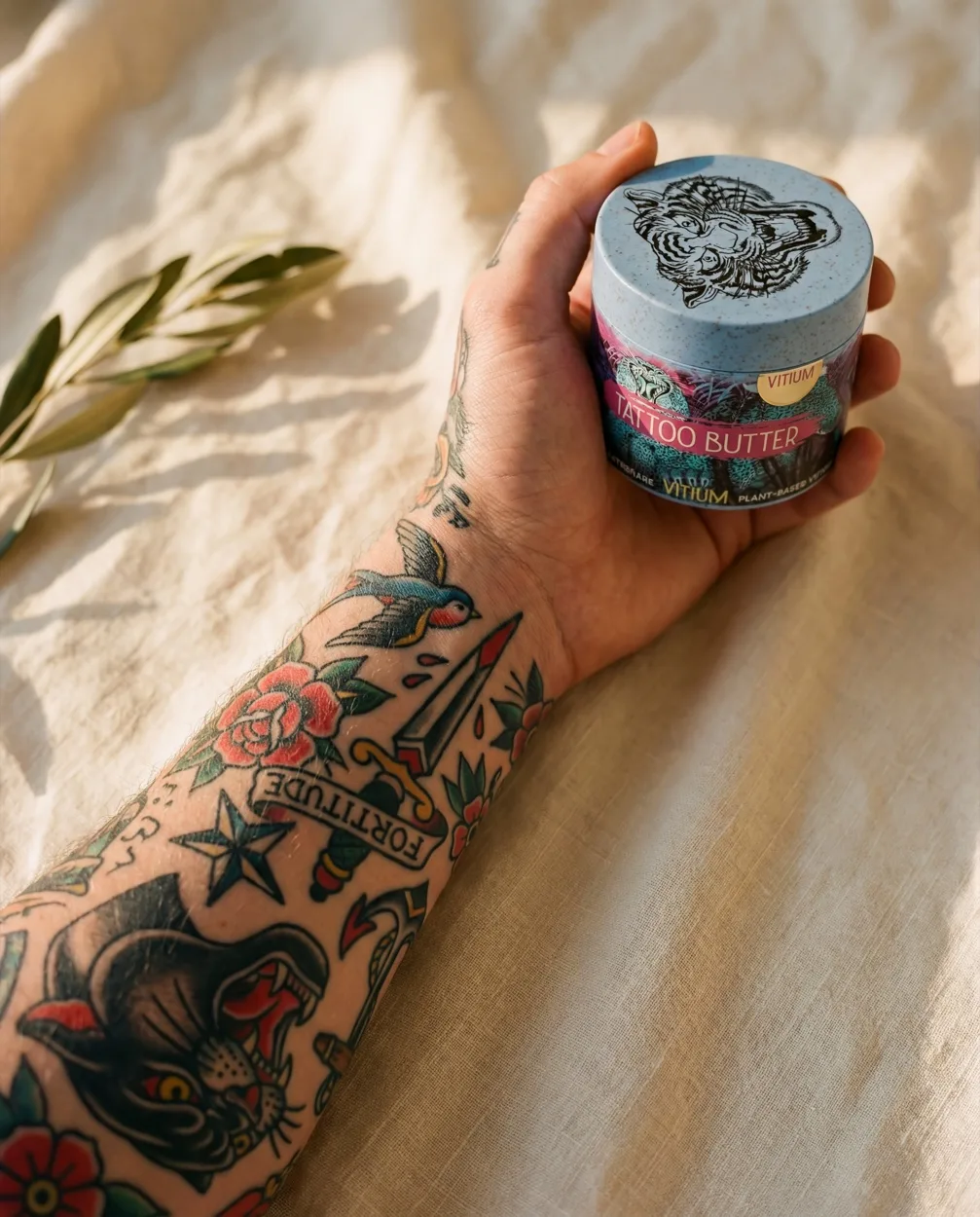
My partners and I spent two years formulating a plant-based tattoo butter in Sicily, working with one of the most respected cosmetic manufacturers in southern Italy. We use the premium grade of shea and mango — not the commodity grade — and real hypericum oil, macerated the traditional way for forty days. It is light enough to absorb without smothering fine work, which is exactly what thin lines need. It’s called VITIUM Tattoo Butter, and it’s what I hand to clients walking out with a fresh fine line piece. If you want to try it, the product page has everything you need.
But honestly, whether you buy ours or another real plant-based butter, the principles in this article are what matter. Keep it thin. Keep it light. Protect it from the sun for the rest of its life. Fine line work asks for a little more discipline than bold work — and it rewards you for decades when you give it.
Your tattoo deserves it.
— Gabriele B. Tattoo artist · Co-founder, VITIUM