Can You Get a Tattoo If You Have a Physically Demanding Job?
A friend of mine got both feet tattooed on a weeknight, went home, slept badly, and woke up to feet that would not fit into socks. He put the socks on anyway. Then the boots. Then he worked a full shift waiting tables, because the rota said he was on and rent does not care about your ankles.
By that evening he had a fever and both feet were swollen tight. He ended up off work for about five days.
The tattoo survived. He cleaned it obsessively once he understood what he had done, and it healed. What did not survive was five days of wages, which is the part nobody warns you about.
It took me a long time to work out why that story is not really a warning. The reason is my own arm. I was working at IKEA back then, long days on my feet, lifting. I had a section of my sleeve done and went in the next morning. It burned a bit. That was all. It was winter, I wore a jacket over it, I kept the film on, I washed it when I got home, and nothing happened.
Same body, same week one, two completely different outcomes.

The short answer
Yes, you can get a tattoo if you have a physically demanding job. Most people in trades, kitchens, wards and warehouses do exactly that, and heal fine.
What decides the outcome is not your job title. It is which patch of skin you chose, and what you do in the first seventy-two hours. Get those two right and a building site is survivable. Get them wrong and a desk job would not have saved you either.
The risk is real. It just sits somewhere other than where people go looking for it.
Why your job is not the variable
A fresh tattoo is an open wound with pigment suspended in the dermis underneath. Your body treats it as damage and starts closing it. The surface generally takes two to four weeks to close; the deeper skin keeps settling for months after it looks finished.
During that window the trouble comes from three directions: contamination, friction, and swelling that has nowhere to go.
Put my friend’s feet next to my arm and the pattern is obvious.
His feet were sealed inside socks and boots for eight hours — warm, damp, dark, and rubbing with every step, on a part of the body that swells more than most because it is the furthest point from your heart and you stand on it all day. It never got a break. My arm was under a loose jacket sleeve in February, moving freely, cool and dry.
Neither of us worked a gentle job that week. The difference was the patch of skin.
It is also the one variable you can still change while you are booking. Once the needle starts, placement is fixed.
The first 72 hours: second skin is the working person’s answer
If you have to work through a fresh tattoo, the single most useful thing you can do is have it covered with an adhesive healing film, the clear, breathable, waterproof kind most studios now use. Ask for it when you book. Not every shop applies one by default.
For someone who has to be on site the next morning, this changes the situation completely. The film gives you a barrier against dust, sweat and whatever is on your hands. It also means you are not trying to run a wound-care routine in a portaloo.
A few things worth knowing before you rely on it:
- The first piece is short. Manufacturer guidance is generally eight to twenty-four hours for the initial application. Then it comes off, the area gets washed gently, and a fresh piece goes on for a few days more.
- The dark fluid underneath is normal. Plasma, lymph and a little loose pigment pool under the film and look alarming. That is the bandage doing its job, not the tattoo leaking out.
- Adhesion is the real deadline, not the calendar. If the edges lift and the seal breaks, the film has stopped being a barrier and starts being a trap. Take it off, wash the area, and either re-wrap properly or move to open aftercare.
- It is not for everyone or everywhere. Some people react to the adhesive. High-flex, high-friction areas — feet, ankles, inside a boot, under a knee pad — are exactly where films struggle to stay sealed, which is the same reason those placements are hard to work through in the first place.
That last point is the honest limit on my own advice. Second skin is genuinely the best tool a working person has for the first few days. It is not a reason to get your feet tattooed the night before a double shift.
Days 3 to 14: the part nobody plans for
The film comes off around day three. The tattoo is not healed until somewhere around day fourteen.
That gap is the real problem for anyone doing physical work, and I have not seen much aftercare advice that deals with it honestly. Most of it is written for people who can go home and sit down.
This is the stretch where it peels and itches, where you sweat into it under a hi-vis, and where a strap or a waistband spends eight hours rubbing the same three inches of healing skin. It is also when infection risk peaks. The barrier is gone and the wound is still open.
The routine that gets people through it is unglamorous:
- Wash it when you finish, not when you remember. Clean hands, lukewarm water, plain unscented soap, no scrubbing. Pat dry with something clean, not the towel that has been on the hook since Tuesday.
- Wash it at lunch too, if the work is dirty. If you are on a site with real dust, use bottled water rather than whatever comes out of the site tap.
- Thin layers only. A healing tattoo needs to breathe. A thick smear traps heat and moisture against the skin and does more harm than nothing at all.
- Let it peel. The flakes are dead epidermis, not your tattoo falling out. Picking them is how flat patches and scarring happen.
- Change what rubs. A looser sleeve, a repositioned tool belt, a strap moved two inches, a bit of soft padding between equipment and skin. Small adjustments, made for ten days.
If you want the detail on why the peel behaves the way it does, we went through it properly in our guide to tattoo peeling, and the full aftercare walkthrough covers the day-by-day version of this routine.

Placement, by trade
This is where the decision actually gets made, and it is worth ten minutes of thought before you book.
- Upper arm, shoulder, chest, upper back, upper thigh. The safest places to heal through physical work. Covered by ordinary clothing, relatively low friction, and not usually where equipment sits.
- Inner forearm. Better than the outer forearm for anyone working outdoors, because it sees considerably less direct sun.
- Hands and fingers. Hard for almost every trade. Constant use, constant washing, gloves on and off, and a placement that heals unpredictably even for people who do nothing all day.
- Feet and ankles. The worst option for anyone who stands, walks or wears safety boots. Swelling is worse, the enclosure is warm and damp, and the rubbing does not stop while you are on shift.
- Wherever your gear sits. A tool belt rules out the hip for a fortnight. Shoulder-supported equipment makes the deltoid a bad bet, and anyone who kneels for a living should keep it off the knee.
None of these are rules. Plenty of chefs have hand tattoos and plenty of builders have healed ankle pieces. But if you have a choice between two placements and one of them lives under a boot, take the other one.
Dust, sweat and the site
Contamination is the risk that turns an inconvenience into time off work, and it is worth being straight about the numbers rather than vague about the danger.
A systematic review of bacterial infection after tattooing found that between 0.5% and 6% of tattooed people report infectious complications, with Staphylococcus aureus identified in 81% of documented cases. The same review is blunt about where that risk comes from. Alongside studio hygiene, it names non-medical wound care, the part after you go home, as a major risk factor.
That is the whole argument for taking the first fortnight seriously. Your artist controls the sterile side. You control the rest, and the rest is where a meaningful share of the problem lives.
In practice, on a dirty site: keep it covered while you work, wash it as soon as you are off the tools, and do not let it sit under damp, dirty fabric for hours. Sweat by itself is not the enemy. Sweat plus dust plus friction plus eight hours of no air is.
Normal healing, and the point where you stop guessing
Some redness, swelling, soreness and clear fluid in the first days is ordinary. So is itching and flaking later. The American Academy of Dermatology describes exactly that as the normal picture.
What is not ordinary, in their words, is redness that darkens or spreads instead of fading, pain that continues or worsens instead of settling, a rash of itchy red bumps inside the tattoo, or pus. Add fever or chills and you are no longer in aftercare territory.
Most people reading this at eleven at night are frightened, and most of them are fine. The simplest test I know: healing gets better every day. If day four is worse than day three, and day five is worse than day four, that trend is the signal. Stop reading, phone your GP. If you have a fever, spreading redness or marked swelling and cannot get seen within a day, that is what A&E is for.
I am not a doctor and neither is your artist. My friend pushed through a full shift on feet that had swollen overnight, then ran a fever that evening. Five days off. I still do not know what that actually was — he never had it looked at, he just stopped and slept and it settled. Which was luck rather than a plan, and I would not repeat it.

Timing the booking
If your rota gives you any control, use it. Getting tattooed the evening before two days off buys you the entire high-risk window at home, with the film on and your feet up. That is the difference between the two stories at the top of this article, more than anything else.
If you cannot choose, book it anyway and plan the placement around the work instead. Somewhere covered and loose, where nothing straps over it.
And tell your artist what you do for a living. Not as a formality. A good one will change the placement conversation, and some will reschedule you rather than put a piece somewhere your job will destroy it.
The long game: sun, fade and touch-ups
Once you are past healing, the slow threat for outdoor trades is ultraviolet light. Sunlight breaks the pigment down over years, and it does not fade everything evenly: carbon-based blacks hold up best, reds, yellows and whites go first, and blues and greens sit somewhere in between.
Sunscreen is the obvious answer, with one timing catch: it does not go anywhere near a fresh tattoo. For the first two to three weeks physical cover is your only option, and sunscreen starts once the skin has closed. After that the AAD’s general guidance on caring for tattooed skin is the baseline, SPF 30 or higher and broad spectrum, and a water-resistant formulation will survive a sweaty afternoon better than a standard one.
Realistically, though, if you are up a scaffold you are not reapplying anything every two hours. A UV sleeve you put on once in the morning beats a bottle you never take out of the van. And keep the skin conditioned, because dry skin makes ink look duller than it is. A lot of what gets called fading at year three looks to me like dehydration.
If you work outdoors through the summer, our summer tattoo care guide goes deeper on sweat, sun and swimming.

FAQ
Can I go to work the day after getting a tattoo? Usually yes, if the placement suits the work. Keep the covering your artist applied, keep the area out of dust and direct sun, and wash it when your shift ends. The exceptions are placements that sit inside boots, under knee pads, or beneath tight straps. Take the day off for those if you possibly can.
How long should I keep second skin on if I work a physical job? The first piece generally stays on for eight to twenty-four hours, then comes off for a gentle wash before a fresh piece goes on for up to several days more. Follow your artist’s instruction over any general rule, and remove it early if the edges lift and the seal breaks.
Will sweat ruin a new tattoo? Sweat alone will not ruin it. The problem is sweat trapped against healing skin under tight, dirty fabric for hours, which is a good environment for bacteria and a bad one for a wound. Wash and dry the area after work rather than leaving it damp.
What is the worst tattoo placement for someone on their feet all day? Feet and ankles. They swell more than anywhere else, they sit inside a warm damp boot for the whole shift, and the rubbing is constant. If you are a chef, waiter, nurse or anyone on their feet, that is the placement to postpone.
How do I keep a tattoo clean on a construction site? Keep it covered while you work, then wash it with clean water and plain soap as soon as you are off the tools, using bottled water if the site supply is questionable. Do not apply product over dust; clean first, then a thin layer.
When should I see a doctor about a new tattoo? When it is getting worse rather than better. Spreading or darkening redness, pain that increases after the first few days, pus, or a rash of red bumps inside the tattoo all warrant a GP appointment. Fever, chills or rapidly spreading swelling need same-day medical attention.
Where this lands
I am not neutral about aftercare. I spent two years working on a jar of it, so treat my enthusiasm accordingly. But look back at what is actually above: placement, a film, and ten minutes of washing at the end of a shift. Barely any of it is product.
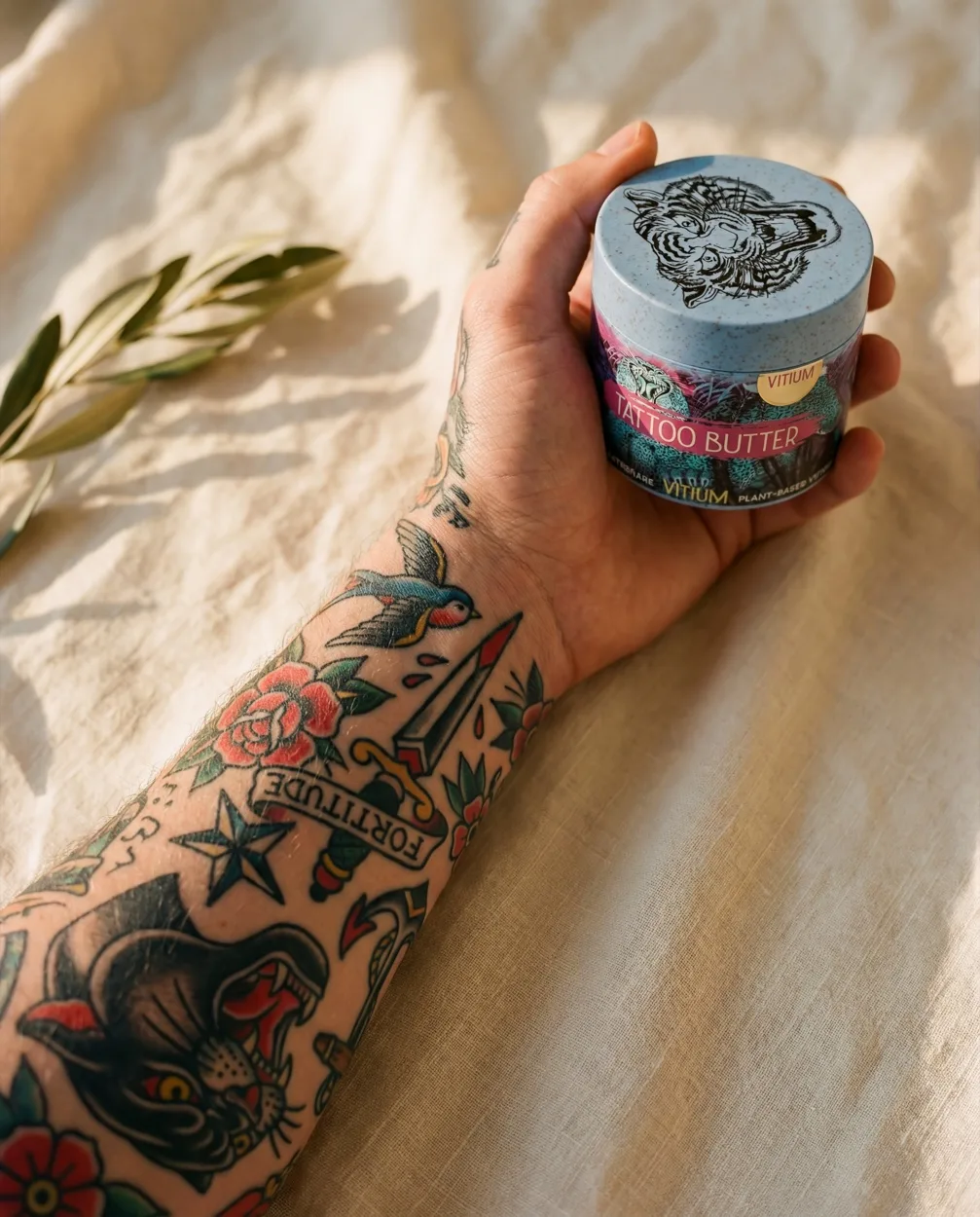
If you do want something on it during that second week, look for plant butters and oils that absorb rather than sit on top, Vitamin E, and botanicals like Calendula officinalis doing real work in the formula. Ours is built on five hero ingredients, alongside the carriers and emulsifiers any balm needs to hold together.
But the property that matters on a work site is thinness. It has to go on light and let the skin breathe. Anything petroleum-based, on a tattoo you are sweating into for eight hours, is the wrong tool.
That is genuinely secondary. The friend with the feet had a placement problem and a timing problem. No balm on earth would have fixed either one.
So get the tattoo. Pick the spot with your job in mind, book it before your days off if you can, get a second skin on it, and be careful for a fortnight.
Do not stress it.
— Damiano C. Co-founder & Creative Director, VITIUM