Summer Tattoo Care: How to Protect New and Old Ink Through Swimming, Sweat and Sun
Summer is brutal on a healing tattoo. Heat, sweat, chlorine, salt water, sand, and direct sun all arrive at once — and fresh ink is an open wound until its surface closes. Get the timing wrong and you risk patchy healing, irritation, or colour that fades before it ever settles.
This is the part nobody plans for. You book the tattoo, then realise the beach trip is two weeks later.
So here’s exactly when you can swim, work out, and sit in the sun after a new tattoo — and how to keep older ink sharp once the heat sets in.
Quick answer:
- Swimming: wait until the tattoo is fully healed — roughly 2–3 weeks for a chlorinated pool, 3–4 weeks for the sea or a lake. No scabs, no peeling, no open patches.
- Sweating and the gym: light movement is fine within a few days; hold off on heavy, sweat-soaked sessions that stretch the tattooed area for 2–3 weeks.
- Sun: keep a new tattoo out of direct sun and covered for the first 2–4 weeks. Once it heals, broad-spectrum SPF 30–50 every time it’s exposed — for life.
- Daily care: a thin layer of breathable plant butter, reapplied after you sweat or towel off, stops healing skin drying out in the heat.
Why summer is harder on a healing tattoo
A new tattoo is an open wound. Until the surface closes — usually two to four weeks — the skin is still knitting itself shut, and everything summer throws at it lands on raw tissue.
Heat raises how much you sweat, and sweat is salt and bacteria. Sun breaks down pigment before it settles into the dermis. Pools carry chlorine; the sea and lakes carry microbes. Sand scratches. Each of these is manageable on its own. In July they show up together.
Your skin sets the timeline. Not your holiday.
The good news: none of this means hiding indoors. It means knowing which week you’re in, and treating the tattoo accordingly.

Swimming after a new tattoo
You should wait until your tattoo is fully healed before swimming — about 2–3 weeks for a pool and 3–4 weeks for open water. Submerging an unhealed tattoo softens the forming scab, can lift pigment out with it, and leaves open skin exposed to whatever is in the water.
Pools
Chlorinated water is harsh on healing skin. Chlorine dries the surface, stings broken skin, and can loosen scabs that are still doing their job. NHS aftercare advice is to stay out of chlorinated pools until any scabs have fallen off. Give a pool two to three weeks, and only once the skin has closed over completely.
The sea, lakes and rivers
Open water is a different risk. Saltwater pulls moisture from healing skin, and natural water carries far more bacteria than a treated pool. There’s no chlorine to keep it in check, either. Wait three to four weeks minimum for the sea, a lake, or a river.
How to tell it’s safe
The tattoo is ready for water when it looks and feels like normal skin:
- No scabs — nothing crusted, nothing flaking off.
- No peeling — the dry, papery layer has finished shedding.
- No raw or shiny patches — the surface is matte and closed, not weepy or glossy.
If you’re not sure, wait another week. A waterproof dressing can cover a tattoo for a quick, unavoidable splash, but it is not a green light to spend the afternoon in the pool. Water always finds the edges.
Working out and sweating with fresh ink
Sweat is not neutral. It’s salt and bacteria, and on a healing tattoo it softens scabs, feeds irritation, and washes off whatever you’ve put on the skin. Light movement is fine within a few days. Heavy, sweat-soaked sessions that stretch or rub the tattooed area should wait two to three weeks.
Friction is the other half of the problem. Gym clothing dragging across a fresh piece, a barbell resting on a forearm tattoo, a backpack strap over a shoulder — all of it pulls at skin that is trying to close.
Best practice while it heals:
- Train around it. Work other muscle groups; skip exercises that stretch or pressure the tattooed area.
- Wear loose cotton. It breathes, and it doesn’t cling to a fresh tattoo the way tight gym fabrics can.
- Rinse soon after. Wash off dried sweat with lukewarm water, pat dry, reapply a thin layer.
Avoid:
- Wiping with a gym towel — blot, never rub, and use something clean.
- Saunas, steam rooms and hot tubs — heat, sweat and shared water together are the worst case for an open tattoo.

Sun and your tattoo
The sun is the single biggest long-term threat to a tattoo, and it asks two different things of you depending on whether your ink is fresh or healed.
On a fresh tattoo: keep it out of direct sun and covered for the first two to four weeks. UV light burns healing skin and breaks down new pigment before it has settled, which is how you end up with patchy, washed-out colour. Don’t reach for sunscreen on an unhealed tattoo either — the skin isn’t ready for it. Cover the area with loose clothing instead, and wait until it has healed before any SPF goes on.
On healed ink: sunscreen becomes a lifelong habit. UV is the main cause of tattoo fading over time, slowly breaking down the ink particles held in the dermis. Once a tattoo is healed, use a broad-spectrum SPF 30–50 every time it sees the sun. If you want help choosing one, we wrote a full guide on what to look for in a tattoo sunscreen.
One honest point: your aftercare balm is not sun protection. A plant-based butter conditions and supports the skin, but it carries no SPF. Sun protection is a separate, dedicated product layered over healed ink — never a substitute for it.
<iframe width=“100%” height=“450” src=“https://www.youtube.com/embed/_POjAZgb1xg” title=“Can you put sunscreen on a new tattoo?” frameborder=“0” allow=“accelerometer; autoplay; clipboard-write; encrypted-media; gyroscope; picture-in-picture; web-share” referrerpolicy=“strict-origin-when-cross-origin” allowfullscreen></iframe>
Beach, sand and travel
A beach holiday is the worst place to take a brand-new tattoo. Sand scratches healing skin, and sun reflecting off water and pale sand hits the tattoo from every angle at once. If you can, book big fresh pieces well away from a beach trip.
If a fresh tattoo is travelling with you anyway, pack for it:
- Loose cotton cover for the tattooed area, so it stays out of direct sun.
- A real broad-spectrum sunscreen for any healed tattoos you’re showing off.
- A small jar of breathable balm for daily care, applied thin.
Delicate styles need extra patience here. Fine-line tattoos blur more easily when healing skin is stressed by sun, salt and friction, so the thinner your linework, the more it pays to keep it covered.

Keeping older tattoos sharp through summer
Healed ink suffers in summer too — not from water, but from dryness and sun. Heat and UV pull moisture out of the skin, and dry skin scatters light instead of letting it through to the colour underneath.
A faded-looking tattoo is often just dry skin sitting over good ink. The fix is daily and simple: a thin layer of moisture in the morning, broad-spectrum SPF before sun, and enough water through the day. Skin that’s properly hydrated lets the colour read clear and deep again. If your ink looks flat and grey by August, dryness is usually the culprit, not the tattoo itself.
This is the quiet work that keeps a tattoo looking new in year five and year ten — not heroic effort, just a habit that survives the summer.
What to use on your skin in summer
In heat, the last thing a healing tattoo wants is a thick, greasy seal. A heavy occlusive layer — anything petroleum-based — traps warmth and sweat against the skin and stops it breathing. What works in summer is the opposite: something light that absorbs clean and doesn’t run when the temperature climbs.
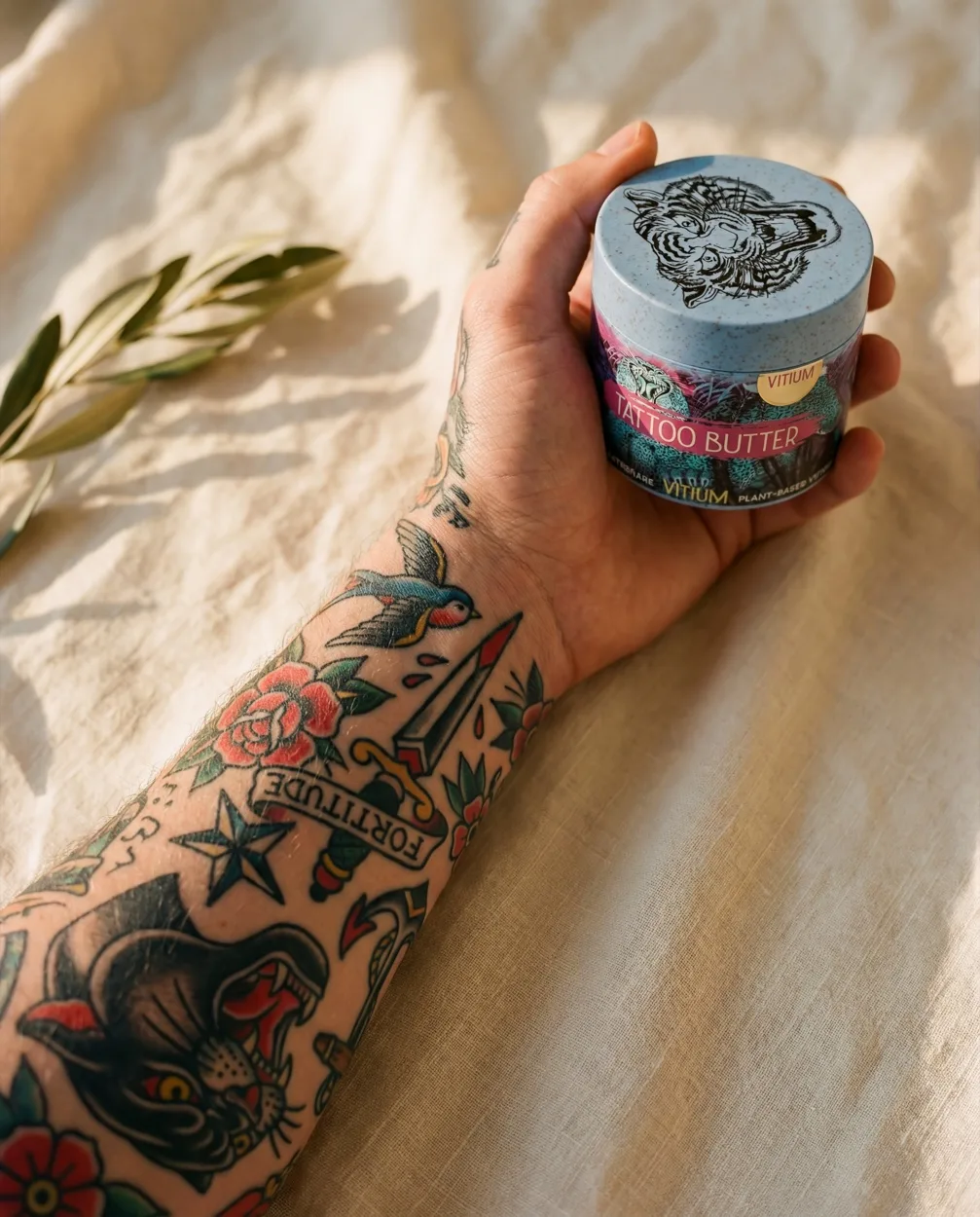
VITIUM Tattoo Butter
It’s a breathable, plant-based balm built to sit thin on the skin and absorb without leaving a film — which is exactly what healing and healed ink need in the heat. It leans on five hero ingredients, each earning its place:
- Shea Butter (Butyrospermum parkii) — fatty acids and natural allantoin that support the skin barrier as it repairs.
- Mango Butter (Mangifera indica) — conditioning without heaviness, keeping skin supple in dry summer air.
- Calendula (Calendula officinalis) — a botanical long used to calm irritated skin.
- Hypericum (Hypericum perforatum) — macerated the old way, in oil and sunlight, traditionally used to support recovering skin.
- Vitamin E — an antioxidant that helps protect pigment, sitting meaningfully within the first dozen ingredients on the label.
A real formula has more than these five — carrier oils, a natural emulsifier, a preservation system. The five above are the hero ingredients, the ones doing the visible work; the rest is the engineering that holds them together. It’s vegan, free of petrolatum, mineral oil and parabens, and it comes in a sugarcane-derived jar.
How to use it through summer:
- Wash the tattoo with lukewarm water and a mild, fragrance-free soap. Pat dry with a clean paper towel.
- Warm a small amount between clean fingertips.
- Apply a thin layer. Thin. If it’s still shining ten minutes later, you used too much.
- Reapply after heavy sweating, after swimming once healed, or after towelling off at the beach.
- For healed ink heading into the sun, layer a dedicated broad-spectrum sunscreen over the top — balm first, sun protection second.
- Keep it gentle: two to three thin applications a day while healing, once or twice a day to maintain older tattoos.
If you want the full picture on how these balms work and how to judge one, our guide to tattoo butter and the complete natural aftercare routine go deeper.
FAQ
How long after a tattoo can you swim?
Wait until your tattoo is fully healed — about 2–3 weeks for a chlorinated pool, and 3–4 weeks for the sea or a lake. Submerging an unhealed tattoo softens the scab, can pull pigment out with it, and exposes open skin to chlorine, salt and bacteria. The tattoo is ready when there are no scabs, no peeling, and no raw or shiny patches. If you’re unsure, give it another week.
Can you be in the sun with a new tattoo?
No. Keep a new tattoo out of direct sun and covered for the first 2–4 weeks while the skin closes. UV light burns healing skin and breaks down fresh pigment before it settles, which leads to patchy, faded colour. Don’t put sunscreen on an unhealed tattoo either — wait until it’s healed, then use broad-spectrum SPF 30–50 every time it’s exposed.
Can I work out or sweat with a fresh tattoo?
Light movement is fine within a few days, but hold off on heavy, sweat-soaked workouts that stretch or rub the tattooed area for 2–3 weeks. Sweat softens scabs and carries bacteria, and friction from clothing and equipment pulls at healing skin. Train around the tattoo, wear loose cotton, and rinse and reapply a thin layer of balm soon after you finish.
Is sweat bad for a healing tattoo?
In volume, yes. Sweat is salt and bacteria, and heavy sweating softens the forming scab while washing off whatever you’ve applied. A light sheen from a walk won’t hurt a tattoo that’s covered and clean. The problem is soaking it — long, intense sessions or hot environments. Blot rather than rub, wear breathable cotton, and rinse the area afterward.
Does the sun fade tattoos?
Yes — UV exposure is the biggest cause of long-term tattoo fading. Sunlight slowly breaks down the ink particles held in the dermis, dulling colour and softening fine lines over the years. The best prevention is simple: once a tattoo is healed, apply a broad-spectrum SPF 30–50 every time it’s in the sun. Black-and-grey work fades this way too, not just colour.
How do I keep my tattoo from drying out in summer heat?
Apply a thin layer of breathable plant butter once or twice a day, drink enough water, and reapply after sun or heavy sweat. Heat pulls moisture from the skin, and dry skin makes even a good tattoo look flat and grey. Keeping the skin hydrated lets the colour read clearly again — most “faded” older tattoos are simply dry on the surface.
I’m not going to pretend I’m neutral about what goes on a healing tattoo. My partners and I spent two years formulating one in Sicily, working with a respected Italian cosmetic manufacturer and premium-grade plant butters rather than commodity ones — and we built it deliberately thin and breathable, for exactly the conditions summer creates. It’s called VITIUM Tattoo Butter, and you can see what’s in it here.
But honestly — whether it’s ours or another real plant-based butter, the rules are the same. Keep it thin. Keep it clean. Keep fresh ink out of the midday sun, and out of the water until it’s closed.
You waited for that tattoo. Give it a summer it can survive.
— Gabriele B. Tattoo artist · Co-founder, VITIUM