Dry Healing vs Wet Healing: Which Tattoo Method Is Better?
Two people leave the same studio on the same day with the same tattoo, and a week later their healing looks completely different. One let it dry out and scab. The other kept a thin film of moisture on it the whole time. Both were told they were doing it “right.” Both want to know the same thing: which one heals faster, and which one keeps the colour sharper?
Here is the honest answer up front, before the detail. Neither method heals meaningfully faster — your body sets that pace, not your cream. What the two methods actually change is comfort, scarring risk, and how much colour you keep. For most tattoos, a thin-moisture approach is what working artists recommend today. For a specific minority of tattoos, dry healing is reasonable. The trick is knowing which one you’ve got.
This guide breaks down what each method does to the skin, the two ways people get each one wrong, and how to choose — without the dogma that usually surrounds this argument.
What dry and wet healing actually mean
The terms get thrown around loosely, so start clean.
Dry healing means exactly that: after the initial wrap comes off, you wash the tattoo and apply nothing. No balm, no butter, no ointment. The skin is kept clean and allowed to scab, tighten, and flake on its own. The thinking is that the skin heals “naturally,” without anything sitting on top of it.
Wet healing — a better name would be moist healing — means keeping a thin layer of moisture on the tattoo throughout the heal, usually with a light plant-based balm or butter applied two or three times a day. The skin still scabs and flakes, but more gently, because it never fully dries out and cracks.
Neither one means what people often assume. Dry healing does not mean “never wash it.” Wet healing does not mean “smother it in thick cream” or “keep it soaking.” Both of those are mistakes, and we’ll get to them.
The mechanism: what each method does to your skin
This is the part most guides skip, and it’s the part that actually settles the argument.
A fresh tattoo is an open wound. As it heals, the surface dries and a scab forms over the puncture sites while new skin builds underneath. Dry healing lets that scab form thick and hard. A thick scab protects the wound, but it also pulls tight as it dries, it cracks when you move, and when it cracks it can take flecks of pigment with it. On a small, flat, low-movement tattoo that’s a minor risk. On anything that bends, stretches, or carries dense colour, it’s how you lose patches.
Wet healing keeps the scab thin and pliable. A light film of moisture stops the surface drying into a hard crust, so the skin flakes off in small soft pieces instead of cracking in sheets. Less cracking means less pigment pulled out, less itching, and less scarring risk. The catch is the opposite failure: too much moisture, too long, and the skin over-hydrates into a soft, waterlogged state — and soft skin lets fresh pigment shift and blur.
So the whole debate comes down to a single trade-off: dry healing risks cracking; wet healing risks waterlogging. Done correctly, wet healing has the wider safety margin for most tattoos, which is why it became the mainstream recommendation. Done incorrectly, either one will cost you.

Does dry healing actually heal a tattoo faster?
Short answer: not in any way that matters.
The idea that an uncovered tattoo “breathes” and therefore heals quicker is mostly a myth. Healing speed is governed by your immune system, your age, your circulation, and the size and depth of the work — not by whether there’s a thin layer of balm on the surface. What dry healing can do is make the surface look done sooner, because a hard scab falls away and leaves tight new skin. But the deeper repair is on the same clock either way.
What dry healing reliably produces is more itching, more visible scabbing, and a higher chance of cracking. For some people that’s an acceptable trade for keeping products off their skin. For most, the discomfort and the colour risk aren’t worth a healing time that’s effectively identical.
The two things people get wrong
If you take one section from this article, take this one — because the method matters far less than avoiding these two mistakes.
1. Over-drying it
This is the dry-healing failure. The tattoo gets tight, the scab thickens, and instead of leaving it alone the person lets it crack through normal movement — bending an elbow, a tight sleeve, a workout. Each crack is a small reopening that can lift pigment and invite bacteria. If you dry heal and the skin starts feeling painfully tight or you see deep cracks forming, that’s the signal the method isn’t working for that piece. A thin layer of butter at that point isn’t “cheating” — it’s the fix. (If you’ve ended up in cracked, flaking, painfully dry territory, the dry-skin tattoo healing guide covers how to recover it.)
2. Over-wetting it
This is the wet-healing failure, and it’s the more common one because it comes from caring too much. More balm, thicker layers, reapplied every time the tattoo looks dull — it feels protective and it’s the opposite. A permanently wet surface macerates: the skin softens, the scab won’t form properly, and shallow pigment can drift. The rule is a thin layer, two or three times a day, fully absorbed between applications. If the tattoo looks shiny an hour after you applied, you used too much. This matters most on delicate work — thin lines blur first, which is why fine line tattoos need an especially light hand.
Who each method actually suits
The honest position is that this isn’t one-size-fits-all. Here’s where each method genuinely fits.
Dry healing can work for:
- Small, simple, low-saturation tattoos (fine black linework, tiny pieces)
- Low-movement, low-friction placements that won’t crack
- People whose skin genuinely reacts badly to balms and butters
- Drier climates where the air does the moisture regulation for you
Wet healing (thin moisture) is the safer default for:
- Colour work and dense black, where pigment retention matters most
- Larger pieces and anything over a joint or high-friction area
- Most skin types, most climates, most people
- Anyone who tends to pick or scratch — a moisturised tattoo itches less
If you’re not sure which camp you’re in, you’re almost certainly in the second one. The narrow case is dry; the broad case is wet.
What “wet healing” should actually mean
Wet healing only works if you’re keeping it moist with the right thing. This is where people sabotage a good method with a bad product.
Skip petroleum jelly and petroleum-based ointments. They form an airless seal that traps moisture and bacteria, turning “moist healing” into suffocated healing, and during a session the friction of wiping petroleum can pull pigment straight back out. What you want instead is a light, plant-based butter built on real plant fats like shea (Butyrospermum parkii) and mango, which melt into the skin and absorb rather than sitting on top in a film. Look for meaningful Vitamin E, which helps preserve pigment against oxidative fading, and an honest short ingredient list without petrolatum, mineral oil, or paraffin. That combination keeps the scab thin without waterlogging the skin.

Day-by-day: how each method plays out
Day 0–2
Identical for both. The tattoo is under film or a second-skin bandage. Leave it as long as your artist says.
Day 3–7
This is where the methods diverge. Dry: wash, pat dry, apply nothing — expect tightness and the start of scabbing. Wet: wash, pat dry, apply a thin layer of plant-based butter two or three times a day — expect a softer surface and lighter scabbing.
Week 2
The peeling week. Dry healing flakes heavily and itches more; resist scratching at all costs. Wet healing flakes in smaller, softer pieces. The colour looks dull under the new skin either way — that’s normal, and it returns.
Week 3–4
The surface closes under both methods. From here the choice stops mattering — keep the skin lightly moisturised regardless, because conditioned skin holds ink sharper for years.
Month 1 onward
Pure maintenance now, and the dry-vs-wet debate is over. Sun protection becomes the priority for keeping the colour, no matter how you healed it.
When to switch methods
You’re allowed to change your mind mid-heal — and sometimes you should. Switch from dry to wet the moment you see painful tightness or cracking; that’s the method failing, not your skin. Switch from wet to dry (or just lighter) if the tattoo looks permanently soggy, won’t stop weeping past the first few days, or the lines start looking soft. Aftercare isn’t a contract you signed in the chair. Watch the skin and respond to it.
Frequently asked questions
What is the difference between dry healing and wet healing a tattoo?
Dry healing means applying nothing to the tattoo after washing — letting it scab, tighten, and flake on its own. Wet (or moist) healing means keeping a thin layer of moisture on it, usually with a light plant-based balm applied two or three times a day, so it never fully dries and cracks. The core difference is the scab: dry healing forms a thick hard scab, wet healing keeps it thin and pliable. Wet healing is the more common recommendation among working artists because it carries less risk of cracking and pigment loss.
Does dry healing heal a tattoo faster?
No, not in any meaningful way. Healing speed is set by your immune system, circulation, age, and the size of the work — not by whether a thin layer of balm is on the surface. Dry healing can make the surface look finished sooner because a hard scab falls away, but the deeper repair runs on the same timeline. What dry healing reliably adds is more itching, more scabbing, and a higher chance of cracking, so any “speed” is cosmetic rather than real.
Why does dry healing cause more itching and scabbing?
Because without a thin layer of moisture, the surface dries into a thick, tight scab. That hard scab pulls as it dries, which feels itchy, and it flakes off in larger pieces, which looks like heavy scabbing. The dryness itself also triggers the itch response. Keeping the skin lightly moisturised with a thin plant-based butter softens the scab, so it flakes in smaller pieces with far less itching — which also makes it easier to leave alone.
Is wet healing better for colour tattoos?
Generally yes. Colour and dense black work have the most pigment to lose, and the thick cracking scabs of dry healing are the main way pigment gets pulled out during healing. Wet healing keeps the scab thin and pliable, so flaking is gentle and more pigment stays in the skin. For vibrant, saturated tattoos, a thin-moisture approach with a light plant-based butter is the safer choice for keeping the colour sharp.
Can a moisturiser help reduce tattoo itching?
Yes, when it’s the right kind and the right amount. A thin layer of a light plant-based butter calms the dryness that drives most healing-stage itching, and it stops the skin cracking, which itches more. The mistake is using too much or using a heavy, petroleum-based product — both trap moisture and can make things worse. Apply a thin layer two or three times a day, let it absorb fully, and never scratch a healing tattoo no matter how much it itches.
Which tattoo healing method is best?
There’s no single best method for everyone — it depends on the tattoo and your skin. Dry healing suits small, simple, low-friction pieces and people whose skin reacts to products. Wet (thin-moisture) healing suits colour work, larger pieces, high-movement areas, and most skin types, which is why it’s the mainstream recommendation. If you’re unsure, a thin layer of a quality plant-based butter is the safer default. Either way, the bigger factors are avoiding petroleum products, never over-applying, and protecting the healed tattoo from the sun.
What I tell my own clients
I’m not going to pretend I’m neutral. I’ve tattooed for sixteen years on Ortigia Island in Sicily, and I’ve watched both methods succeed and both methods fail — almost always because of how they were done, not which one was chosen. My own clients leave with the same advice: a thin layer of real plant-based butter, two or three times a day, unless you have a specific reason to dry heal.
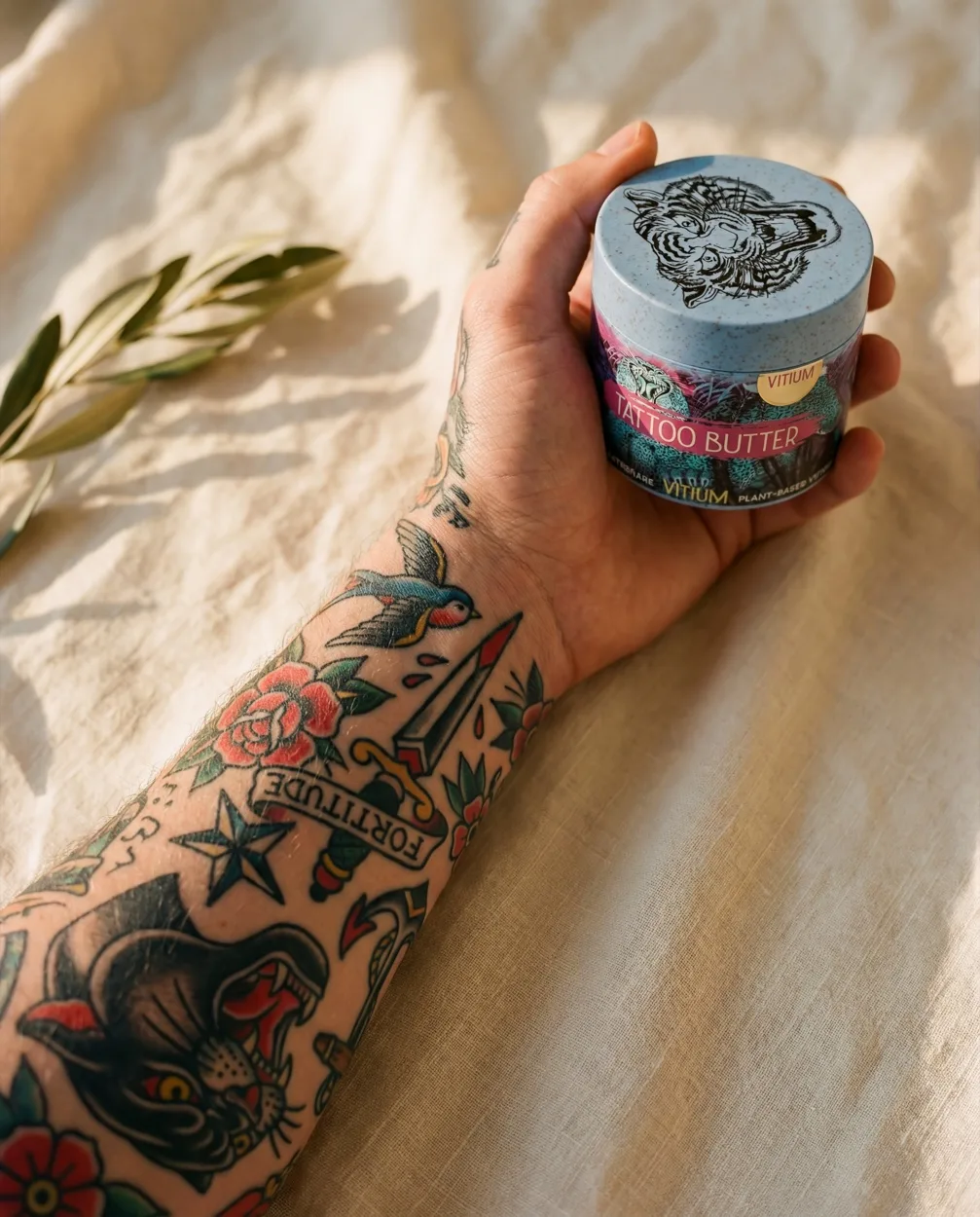
My partners and I spent two years formulating a plant-based tattoo butter in Sicily for exactly this job — light enough to keep the scab thin without waterlogging the skin, with the premium-grade shea and mango and real Vitamin E that healing skin actually uses. It’s called VITIUM Tattoo Butter, and the product page has the details if you want them. But honestly, whether you use ours or another real plant-based butter, the principles here are what matter. Skip the petroleum. Keep it thin. Watch the skin and respond to it.
Your tattoo deserves it.
Whichever method you choose, the product you put on the skin matters just as much — our complete guide to tattoo butter covers what to look for and how to apply it.
— Gabriele B. Tattoo artist · Co-founder, VITIUM