How to Get Hired at a Tattoo Shop as a Receptionist
For sixteen years I’ve run my own studio in Ortigia, and for most of them the front desk was me, between clients, phone in one hand and a stencil in the other. The day I finally hired somebody to do it properly, one thing became obvious very quickly. Nobody in a tattoo shop sits in a more exposed seat than the person at the desk. Judge the artist on the work. The receptionist gets judged on everything else.
Which is exactly why the job is worth wanting. Walk into a studio with a good front-desk person and the whole place feels different, and owners know it. What most of us can’t do is put into words what we’re looking for, so the adverts ask for “a positive attitude” and leave it there.
Here I’ll say the rest out loud. What the role actually involves from open to close. What owners screen for, and the two things that get an application thrown in the bin. The skills and the legal literacy worth having before you apply. How to walk into a shop, what a trial shift is really measuring, and what the job pays on both sides of the Atlantic.
What a tattoo shop receptionist actually does
Everything that happens between the front door and the chair belongs to the receptionist. The job title barely covers it. In a real studio the desk means bookings, deposits, walk-ins, ID checks, consent paperwork, the phone, the inbox, the Instagram DMs, the stock shelf, the card machine, and the mop.
This is what an ordinary day looks like in a three-artist shop.
- Bookings and deposits. Consultation requests arrive by email, DM, phone, and in person. The desk replies, checks each artist’s calendar, takes the deposit, sends the confirmation, and chases whoever hasn’t answered. Every artist books differently. You keep all of them straight.
- Check-in. A client arrives. You confirm the appointment, check ID, walk them through the consent form, answer the nervous questions, and let the artist know they’re here. Their first ten minutes are you.
- Walk-ins. Somebody wanders in off the street with a photo on their phone. You work out what they want, which artist in the shop suits it, whether there’s a gap today, and what it costs. They get a real answer, not a shrug.
- Payments. Deposits, balances, tips, aftercare sales, gift vouchers. Every evening you reconcile the till, and you don’t get it wrong.
- Aftercare questions. The client is about to go home with a wound and wants to know what to put on it. The desk answers, and that answer has to be right.
- Stock and cleaning. Gloves, wrap, ink caps, paper towel, aftercare on the shelf. The lobby stays clean. The bathroom stays clean. Nobody else is going to do it.

Once you see the pattern it’s hard to unsee. Half of the job is admin. The other half is judgement, and judgement is what an owner is really paying for.
What owners look for (and the two things that get you binned)
Every studio owner I know screens for the same short list, whether or not they could recite it. Reliability. Calm. Warmth that stops short of chatter. Being at ease with money. Holding three artists’ diaries in your head without a meltdown. Basic computer literacy, since booking software is the job now. And real interest in the shop itself, not only in tattoos.
None of that needs a tattoo background, which is the good news. The person I took on for my own desk had never been inside a studio. She’d run the front of a busy restaurant for three summers, and that was the whole interview. If you can get through a Saturday night rush still smiling, a Saturday afternoon of walk-ins won’t trouble you.
You won’t get ten red flags from me. Two matter. Owners remember two.
1. Any sign you’ll be unreliable
A tattoo studio lives on appointments booked weeks ahead, with deposits, for artists who earn nothing unless the chair is full. When the desk opens late, the whole day slides. When a confirmation never goes out, a chair sits empty and an artist has lost a day’s pay.
So owners fixate on reliability in a way that can look out of proportion. Arrive late for the interview and it’s over. Hand over a CV with six jobs in two years and no explanation, over. Answer the phone on your trial shift as though you’d rather be somewhere else, over. Reliability is the single most valuable thing you can demonstrate, and you demonstrate it before anyone reads a line about your skills.
2. Treating the desk as a back door to an apprenticeship
This one rarely gets said out loud. A lot of applicants want the desk because they want to tattoo, and they assume being nearby will get them there. Owners can smell it, and most of us can’t stand it, because it means a half-done desk and an applicant who’s gone within the year either way.
Apply for the job that exists. If drawing is what you want, say so honestly and separately, then do the desk job as though it were the only one. Ironically, that is the only path by which a front-desk hire ever does end up an apprentice. In sixteen years I’ve watched it happen exactly twice, and both times the person had first been the best receptionist that studio ever had.
Skills to build before you apply
Nobody expects you to turn up already knowing the industry. What owners do expect is that you can already do the parts of the job that exist in every front-of-house role. Start with these.
- Customer service under pressure. Retail, hospitality, a salon or clinic reception, a busy bar. Anywhere you’ve handled a queue, a complaint, and a declined card inside the same ten minutes. That is the experience that carries over.
- Booking software. Most studios now run on an online scheduling tool with deposits built in. If you’ve used one, name it. If you haven’t, spend an evening on the tutorials for the two or three most common ones. That’s all it takes.
- Money handling. Card terminals, cash reconciliation, deposits set against balances, refunds. A studio taking a deposit on every booking needs somebody who can say “the balance today is £240” without flinching, and then take it.
- Written tone. A big share of bookings now arrive as Instagram DMs and emails. Your replies need to be short, warm, and clear, without sounding like a bot and without promising anything an artist can’t deliver.
- Calm. One client arrives shaking. Another is furious about a rescheduled slot. An artist is running forty minutes behind. The desk absorbs all of it. If you’re the friend people ring when things fall apart, you already have this.
The UK’s National Careers Service lists the same core skills for any receptionist role: customer service, attention to detail, administration, patience under stress, and competent use of a computer. A tattoo shop adds the money, the paperwork, and the wound care on top.
The literacy nobody teaches you: ID, consent, data, hygiene
Here is where you pull away from the other twenty applicants. Most people applying for a tattoo shop front desk have no idea that the desk is where the shop’s legal exposure sits. Learn it and you’ll be the only candidate who brings it up.

Age verification is the shop’s legal defence
In the UK, tattooing anyone under eighteen is a criminal offence under the Tattooing of Minors Act 1969. The only defence the law offers a studio is that it had reasonable cause to believe the client was eighteen or over. That defence gets built at the front desk, by you, when you ask for photo ID and note that you checked it. No ID, no tattoo. A receptionist who waves through someone who “looks about twenty” has just thrown away the studio’s only defence.
The US does this state by state, but the principle holds everywhere: the desk checks ID, every time, and keeps a record.
Consent forms and client records
Every client signs a consent form covering health conditions, allergies, medication, and an acknowledgement of the aftercare advice. That form, and any copy of their ID, is personal data. In the UK it sits under the data protection rules the Information Commissioner’s Office publishes for small businesses. Keep it secure. Don’t leave the folder on the counter. Don’t photograph it on your own phone. Hold it only as long as the studio’s policy allows, and know what that policy says.
Studio registration
In England and Wales a tattoo business and its premises have to be registered with the local council under Part VIII of the Local Government (Miscellaneous Provisions) Act 1982. Environmental health officers from the council can inspect. Before you apply, you can check any studio’s registration by contacting the local council, and saying that you did is a cheap way to show you understand the trade.
Hygiene basics
You won’t be tattooing, but you will be handling the shop. Know what a sharps bin is, and never touch one. Know that used wrap, paper towel, and gloves from a session count as clinical waste. Know that stations are cleaned between clients and that you never step into a bay mid-session. In the US, employers whose staff can reasonably expect any contact with blood follow the OSHA Bloodborne Pathogens standard, which requires a written exposure control plan and an offer of hepatitis B vaccination. If cleaning stations or handling used equipment is part of your role, that standard covers you. Raise it in the interview. Owners notice.
Learn aftercare well enough to explain it at the counter
This is the part of the job no advert mentions and every owner cares about. The last voice a client hears before walking out with a fresh tattoo is the desk. If all the desk says is “just keep it moisturised”, the studio’s work now depends on whatever the client digs out of the bathroom cabinet.
You don’t have to be an expert. You have to be able to say, with confidence, what the studio’s aftercare advice is and why. That means reading it, understanding the healing timeline, and having answers ready for the three questions every client asks: how long do I keep the wrap on, what do I put on it, and is this peeling normal.

Begin with the fundamentals in this guide to natural tattoo aftercare, which sets out what a healing tattoo needs and what to keep away from it. Then read why tattoo peeling is normal, because the panicked message on day six is the one you’ll field most often.
Learn to read the label on whatever aftercare the studio stocks. A serious plant-based butter names its botanicals properly on the ingredient list, shea butter as Butyrospermum parkii for instance, and it doesn’t open with petrolatum or mineral oil. When a client asks why the shop recommends one product over the tube from the pharmacy, you should have a two-sentence answer. That isn’t sales. That’s protecting the work.
Where a client’s job makes healing harder, a builder, a chef, a nurse, there’s a guide to healing a tattoo with a physical job with the practical answers. Send people to it. A desk that sends clients home better informed gets fewer angry calls in week two.
How to approach a shop
Most front-desk jobs in tattoo studios never make it to a job board. Somebody walked in, or an artist knew somebody. Job boards are worth a look, but they’re the last channel, not the first.

- Choose the studios first. Three to five you genuinely like, ideally ones you’ve been tattooed at or would be. Owners can hear the difference between “I want this job” and “I want a job.”
- Walk in on a quiet day. Tuesday or Wednesday, mid-morning or mid-afternoon. Never a Saturday. Never at opening, while the first client of the day is being checked in. Ask whether the owner or manager is about, say in one sentence why you’ve come, and leave a CV. If they’re busy, leave it and go. Don’t linger.
- Follow up once by email. A week later. Short. Mention the visit. Attach the CV again. Then stop.
- Bring references, not a portfolio. Unless you’re applying to draw, nobody wants your sketchbook. One manager from a previous front-of-house job who’ll actually answer the phone is worth more than any qualification.
- Keep the CV to one page. Front-of-house experience first. Name the booking software you’ve used. Mention the money handling. If you’ve read up on ID checks and consent, give it a single line.
- Follow the studio on social media before you go in. Know the artists’ names. Know which styles the shop does. Say “I’d love to work here” and then fail to name a single artist, and the conversation is finished.
Your own tattoos don’t matter. A few studios prefer visibly tattooed staff because it reads as belonging. Most couldn’t care less. No good owner has ever passed on a reliable receptionist because their arms were bare.
The interview and the trial shift
An interview at a tattoo shop is usually informal. Twenty minutes at the desk or in the back room, often with an artist drifting through. Don’t confuse informal with casual. The owner is watching how you speak to whoever walks in while you’re mid-sentence.
Expect questions along these lines, and have your answers ready.
- Why this studio? (Name the artists. Name the style. Be specific.)
- What would you do if a walk-in asked for a tattoo that nobody here does?
- How would you handle a client who turns up without ID?
- A client emails to say their two-week-old tattoo is peeling and they’re panicking. What do you reply?
- Which booking software have you used, and how do you keep three calendars straight?
Then the trial shift. Most studios ask for one, paid or unpaid depending on the country and the shop. It isn’t a test of whether you know the industry. It tests three things. Do you turn up early. Do you pick up the phone as though you want to. Do you ask before you guess. A trial-shift candidate who asks “how do you want deposits handled?” beats one who improvises and gets it wrong.
Dress the way the studio dresses. Look at their photos. Clean, black, comfortable, something you can stand in for eight hours. Go light on fragrance or skip it, because you’ll be close to people all day and some of them will be nervous.
What the job pays, and the hours
In the UK, the National Careers Service puts a general receptionist’s salary at £18,000 to start and around £22,000 with experience, on 38 to 40 hours a week. Tattoo studios sit inside that range. A busy multi-artist studio in a city will often pay more, particularly where the desk also runs the artists’ bookings and the shop’s social media. Some studios add commission on aftercare and merchandise.
In the US, the Bureau of Labor Statistics reports a median of $18.27 an hour for receptionists as of May 2025, about $38,000 a year, with a high school diploma as the usual entry requirement. Tattoo-specific listings tend to cluster between $16 and $19 an hour, which comes to roughly $2,500 to $3,000 a month full time and $1,600 to $2,280 for a 25-to-30-hour week.
Hours follow the studio’s opening times, which usually means late starts, late finishes, and Saturdays. Sunday and Monday are the usual days off. If you need your weekends, this is the wrong job.
Where the role can lead
The desk isn’t a dead end. In a growing studio it turns into studio manager, running the artists’ calendars, the guest-spot schedule, the supplier accounts, and the marketing. Some receptionists move into booking management for several artists at once, working remotely. Others cross to the supplier side, into aftercare brands, equipment companies, or convention organisers, where front-desk experience is precisely what those businesses lack.
And, rarely, it leads to the chair. Only ever for the person who did the desk job as if it were the whole job.
Frequently asked questions
Do you need experience to be a tattoo shop receptionist?
No, not in tattooing. What you need is front-of-house experience from somewhere with pressure: hospitality, retail, a salon, a clinic. Owners hire for reliability, calm, warmth, money handling, and the ability to run several artists’ bookings at once. Most studios will train you on their booking software, their consent process, and their aftercare advice during the first week. Turning up with those basics already researched is what sets you apart from the other applicants.
How much does a tattoo shop receptionist make?
In the US, tattoo receptionist listings typically pay $16 to $19 an hour, close to the Bureau of Labor Statistics’ May 2025 median of $18.27 for receptionists generally. In the UK, expect £18,000 to £22,000 a year for a full-time role, in line with National Careers Service figures, with busy city studios paying more. Some shops add commission on aftercare and merchandise sales, and studio manager roles pay above the receptionist range.
Do you need tattoos to work at a tattoo shop reception?
No. Some studios prefer visibly tattooed front-of-house staff because it suits the shop’s image, but most don’t mind either way. What every studio cares about is whether you arrive on time, handle money accurately, keep three calendars straight, and put a nervous first-time client at ease. Nobody serious has ever turned down a reliable receptionist because their arms were bare.
What does a tattoo shop receptionist do all day?
A tattoo shop receptionist runs bookings and deposits across several artists, checks clients in, verifies photo ID, handles consent forms, deals with walk-in enquiries, takes payments, sells and explains aftercare, keeps the studio stocked, and keeps the lobby and bathroom clean. Most booking traffic now arrives by email and Instagram DM, so a large part of the day goes on written replies. The desk also fields aftercare questions from clients who have already gone home.
Can a receptionist job lead to a tattoo apprenticeship?
Sometimes, but only for the person who never treated the desk as a shortcut. Owners hire receptionists to run the front of the shop, and an applicant who is plainly using the job to get near the chair usually gets passed over. If you want to draw, be honest about it separately, then do the desk job completely. In sixteen years I’ve seen the front desk lead to an apprenticeship twice, and both times the person had first been the best receptionist the studio ever had.
What should I wear to a tattoo shop interview?
Dress the way the studio’s staff dress in their own photos. For most shops that means clean, dark, comfortable clothes you could stand in for eight hours, nothing that reads as a costume or an office. Keep fragrance light or skip it, since you’ll be close to nervous people all day. Arrive ten minutes early. Punctuality is the first thing an owner notices, and lateness ends the interview before it begins.
What I actually look for at my own counter
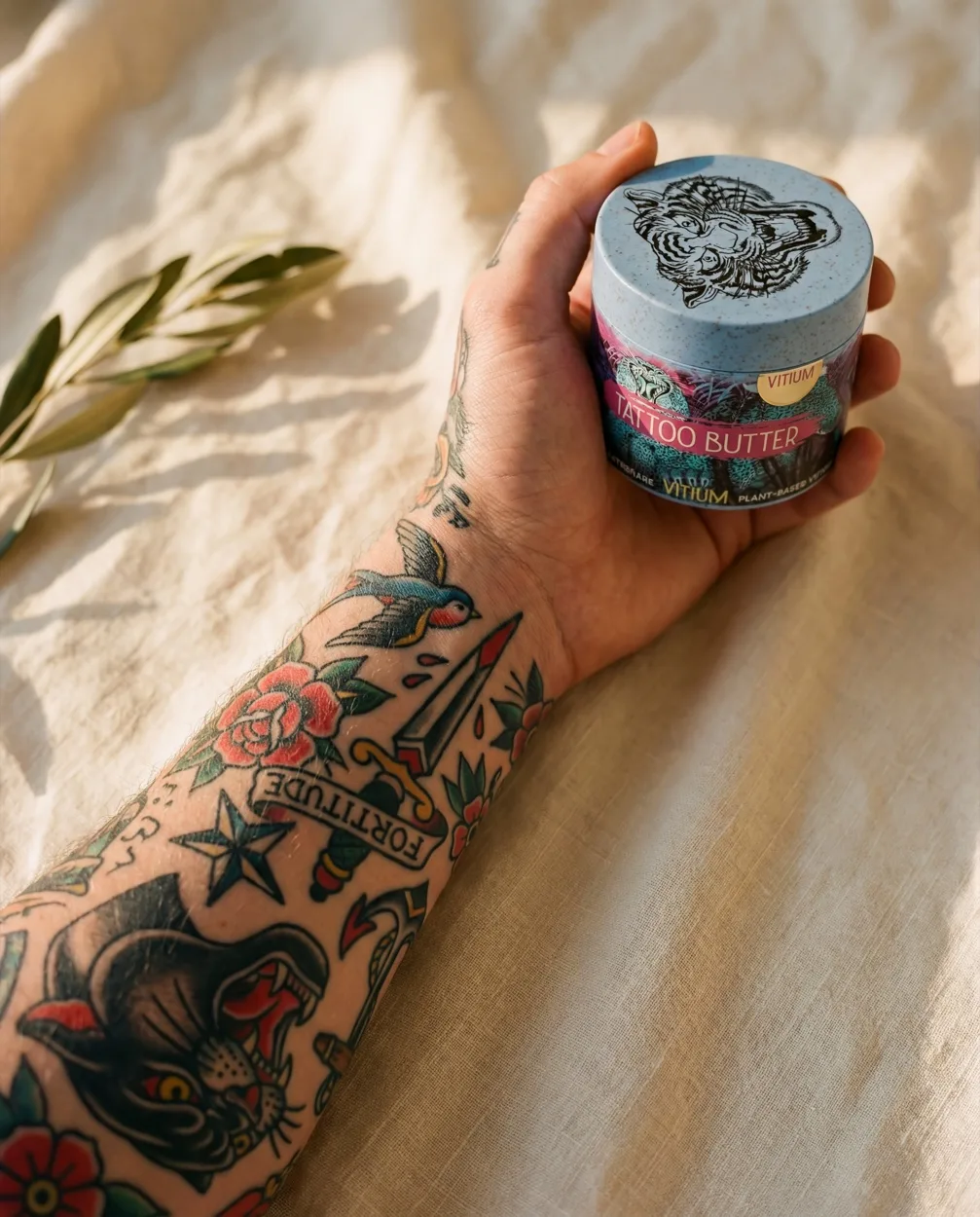
I’m not going to pretend I’m neutral about the aftercare side of this job. My partners and I spent two years in Sicily formulating a plant-based tattoo butter, with a respected Italian cosmetic manufacturer and a top Italian perfumer, because I was tired of watching good work go home under petroleum jelly. It’s called VITIUM Tattoo Butter, and it’s what sits on the counter in my own studio. If the shop you’re applying to stocks it, the product page will teach you the ingredient list in ten minutes. Studios that want to stock it will find the details on the artists and studios page.
But honestly, whatever butter is on the shelf, learn it well enough to explain it to a scared nineteen-year-old with a fresh forearm piece. That’s the part of the job nobody puts in the advert. The people who get hired are the ones who did it anyway.
The desk deserves it.
— Gabriele B. Tattoo artist · Co-founder, VITIUM