What’s Really In Plant-Based Tattoo Aftercare: An Honest Ingredient Guide
I spent two years arguing with chemists in Sicily over a jar of butter.
That’s not a metaphor. That’s a real stretch of time in my life — sitting across a steel table in a small Italian cosmetic facility, trying to understand why the shea butter we wanted was three times the price of the shea butter our manufacturer normally used. Why a specific oil needed to be macerated for forty days, not thirty. Why our Italian perfumer wouldn’t let us see the formula even after we paid for it.
I’m a designer, not a chemist. I came into this category because my best friend is a tattoo artist and he was watching his work get ruined by products marketed as “natural” that were, in fact, mostly cheap industrial base with a sprig of something botanical on top. I thought: how hard can it be to make a tattoo balm that’s actually what it says it is?
It turns out the answer is: it’s very hard. The plant-based skincare industry is built on a series of half-truths that are technically legal and entirely misleading. What I want to do in this article is walk you through what should actually be in a plant-based tattoo aftercare product — ingredient by ingredient, honestly. Including where the word “natural” stops meaning anything, and where the real craft lives.
This is the guide I wish I’d had before I started. If you’ve ever stood in front of a wall of tattoo balms trying to figure out which one isn’t lying to you, this is for you.

The problem with “natural” as a marketing word
Let me start with the thing that took me the longest to accept.
The word “natural” has no legal definition in most skincare markets. Not in the US, not in the UK, not across most of the EU. A product can be 95% industrial-grade filler and 5% botanical extract and still print “natural” on the front of the jar. An aftercare product can contain petrolatum as ingredient number one and call itself natural if it has a sprig of calendula floating somewhere in the formulation.
This isn’t a loophole. This is the actual state of the regulation.
What you can trust is the INCI list — the ingredients list on the back of the jar, in descending order of concentration. INCI is regulated. It has standardised names. It tells you exactly what’s in the product, in what proportion. The problem is that reading INCI is a skill, and most customers were never taught it. Brands count on that.
Here’s what I learned to look for, after two years of reading hundreds of aftercare labels:
First three ingredients matter most. By volume, those are 60-80% of the product. If they’re plant butters and oils, you’re looking at a real plant-based formulation. If they’re water, petrolatum, or something ending in “-siloxane,” you’re looking at a cosmetic base with a plant garnish.
Length of the list correlates inversely with quality. There are exceptions — well-formulated products sometimes need a few extra ingredients for stability — but a label with 40 entries is almost always a water-based emulsion loaded with cheap industrial fillers. A serious plant-based formulation usually lives in the 12-18 ingredient range. Enough for stability, not enough for hiding anything.
Latin names are a good sign. When you see Butyrospermum parkii instead of just “shea butter,” it usually means the brand is being precise. Binomial nomenclature is how the ingredient supplier identified what they shipped. If the label avoids the Latin, it’s either not reading its own INCI closely, or it doesn’t want you reading it closely either.
The label itself is a reference document, not a marketing surface. The real test of a fragrance is where the brand tells you about it in its own voice — on the website, in the packaging insert, in the product description. Serious brands can tell you who composed the scent, what the brief was, what notes are at the top and which carry through the base. Commodity brands skip that conversation entirely, because there's no story to tell — they bought a stock blend from a catalogue and poured it in.
The honest ingredient list — what a plant-based aftercare actually needs
Here’s what’s in a serious plant-based tattoo balm, by function. I’ll walk through it the same way I walked through our own formulation with the lab in Sicily, two years ago.

Base butters (60-70% of the formulation)
The structural foundation. These are the thick, waxy plant fats that give the product its body, its melt temperature, and most of its moisturising power.
Shea butter (Butyrospermum parkii) is the backbone of almost any serious aftercare. But shea is also where the grade game gets played hardest. Commodity shea — the stuff most drugstore products use — is deodorised, heat-treated, and stripped of the minor lipids that make the butter therapeutic. It’s a neutral, shelf-stable fat. Premium unrefined shea, often sourced from women’s cooperatives in West Africa, retains its full fatty acid profile and a trace amount of natural allantoin (a cell-regeneration compound). The price difference between the two grades is roughly 3-5x at wholesale. On the label, they’re both just called “Butyrospermum parkii butter.” You can’t tell which grade you bought. You can only tell from the texture, the smell, and the price of the finished product.
Mango butter (Mangifera indica) is the second structural butter in a good formulation. Lighter than shea, with a higher concentration of polyphenols and a slightly cooling feel on skin. Its natural SPF is around 4 — not enough to be called sunscreen, but a real effect. Good mango butter sourced from India or South America is melty at body temperature, which is why a well-made balm sinks in rather than sitting on top of your skin.
Cocoa butter (Theobroma cacao) is the third common base. Adds firmness to the final product — without it, a shea-and-mango formulation can feel greasy. Cocoa butter has a distinct smell that a perfumer has to work around in the fragrance composition; some brands avoid it for that reason. We kept it in ours because the texture payoff is worth the fragrance engineering challenge.
Carrier and infusion oils (15-20%)
These are the liquid oils that thin the butters, improve absorption, and act as infusion vehicles for botanical extracts.
Rice bran oil (Oryza sativa) and sunflower oil (Helianthus annuus) are the two I settled on. Both are high in linoleic acid, which is what healing skin actually needs. Sunflower oil specifically has been studied for its skin-barrier repair properties and is cheaper than jojoba or rosehip — and more effective for our purposes. Rice bran oil is lighter, absorbs faster, and has a natural concentration of gamma-oryzanol, a plant antioxidant.
The oils you don’t want to see in the first half of an aftercare label: mineral oil, petrolatum, silicone derivatives (anything ending in “-cone” or “-siloxane”). These are occlusive — they sit on top of skin, trap moisture under them, and are associated with clogged pores and pigment suppression on fresh tattoos.
Botanical actives (3-6%)
These are the small-percentage ingredients that do the specific therapeutic work — calming inflammation, speeding healing, reducing redness. Small amounts, real effects.

Aloe barbadensis leaf extract is the most proven anti-inflammatory botanical in skincare. Works across all skin tones. Small quantities — this isn’t pure aloe gel — but consistent presence.
Calendula officinalis (marigold flower extract) has been used in European wound care since the Middle Ages. Italian herbal medicine traditions included calendula macerations in olive oil for scrapes, bruises, and minor burns — my grandmother would have recognised the ingredient immediately. It calms redness and speeds skin closure on healing wounds.
Chamomilla recutita (chamomile extract) is calendula’s quieter cousin. More subtle effect, but adds to the overall anti-inflammatory character. When you see both in a formulation, the brand is layering botanicals rather than leaning on one headline ingredient.
Hypericum perforatum (Saint John’s Wort) is the one almost nobody uses, because doing it properly is expensive and slow. The active compounds only come out when the fresh flowers are macerated in oil for forty days — ideally sunlight-macerated in olive oil until the oil turns a deep red. I watched that process the first time I visited our manufacturer in Sicily. They had large demijohns of hypericum oil sitting in a south-facing window, slowly turning from yellow-green to rust-red over the weeks. That oil is one of the most effective skin-regenerating compounds in European herbal tradition. Most brands skip it because the supply is limited and the price per kilo is many times what a mass-produced alternative would cost.
Vitamin E — the antioxidant that keeps your colour
Vitamin E is the pigment preservative. It neutralises free radicals in the skin that would otherwise break down ink molecules over time. A tattoo protected with daily Vitamin E in year one looks noticeably sharper in year ten than one without — this is visible, real, and one of the most under-appreciated reasons to moisturise a tattoo for its entire life.
Where brands differentiate is in how much Vitamin E they actually include. Cheap aftercare puts in the bare minimum required to print “contains Vitamin E” on the front of the jar. Serious formulations pack a meaningful concentration into the mid-section of the INCI list, which tells you immediately that the brand is committing to the antioxidant function rather than performing it. If you see Vitamin E listed inside the first dozen ingredients on the back of the jar, the brand means it. If it’s listed at the bottom with the preservatives, it’s decorative.
The fragrance — where the real craft of this category lives

The fragrance in a plant-based tattoo butter is where cheap brands give themselves away fastest, and where serious brands spend most of their formulation budget.
Cheap fragrance comes from commodity aroma houses that sell stock blends by the kilo to hundreds of brands at once. The same sweet vanilla-coconut blend ends up in body washes, candles, air fresheners, and yes, tattoo balms. It costs under ten euros per kilogram. It’s stable, bright, obvious — you smell it from across a room. It also sits on top of the skin, often causes irritation on broken or healing areas, and fades to something flat and unpleasant within hours.
A real fragrance is composed by a perfumer. Ours was built by a top Italian perfumer, working to a brief we developed over months: “Tropical, but grown-up. Passion fruit and coconut on top, mango weaving through, with a warm oud twist in the base. Sweet enough to be seductive, not sweet like candy. Sensual, skin-close, warm — made to be worn on the inside of a wrist where a fresh tattoo is healing.” What he composed has depth, warmth, and a quiet sensuality that sits against your own skin rather than shouting across a room.
The cost per kilogram of a composed fragrance at this level is forty to a hundred times what a commodity mix costs. We pay it because skin recognises the difference. Our customers tell us this is the reason they buy once and then keep buying — not the plant-based base, not the ingredient list, but how the product actually smells on their skin over the course of a day. It’s the hardest part of the formulation to get right, and it’s the thing we’re most proud of.
What a well-labelled fragrance section looks like on an INCI
The label itself uses standard cosmetic nomenclature — the fragrance line is written the way regulation and industry convention require. What the rest of the INCI can still tell you about the quality of the composition is quiet but legible. When you check the back of a jar, these are the signals worth looking for:
A brand that tells you about its fragrance in its own voice. The label is standardised and can't carry a scent story. Serious brands fill that gap in their own content — they'll name who composed the scent, what it's built around (the essential oils, the top notes, the base), and the brief that shaped it. Brands that stay silent about their fragrance across their website and packaging usually have a commodity blend inside the jar and nothing to say about it.
Latin botanical names for any essential oils used in the composition. Entries like Pogostemon cablin oil (patchouli), Citrus aurantium (bergamot), or Rosa damascena (rose) tell you the perfumer layered real natural elements into the composition alongside the rest of the craft. A fragrance built with named essential oils is almost always more expensive and more wearable than a stock industrial blend — and more interesting to smell over a long wear.
A concise, coherent fragrance section rather than a sprawling list. Real perfumery is edited. A good composition is usually a small number of beautifully chosen elements, not a scattergun of fifteen obscure entries. When the fragrance section on an INCI looks intentional, that’s a sign the formulation was too.
How to tell a proper fragrance from cheap on any product
Apply it, wait thirty minutes, then smell again on the skin. Cheap fragrance will be flatter, louder, and already fading badly. A properly composed fragrance will have quietened down, layered with your own skin warmth, and left something wearable. A bad fragrance announces itself. A good one integrates.
Red flags — what to avoid in any aftercare label
After two years of this, I’ve developed a short list of instant disqualifiers. If I see any of these in an aftercare product, I don’t even consider it.
Petrolatum, petroleum jelly, mineral oil, paraffin. Petroleum derivatives at the top of a label mean the brand is building on the cheapest possible base. On fresh tattoos, these occlude the skin in a way that can trap bacteria, slow healing, and in some cases pull pigment out of the dermis during the healing weeks. My friend and business partner has spent ten years watching this happen to clients who followed bad aftercare advice. There’s no world in which a petroleum-based product is the right choice for a healing tattoo.
A brand that can't tell you about its fragrance anywhere. The label is standardised — that's just how cosmetic labelling works. But if you check the product page, the About section, the packaging insert, and there's no description of who composed the scent, what the brief was, or what character they were aiming for, that silence usually tells you the fragrance was picked from a commodity catalogue and nobody wants to elaborate. Real perfumery comes with a story. Stock blends don't.
PEG compounds, sodium laureth sulfate, other surfactants. These belong in shampoos, not in an aftercare product. If a “tattoo balm” has these in it, you’re looking at a rebranded body wash.
Formaldehyde-releasing preservatives. Look for DMDM hydantoin, imidazolidinyl urea, quaternium-15, or 2-bromo-2-nitropropane-1,3-diol. These are cheap, effective preservatives that slowly release formaldehyde to keep products bacteria-free. You don’t want a formaldehyde-release system on a fresh tattoo. Safer preservative options exist (phenoxyethanol and tocopherol-based systems) that do the same job without the release chemistry.
Artificial dyes. Listed as “CI” followed by a five-digit number, or “FD&C” and a colour name. A plant-based aftercare has no reason to contain a dye. If it’s been dyed, something is off.
Packaging is the first ingredient to read

I came to this category as a designer, and I’m going to end with the design part — because the container is telling you something about the product before you even open it.
Sugarcane-derived jars — the kind we use — are one of the cleanest packaging options available for a plant-based formulation. Sugarcane-sourced material is carbon-negative in its manufacture (the plant absorbs CO₂ as it grows), it doesn’t leach into fatty formulations the way petroleum-based plastic can, and it’s a genuinely plant-based container for a plant-based product. It’s the only packaging choice we considered seriously.
Opaque jars are almost always better than clear. Light degrades plant actives — particularly the oils. Calendula extract in a transparent container on a bathroom shelf loses potency measurably faster than the same extract in an opaque one. Brands that use clear or showy packaging are usually prioritising shelf appeal over formulation integrity.
Pump bottles vs open jars is a trade-off. A pump protects the formulation from contamination (your fingers carry bacteria, particularly relevant for a product you’re putting on a fresh tattoo). An open jar is more tactile, feels more like a ritual product, and preserves the plant-butter aesthetic. We went with jars because the product is a butter, not a lotion — it wouldn’t pump properly anyway, and the ritual of dipping into a jar feels right for the category. Different formulations justify different choices.
The font on a label tells you what kind of company you’re dealing with. I know this sounds ridiculous, but I’m a designer and it’s true. Brands that hired a junior designer to set Helvetica in two sizes and called it done are communicating something different from brands that commissioned a custom typeface. Neither is good or bad intrinsically — but pay attention. The care that goes into the label tends to track with the care that goes into the formulation.
Where these ingredients actually come from
One last thing worth knowing: the sourcing story behind a plant-based formulation is mostly invisible to the end customer, but it’s where most of the real quality difference lives.
Our shea butter comes from cooperatives in West Africa. Our mango butter from India. Our hypericum is macerated in Sicily from flowers picked during the saint’s-day window in late June. Our fragrance is composed by a professional Italian perfumer with a relationship to one of the country’s established fragrance houses. The product is formulated and filled at a respected cosmetic manufacturer in Sicily — a facility where my partner visits in person during every new production run to sign off on quality.
That last part matters. A formulation is only as good as the batch that actually gets made. The brands cutting corners are usually cutting them in production — substituting grades, rushing maceration, using older ingredient stocks. Having someone who made the formulation be the same person who checks the batch is a discipline that most brands don’t bother with. It’s the unglamorous part of craft. It’s also the difference between a product that’s consistent and a product that’s only good when the boss is watching.
Frequently asked questions
Is plant-based tattoo aftercare really different from plant-based body lotion?
Yes, usefully different. Most body lotions are water-based emulsions built for all-over daily use — they’re roughly 70-80% water and 20-30% oils/actives. That ratio works for dry skin on your legs but is wrong for healing tattoo skin, which needs a higher concentration of lipids to support barrier repair. A plant-based aftercare balm is 90-95% oils and butters with just enough stabilisers to hold the formulation together. The concentration of botanicals that actually does therapeutic work is higher. You use less product per application, and the application feels more like conditioning leather than moisturising skin.
Can I trust a “fragrance-free” product more than a scented one?
Not automatically. “Fragrance-free” usually just means the brand didn’t want to spend on a real fragrance composition — and brands that cut corners on fragrance often cut corners on other parts of the formulation too. A well-composed fragrance in a plant-based balm is a quality signal, not a concern. What matters is whether the fragrance was built by a perfumer or picked from a commodity catalogue, and that you can usually tell by the brand’s willingness to describe the scent character on the label rather than hide behind a generic word.
How do I tell if a brand is just slapping “plant-based” on their marketing?
Look at the top of the ingredient list on the back of the jar. You want plant butters and oils leading — Latin names like Butyrospermum parkii (shea), Mangifera indica (mango), Helianthus annuus (sunflower), Oryza sativa (rice bran) — with a composed fragrance earning its place among them. Fragrance is the single most expensive line item in a premium formulation, so its presence near the top of a serious plant-based product is a signal of investment, not a red flag. What you don't want to see opening the list: water, glycerin, petrolatum, mineral oil, or silicone derivatives. If any of those dominate the top, the "plant-based" claim is living in the last 10% of the formulation. The front of the jar can say anything. The back of the jar doesn't lie.
What should ALWAYS be in a tattoo balm, and what should NEVER be?
Always: a plant butter as the first or second ingredient (shea, mango, cocoa), Vitamin E in meaningful concentration, at least one anti-inflammatory botanical (calendula, chamomile, aloe, hypericum).
Never: petrolatum, mineral oil, paraffin, cheap drugstore fragrance, formaldehyde-releasing preservatives, artificial dyes, SLS or other sulfates.
How long does plant-based tattoo aftercare last once opened?
A well-formulated plant-based butter has a PAO (Period After Opening) of 12 months — marked on the label with a small jar icon and “12M.” Some formulations push to 18 months if the preservation system is robust. The actual shelf life depends on how clean your dipping hands are, whether the jar lives in a bathroom (humid + warm, bad) or a cooler cabinet (better), and the quality of the antioxidants in the formulation. Rule of thumb: if the butter smells rancid, has darkened, or has changed texture, replace it regardless of date.
Can I use food-grade plant oils (olive, coconut, shea from the kitchen) as tattoo aftercare?
Technically you can, but you shouldn’t as your primary product. Food-grade oils don’t contain the botanical actives (calendula, hypericum, aloe) that do the specific healing work on tattooed skin. They also lack preservation systems, so a jar of plain shea from your kitchen will turn rancid within weeks if you’re dipping fingers into it daily. As an emergency moisturiser when you’ve run out of proper aftercare, a spoonful of unrefined coconut or olive oil will do less harm than petrolatum. As a long-term strategy, a properly formulated plant-based aftercare is genuinely better.
Why we did this
I’m not going to pretend I’m neutral. My partners and I built this product over two years, and we care about it in a way that makes objective reviews hard.
But the reason we built it wasn’t to sell a miracle product — it was to close the gap between what plant-based tattoo aftercare claims to be and what most of it actually is. Most of the category is dishonest. Not maliciously, usually — just carelessly. Formulations built around commodity-grade shea, cheap stock fragrance dressed up as craft, petrolatum hidden in the back half of a long label, packaging that prioritises shelf appeal over product integrity.
What we made is a small-batch artisan product, not a mass-produced myth. It’s made in Italy at a facility where the machines sometimes break down and we have to wait two weeks for a production run to resume. Some batches come out with a very slightly different colour from the previous one because that year’s shea butter harvest was different. That’s the cost of working with real plant ingredients at grade instead of deodorised commodities, and we accept it.
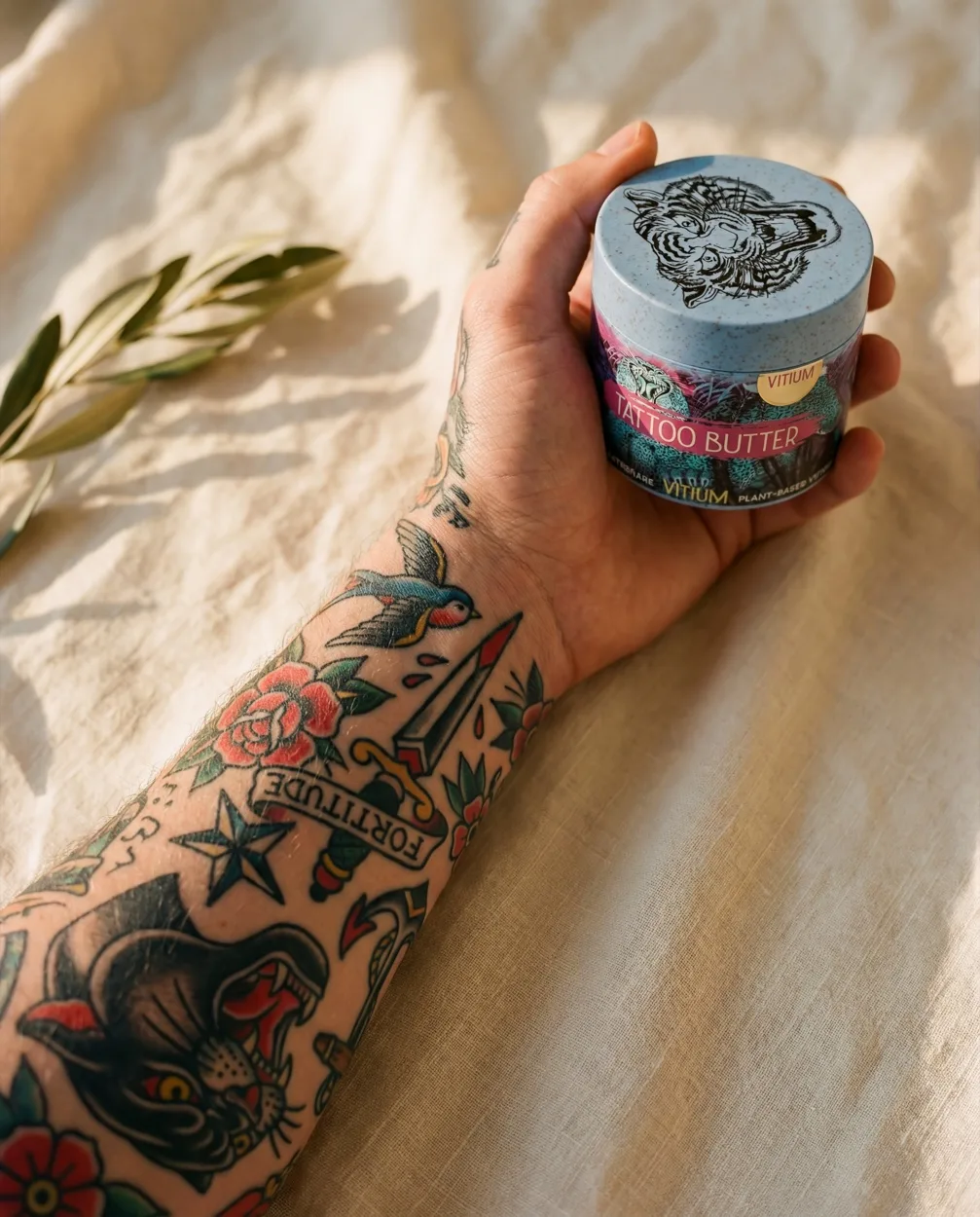
What VITIUM is, is plant-based, vegan, crafted in Italy, composed with a perfumer’s care, and built to be what plant-based aftercare is supposed to be — without the shortcuts the rest of the category takes. That’s the bar we set for ourselves, and it’s higher than most of this category clears today.
If you want to read the practical counterpart to this piece — what to actually do with the stuff, day by day, when you have a fresh tattoo — my partner Gabriele wrote his guide to natural tattoo aftercare from the tattoo artist’s side of the chair. And if you want to see the product we’ve been obsessing over, it’s on our product page.
Either way, read labels. Read them closely. The brands that deserve your money are the ones that will reward the closer reading.
For how these ingredients come together in a finished balm, see our guide to tattoo butter.
— Damiano C. Co-founder & Creative Director, VITIUM