The Working Person’s Ink Dilemma
There exists, in our modern world, a rather delicious irony that I feel compelled to share with you. The very professions that built our civilisation—the electricians who illuminate our homes, the welders who forge our infrastructure, the carpenters who construct our sanctuaries—are often the most magnificently adorned with tattoo artistry. Yet these same noble vocations present perhaps the most formidable challenges to keeping said body art in pristine condition. It’s rather like discovering that professional swimmers are the ones most likely to have issues with moisture damage to their wristwatches.
If you find yourself among the ranks of those who earn their keep through physical labour, wielding tools rather than keyboards, and you harbour aspirations of joining the inked fraternity (or have already done so), then I invite you to settle in for what promises to be an illuminating discourse on the art of tattoo preservation in demanding work environments.
Understanding the Battleground: What Your Job Does to Your Ink
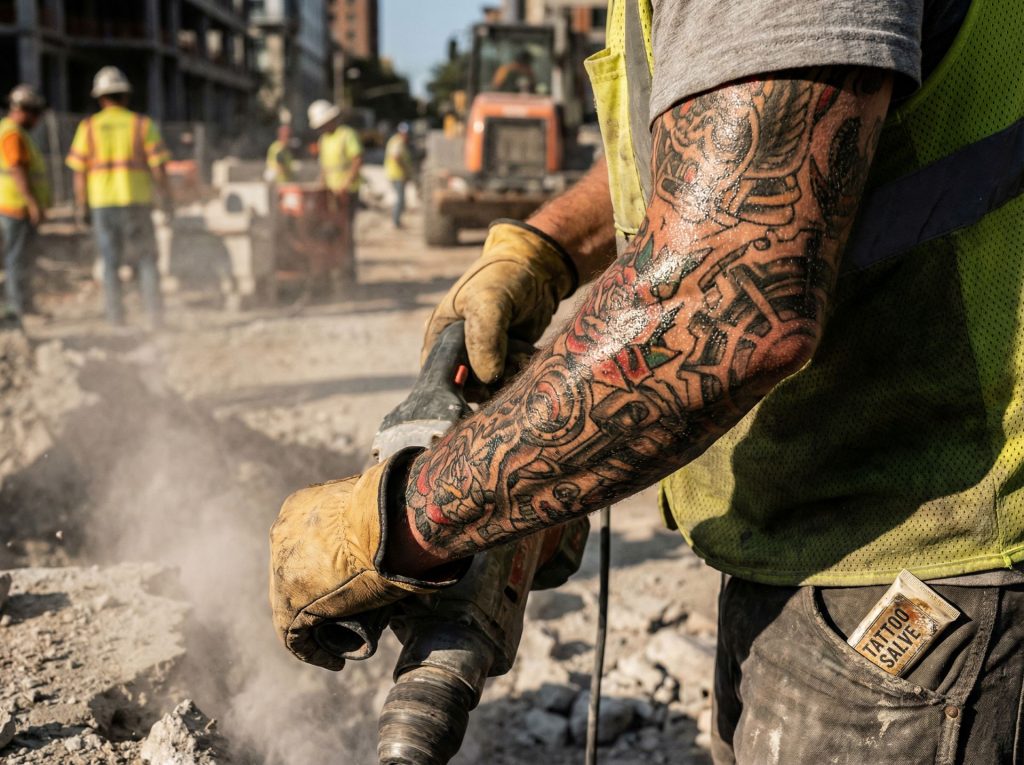
Before we discuss solutions, we must first understand the nature of the beast we’re confronting. Your body, you see, recognises a fresh tattoo as something rather alarming—essentially, an open wound peppered with foreign particles. The dermis, that second layer of skin where your tattoo ink resides, is desperately trying to heal whilst simultaneously playing host to pigment molecules that, quite frankly, it never invited to the party.
Now, imagine subjecting this delicate biological process to the particular indignities of a construction site or workshop. We’re talking about a veritable rogues’ gallery of assailants: dust particles that would make a Victorian chimney sweep weep, ultraviolet radiation streaming down like an overzealous spotlight, friction from clothing and equipment that treats your skin like a particularly aggressive cheese grater, and enough perspiration to fill a modest swimming pool.
Research from dermatological studies, including those referenced by the National Institutes of Health, confirms what any tattooed tradesperson suspects: UV radiation causes what scientists call photodegradation—essentially, the sun is attempting to perform its own version of laser tattoo removal, free of charge and without your consent. The pigments in your tattoo contain chromophores, those marvellous light-absorbing molecules, and when UV rays strike them with sufficient enthusiasm, they break apart like a poorly constructed flatpack bookshelf.
Strategic Placement: Thinking Like a Chess Master
The first consideration for any tradesperson contemplating a tattoo—or indeed, planning their next piece—is strategic placement. This requires the sort of forward-thinking usually reserved for military campaigns and choosing which queue to join at the supermarket.
Consider your daily activities with the cold, analytical eye of a surgeon. If you’re a roofer, perhaps that stunning piece on your outer forearm might be subjected to more solar bombardment than the Sahara Desert. If you’re a plasterer, maybe that inner bicep would be rather more protected than, say, your hands—which, I must say, are rather impractical locations for tattoos in almost any trade, given the constant abuse they endure.
The torso—particularly the chest and upper back—offers excellent protection from both sun exposure and mechanical abrasion, provided you’re wearing a shirt (which one rather hopes you are). The inner forearm receives considerably less UV exposure than its outer counterpart, making it a rather clever choice for detailed colourwork that you’d prefer didn’t fade to the consistency of an old newspaper left on a windowsill.
Similarly, the upper thigh enjoys almost permanent protection from the elements—unless your workplace dress code is considerably more liberal than most. For those working in particularly grimy environments, consider that covered placements also mean less contact with the sort of industrial contaminants that would give a health and safety inspector nightmares.
The First Fortnight: Surviving Fresh Ink on the Job Site
The initial healing period—roughly two to four weeks—represents the most perilous time for your new artwork. This is when your tattoo is most vulnerable to infection, UV damage, and all manner of calamities that would result in your beautiful design resembling something created by an enthusiastic toddler with access to permanent markers.
The golden rule, if such a thing must be distilled: keep it clean, keep it covered, and for heaven’s sake, keep it out of direct sunlight. Now, I appreciate that this presents something of a logistical challenge when your livelihood requires you to be outdoors or in less-than-sterile environments. One cannot simply take a month’s sabbatical every time one fancies a new piece.
The solution lies in breathable protective barriers. Medical-grade films such as Saniderm or similar products have revolutionised the process for those in physical professions. These transparent, waterproof coverings allow the skin to breathe whilst protecting against dust, sweat, and bacterial contamination. However—and this is rather crucial—they must be applied correctly and changed appropriately. Think of them as a very sophisticated plaster rather than a permanent seal.
For those without access to such products, or once you’re past the initial bandage phase, loose-fitting clothing becomes your stalwart ally. We’re talking garments that cover the tattoo without clinging to it like a desperate ex-partner. The fabric should be light, breathable, and preferably dark enough that any inadvertent ink or ointment transfer won’t leave you looking like you’ve been in a fight with a ballpoint pen.
Midday Menaces: Combating Sun Exposure
If your profession requires outdoor work, you’re essentially engaged in a long-term custody battle with the sun over the vibrancy of your tattoos. The American Academy of Dermatology recommends broad-spectrum sunscreen of at least SPF 30 for general skin protection, and this becomes doubly important for tattooed skin.
Now, a critical caveat: sunscreen should never be applied to a fresh tattoo during the initial healing period. The chemicals in even the gentlest formulations can irritate the healing wound and potentially affect the way ink settles in the skin. During those first two to three weeks, physical coverage is your only option. Once healed, however, sunscreen becomes as essential as your morning cup of tea.
For the working person, practical considerations matter enormously. Look for water-resistant formulations that won’t immediately dissolve in sweat—because let’s be honest, physical labour and perspiration are rather intimate acquaintances. Reapplication every two hours is the official recommendation, though I recognise this might be optimistic when you’re up a scaffold or elbow-deep in engine components. At minimum, apply before work and during your lunch break.
UV-protective sleeves and clothing have become increasingly sophisticated and are worth investigating. These garments offer consistent protection without the need for constant reapplication, and some are designed specifically for active wear—wicking away moisture whilst blocking harmful rays. Rather like having a personal bodyguard for your body art.
The Grime Factor: Keeping Clean in Dirty Environments
Dust, dirt, and various industrial substances pose particular threats to both healing and established tattoos. For fresh ink, any contamination risks infection—and if you’ve ever seen what an infected tattoo looks like, you’ll understand why prevention is considerably preferable to cure.
The solution for fresh tattoos is straightforward if somewhat inconvenient: keep it covered during work, then clean it promptly when you have access to potable water and gentle, fragrance-free soap. If you’re on a construction site, use bottled water rather than whatever mysterious liquid emerges from the communal tap. Your dermis will thank you.
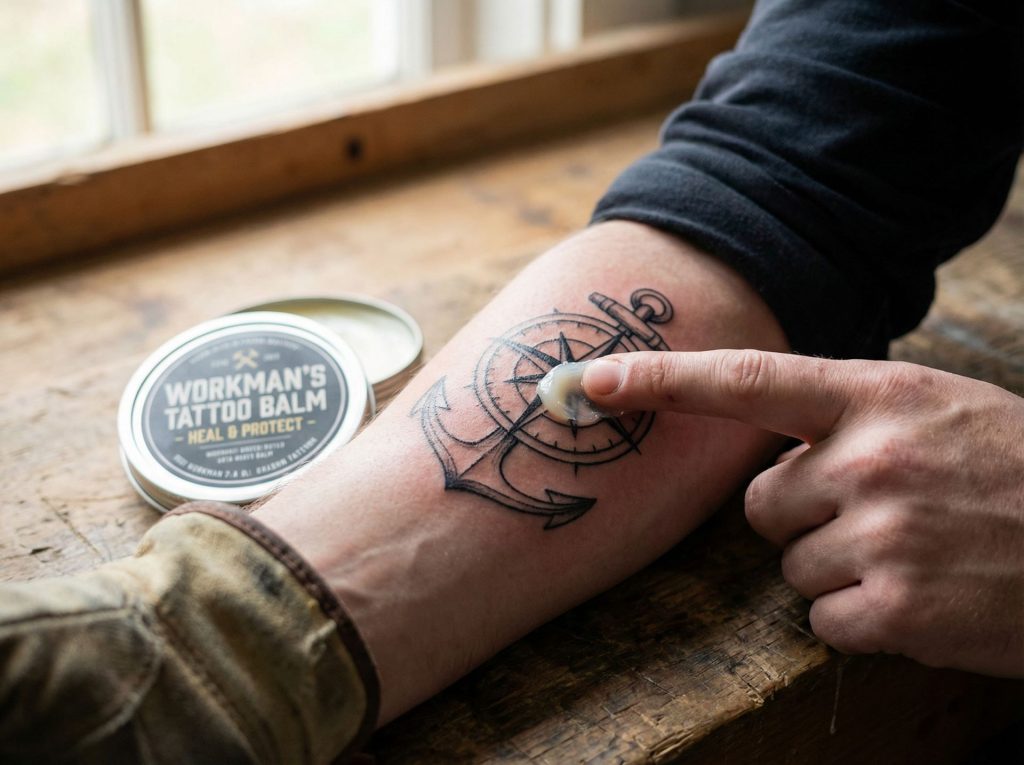
For healed tattoos, regular cleaning removes accumulated grime that can dull the appearance of your ink over time. Develop an end-of-workday ritual: gentle cleansing followed by proper moisturisation. Speaking of which, quality tattoo-specific aftercare products designed for professional-grade care make an enormous difference in long-term colour retention. These formulations typically contain ingredients that support skin health whilst keeping the dermis properly hydrated—crucial for maintaining that fresh-ink vibrancy years down the line.
Friction and Physical Stress: The Silent Saboteurs
Here’s something that often escapes consideration until it’s too late: physical friction can significantly impact tattoo healing and longevity. Straps, tool belts, harnesses, protective equipment—all of these can create constant rubbing against your skin that interferes with healing and, over time, contributes to premature fading.
The solution requires some advance planning. If you know you’ll be wearing a particular piece of equipment regularly, consider whether the placement of your tattoo will conflict with it. An electrician who constantly wears a tool belt might want to avoid hip tattoos, whilst someone who regularly wears shoulder-supported equipment might reconsider that deltoid piece.
For existing tattoos or unavoidable equipment interactions, padding can help. Some tradespeople use soft fabric barriers between equipment and tattooed skin, whilst others adjust straps to avoid direct contact with their artwork. It’s rather like protecting a valuable painting from the frame rubbing against it—common sense preservation that requires minimal effort once you’ve established the habit.
Long-Term Maintenance: The Marathon Approach
Here’s the thing about tattoos that many people fail to appreciate: they’re not just a one-time investment requiring a healing period and then permanent neglect. They’re rather more like classic cars—requiring ongoing maintenance to keep them looking their best, particularly if they’re regularly exposed to harsh conditions.
Daily moisturisation keeps skin supple and helps maintain ink vibrancy. Sun protection becomes a lifelong companion rather than a temporary inconvenience. Occasional touch-ups from your artist can restore definition and colour that time and exposure have diminished—think of it as routine servicing rather than major repairs.
For tradespeople, this maintenance mindset should feel familiar. You maintain your tools because neglect leads to malfunction. Apply the same principle to your body art, and you’ll find that even the most demanding work environment needn’t spell doom for your tattoos.
Colour Considerations: What Fades and What Holds
A brief word on pigment selection, as this becomes particularly relevant for outdoor workers. Scientific research confirms that certain colours demonstrate greater photostability than others. Black ink, particularly carbon-based formulations, tends to be the most resilient against UV degradation. Blues and greens containing phthalocyanine pigments also hold up reasonably well.
Reds, yellows, and particularly whites are the most vulnerable to fading. This doesn’t mean you must resign yourself to monochromatic designs—simply that colourful pieces require extra vigilance in protection. If you work outdoors regularly and your heart is set on a vibrant, multi-coloured piece, consider placement in areas that receive less direct sun exposure, or accept that touch-ups may be needed more frequently than for someone who works indoors.
The Practical Philosophy: Ink That Works as Hard as You Do
There’s something rather poetic about tattoos on working hands—the juxtaposition of art against the evidence of honest labour, of permanent beauty existing alongside calluses and the occasional industrial scar. Tattoos in the trades represent a particular commitment: not just to the art itself, but to the ongoing care required to preserve it despite conditions that would make a dermatologist wince.
The working person’s tattoo is, in many ways, a testament to determination. It requires planning where others might act on impulse, maintenance where others might coast on luck, and protection where others might trust to chance. But then again, these are precisely the qualities that define skilled tradespeople in the first place.
So go forth, ink-curious craftspeople of the world. Plan your placement with strategic wisdom, protect your investment with military precision, and maintain your artwork with the same dedication you bring to your trade. Your tattoos may face more adversaries than those belonging to office workers and sedentary types, but with proper care, they’ll survive—and indeed thrive—as lasting testaments to both your personal expression and your professional pride.
After all, if your body can handle the demands of a physically demanding profession, it seems only fair that it should be allowed to look rather magnificent whilst doing so. And that, dear reader, is simply good sense.