Ah, the delicious complexity of human relationships! We navigate the treacherous waters of romance armed with nothing more than good intentions and, increasingly it seems, permanent ink. The intersection of tattoos and intimacy presents one of the more fascinating anthropological developments of our age, a subject upon which I find myself compelled to offer some observations. You see, when we choose to mark our bodies permanently, we are making a statement not merely to the world at large, but to everyone who might ever see us in states of undress. And therein lies a rather wonderful complexity that deserves our careful attention.
The Psychology of Revealing Your Ink
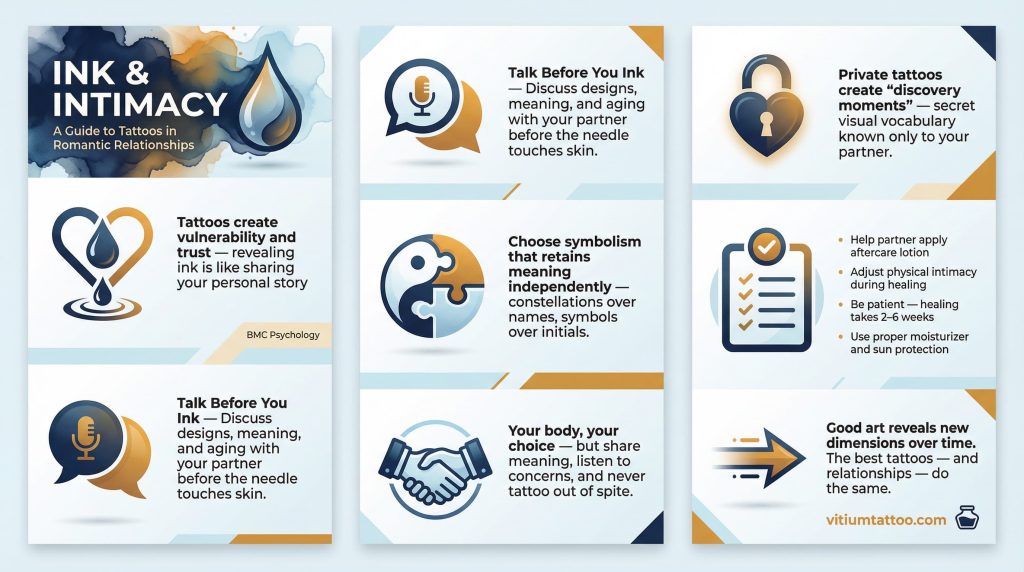
There exists a peculiar vulnerability in the revelation of a tattoo to an intimate partner. It is, in many ways, akin to showing someone your teenage poetry, that rather terrifying moment where you expose something deeply personal and hope desperately that they do not laugh or, worse still, appear politely disinterested. Research from BMC Psychology suggests that individuals with tattoos often report higher levels of body appreciation and self-expression. When translated into the context of intimacy, this creates a fascinating dynamic. Your partner is not merely seeing skin adorned with ink; they are witnessing a curated museum of your personal history, beliefs, and aesthetic sensibilities. The placement of tattoos carries its own psychological weight in intimate contexts. That discreet piece on your hip or ribcage, invisible to the wider world, becomes a secret shared only with those who see you at your most vulnerable. It is rather like having a wonderful inside joke, except this particular joke is permanently embedded in your dermis and cost considerably more than a witty observation at a dinner party.
Communication: The Bedrock of Inked Relationships
Now, here is where things become genuinely interesting. The decision to get a tattoo, particularly when one is in a committed relationship, requires what the psychologists rather clinically call “dyadic communication.” In plain English, this means actually talking to your partner about it. I have witnessed many a domestic disagreement sparked by unexpected body art. One rather memorable instance involved a gentleman who surprised his wife with her name tattooed across his chest in elaborate Gothic script. The gesture was intended as romantic; the execution, however, left something to be desired, particularly as he had opted for a slight misspelling that transformed “Catherine” into “Catharine,” a variant that belonged to neither his wife nor any of his known acquaintances. The solution to avoiding such unfortunate incidents lies in asking the right questions before the needle ever touches skin. This applies equally to conversations with your tattoo artist and your romantic partner. Consider the following: How might this design age? Will it still feel meaningful in twenty years? And crucially, does your partner have strong feelings about whether your shared surname should be permanently emblazoned anywhere upon your person?
Matching Tattoos: Romance or Regret?
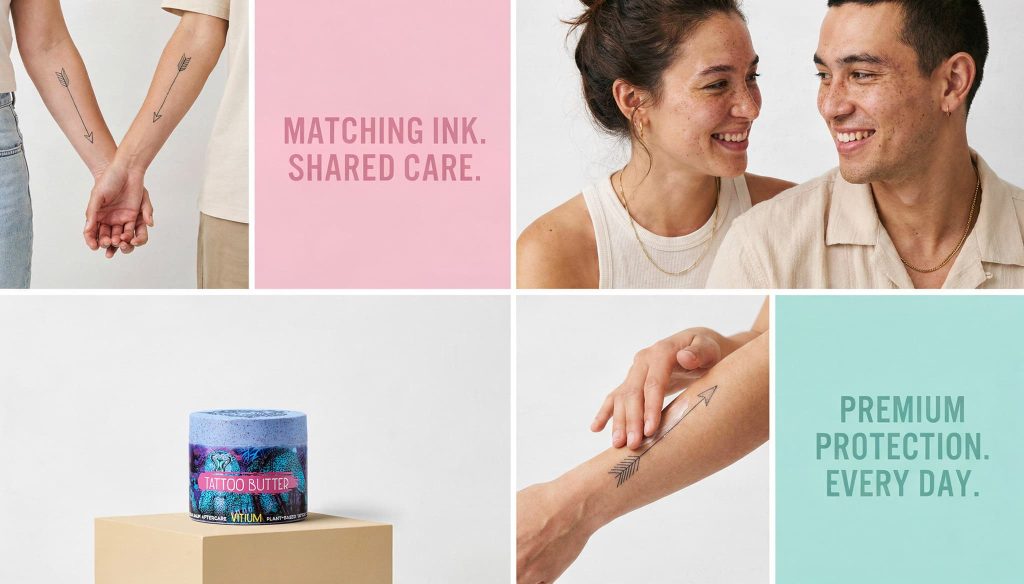
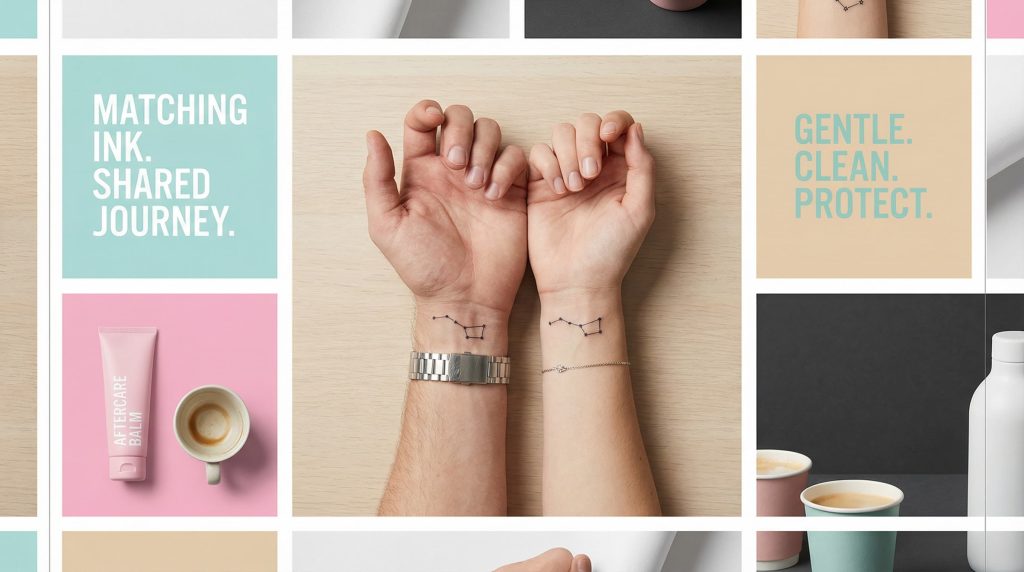
The phenomenon of couples getting matching tattoos deserves particular examination. On one hand, it represents a rather touching commitment to permanence in an age of disposable everything. On the other hand, well, statistics regarding relationship longevity are not entirely encouraging. The psychology of tattoo placement becomes especially relevant here. Couples who choose matching designs for visible locations are making a public declaration of their bond, rather like wearing matching Christmas jumpers except considerably more permanent and significantly less likely to feature a cartoon reindeer. Those who opt for more intimate placements, areas that remain covered in professional settings, are creating a private language of symbols known only to each other. There is something rather lovely about this, a secret visual vocabulary that exists solely within the confines of your relationship. However, I feel duty-bound to mention that the tattoo removal industry has experienced remarkable growth, and a not insignificant portion of their clientele arrives clutching faded memories of relationships past. The lesson here is perhaps to choose symbolism that retains meaning independent of the relationship itself. A shared love of astronomy, for instance, might be commemorated with matching constellation designs that remain personally significant even should the relationship encounter gravitational difficulties.
The Intimate Canvas: Body Art Below the Collar Line
Let us address, with appropriate delicacy, the matter of tattoos in intimate locations. The decision to place permanent artwork on areas that are typically reserved for close personal acquaintance carries its own unique psychological implications. For many individuals, particularly those emerging from periods of personal transformation, such tattoos represent reclamation of bodily autonomy. The act of choosing what adorns your most private real estate is profoundly empowering, a statement of ownership over one’s own physical form that can be particularly meaningful for survivors of various forms of trauma. In the context of romantic relationships, these intimate tattoos create what might be termed “discovery moments.” There is something genuinely delightful about learning something new about a person you thought you knew entirely. That unexpected design revealed for the first time adds a layer of intrigue to even the most established relationship. The practical considerations, however, should not be overlooked. Certain anatomical regions are notoriously painful to tattoo, and the healing process for intimate placements requires additional care and patience. One must be prepared for temporary adjustments to one’s romantic calendar whilst the body does its remarkable work of incorporating that ink into its structure.

When Partners Disagree About Body Art
Not every relationship approaches the subject of tattoos with perfect harmony. Disagreements about body modification can strike at fundamental questions of autonomy, aesthetic preferences, and mutual respect. The essential principle here is reasonably straightforward: your body belongs to you. However, relationships exist in a more complex space where individual autonomy intersects with partnership consideration. A thoughtful approach might include explaining the design process to your partner, sharing the symbolism and personal meaning behind your chosen piece, and genuinely listening to their concerns without necessarily being bound by them. What one must studiously avoid is obtaining body art specifically designed to provoke or upset a partner. Passive-aggressive tattooing, whilst theoretically amusing, tends to create rather more problems than it resolves.
Aftercare: A Team Sport
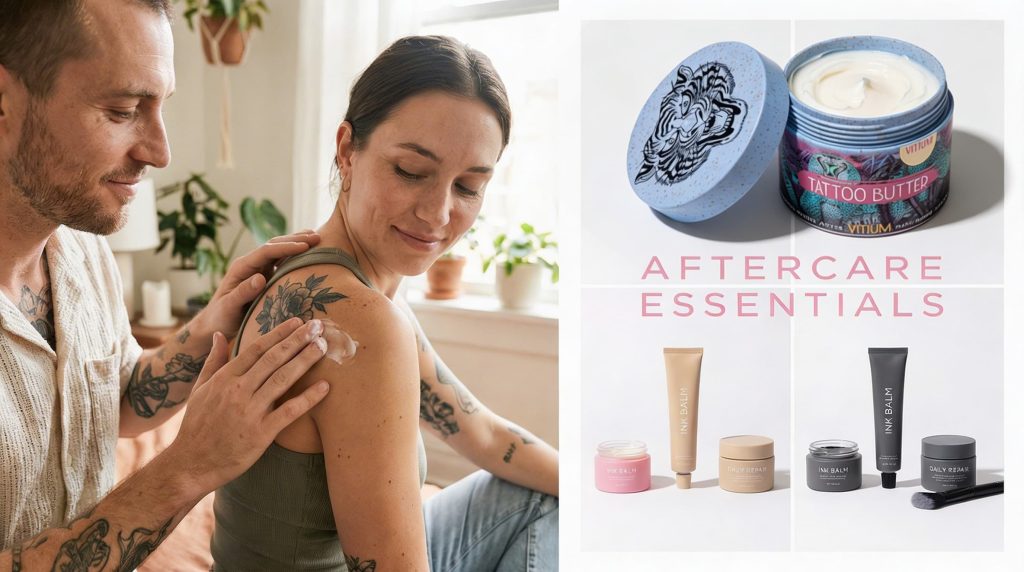
Here is an aspect of tattoo intimacy that receives insufficient attention: the healing process. Fresh tattoos require diligent aftercare, and in romantic relationships, this often becomes a collaborative endeavour. There is something unexpectedly intimate about helping a partner apply aftercare lotion to a tattoo in a location they cannot easily reach. It requires trust, gentleness, and a willingness to take responsibility for another person’s healing. In many ways, it mirrors the broader dynamics of a healthy relationship: showing up consistently, paying attention to what the other person needs, and resisting the urge to pick at things that need time to heal. The metaphor practically writes itself. Proper aftercare also means temporary adjustments to physical intimacy. Fresh tattoos and friction are not the best of companions, which requires honest conversation about what activities might need to be approached with additional caution during the healing period. This enforced patience can, paradoxically, strengthen a relationship by reminding both partners that some things are worth waiting for.
The Long View: Aging Together with Ink
Finally, we must consider how tattoos age alongside relationships. That fine-line design which looked positively ethereal at thirty may require some maintenance and protection to retain its beauty at fifty. Bodies change, skin loses elasticity, and tattoos migrate and fade in ways that might be described as either “developing character” or “requiring a touch-up,” depending on one’s perspective. Couples who have been together for decades often find that their tattoos become part of their shared history, visual markers of who they were at particular moments in their relationship. That somewhat questionable tribal design from 1997 becomes not an embarrassment but a time capsule, a reminder of the people you were when you first fell in love. The key to navigating this gracefully is the same principle that applies to aging in general: approach it with humour, maintain what can be maintained through proper skincare and sun protection, and accept that the alternative to getting older with your tattoos is considerably less appealing.
Final Thoughts on Ink and Intimacy
The relationship between tattoos and romantic intimacy is, like all matters of the heart, gloriously complicated. Body art can serve as a catalyst for deeper conversations, a symbol of shared commitment, or simply an aspect of personal expression that a supportive partner celebrates rather than merely tolerates. What seems clear is that the most successful navigation of this territory requires the same qualities that successful relationships require in general: honest communication, mutual respect for individual autonomy, and a willingness to appreciate that your partner is an endlessly complex person who might, at any moment, surprise you with a phoenix emerging from their left shoulder blade. For those considering a thoughtful approach to placement and design, I would simply encourage you to consider not merely how the tattoo looks today, but how it might feel to show it to someone you love, someone you have not yet met, or someone you have been with for decades. Good art, after all, continues to reveal new dimensions with repeated viewing. The best tattoos, and the best relationships, do precisely the same.