The Intrepid Traveller’s Guide to Getting Inked Abroad
There exists a particular breed of traveller—and I suspect you may be among them—for whom the acquisition of refrigerator magnets and overpriced snow globes simply won’t do. These adventurous souls seek souvenirs that cannot be lost in transit, misplaced in hotel rooms, or confiscated by overzealous customs officials. They seek something rather more… permanent. I speak, of course, of the growing phenomenon known as tattoo tourism: the delightfully mad pursuit of collecting ink from the world’s most remarkable destinations.
Now, before you dismiss this as the exclusive domain of gap-year students and motorcycle enthusiasts, consider that combining travel with tattooing represents perhaps the most authentic form of souvenir-collecting imaginable. Unlike that questionable sombrero gathering dust in your wardrobe, a tattoo acquired abroad becomes quite literally part of you—a permanent reminder of a moment, a place, a cultural exchange that no amount of baggage fees can diminish.
But here’s the rub, as the Bard might say: getting tattooed abroad isn’t quite as straightforward as pointing at a flash design and hoping for the best. It requires research, cultural sensitivity, and a rather robust understanding of what separates a transcendent experience from a regrettable one. Shall we explore together? Excellent. Do keep up.
The Sacred and the Profane: Understanding Cultural Significance
Before we dive headlong into destination recommendations, we must address the proverbial elephant in the room—or rather, the Buddha on one’s bicep. You see, tattooing in many cultures isn’t merely decorative; it carries profound spiritual and ancestral significance that demands our respect as visitors.
Thailand’s Sak Yant: Sacred Geometry with Strings Attached
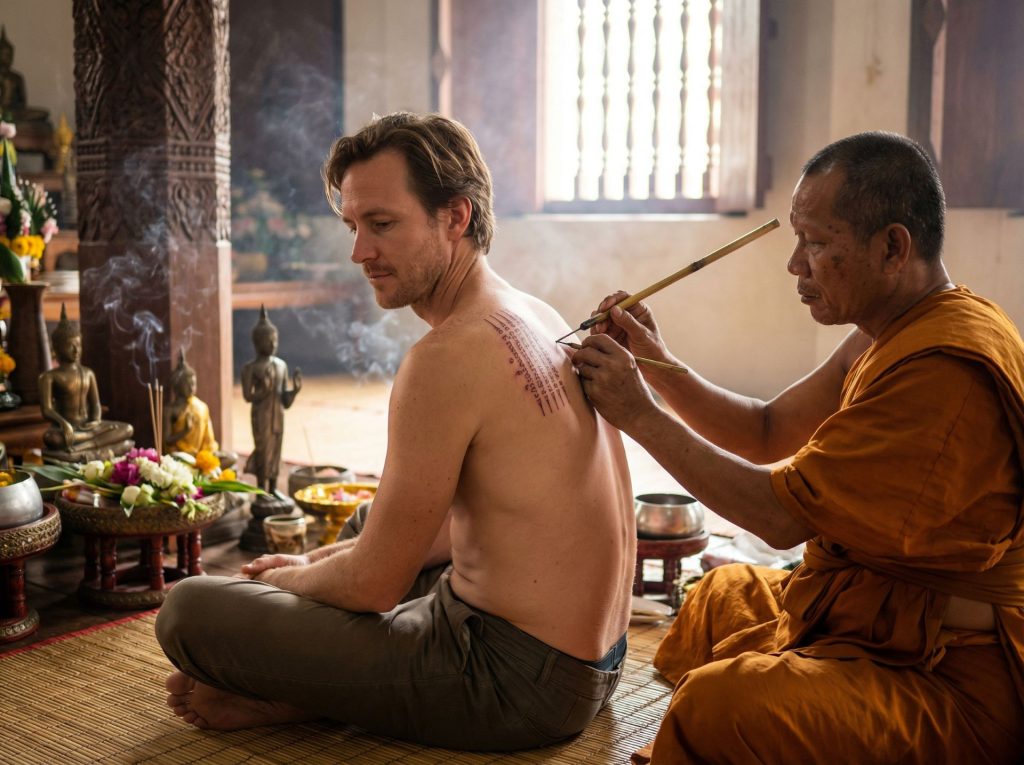
The Sak Yant tradition of Thailand and Southeast Asia represents perhaps the most spiritually charged tattoo practice a traveller might encounter. These aren’t mere designs; they’re believed to confer genuine magical protection and blessings upon the wearer. Buddhist monks and spiritual masters called ajarns traditionally administer these tattoos using a long metal rod or bamboo needle in ceremonies that involve chanting, meditation, and the offering of respect.
Here’s the crucial bit: receiving a Sak Yant traditionally requires the recipient to follow certain rules called Sila—prohibitions that might include abstaining from specific foods, behaviours, or actions. Break these rules, the belief goes, and your magical protection evaporates faster than a puddle in the Sahara. If you’re merely after an “authentic-looking” design without any intention of honouring its spiritual requirements, you might consider whether you’re participating in cultural exchange or cultural extraction. The distinction matters rather a lot.
Furthermore—and this cannot be stressed emphatically enough—Buddha imagery on the body is considered deeply offensive in Thailand and Sri Lanka. The Thai government officially deems such tattoos “culturally inappropriate,” and tourists have been detained and deported for displaying Buddha tattoos below the waist, where the body is considered spiritually impure. If you already possess such a tattoo, do keep it covered during your travels in Buddhist countries. Consider this your official warning.
New Zealand’s Tā Moko: Identity Written in Skin
The Māori people of Aotearoa New Zealand have practised tā moko for over a thousand years, using chisels rather than needles to carve designs into the skin. But here’s what every well-intentioned tattoo tourist must understand: tā moko is not merely decorative art. It is a visual language encoding one’s whakapapa (genealogy), tribal affiliations, social standing, and personal achievements. Each design is as unique as a fingerprint and as personal as a biography.
For non-Māori to receive traditional tā moko—particularly the moko kanohi (facial tattoo) or moko kauae (chin tattoo for women)—is widely considered cultural appropriation of the most egregious sort. It would be rather like tattooing military medals onto oneself without having served, or wearing a doctoral gown to Tesco having never darkened a university’s doorstep.
However, Māori culture has thoughtfully developed an alternative: kirituhi, which translates roughly as “skin art.” Kirituhi designs are created by Māori artists specifically for non-Māori recipients, employing Māori-inspired patterns without claiming the ancestral significance of true tā moko. This represents cultural sharing at its finest—respectful, collaborative, and honest about what is and isn’t appropriate. If Māori artistry calls to you, seek out a Māori artist who offers kirituhi, and approach the conversation with humility and genuine curiosity.
Japan’s Irezumi: Art, Stigma, and the Onsen Dilemma
Japanese tattooing, or irezumi, represents perhaps the most technically sophisticated tattoo tradition on the planet. The traditional hand-poked method called tebori produces shading and colour gradients that modern machines struggle to replicate—though tebori requires significantly more time, sessions, and financial commitment than machine work.
Here’s where it gets complicated: despite Japan’s extraordinary tattoo heritage, the practice carries profound social stigma domestically. Since the Edo period, tattoos have been associated with criminality and, more recently, with the yakuza organised crime syndicates whose members traditionally sport elaborate full-body work. This association means that tattooed individuals—Japanese and foreign alike—are frequently barred from onsen (hot springs), gyms, swimming pools, and certain ryokan (traditional inns).
The situation is evolving, particularly in tourist-heavy areas, but remains a practical consideration. A 2023 survey found that 44% of Japanese respondents still believe tattoos should be strictly prohibited in public baths. If you’re planning a tattoo pilgrimage to Japan, research tattoo-friendly onsen in advance, consider booking ryokan with private baths, and pack cover-up stickers for any tattoos you already possess. The Japanese Tourism Agency has compiled resources for tattooed visitors—do avail yourself of them.
As for getting tattooed in Japan itself, understand that you’re entering a culture where the artist-client relationship is built on trust and respect. Many traditional irezumi artists prefer to work with clients over extended periods, building both the tattoo and the relationship gradually. Walk-in appointments for elaborate work are uncommon; planning, patience, and proper introductions are the order of the day.
Destination Showcase: Where to Get Inked Around the World
Having established the importance of cultural sensitivity, let’s turn to the rather more exciting business of where exactly one might seek excellent ink abroad. Each destination offers distinct advantages, styles, and considerations.
Bali, Indonesia: Paradise with Needles
Bali has emerged as Asia’s premier destination for tattoo tourism, and not without reason. The island combines world-class artists, competitive pricing, and—let’s be honest—the rather appealing prospect of recovering from your session while gazing at rice terraces rather than grey urban sprawl.
Seminyak, in particular, has developed a concentration of studios offering everything from traditional Balinese blackwork to contemporary realism. Competition has driven standards remarkably high, with reputable studios maintaining hygiene protocols that would satisfy any Western inspector. That said, the very accessibility that makes Bali attractive also means tourist traps exist—establishments where sterility is more aspiration than practice.

The Indonesian legal tattooing age is 18, and reputable studios will require identification. Expect to pay significantly less than Western prices for comparable quality, though “cheap” should never be your primary criterion when someone is inserting ink into your dermis.
Berlin, Germany: Europe’s Ink Capital
If Berlin were a tattoo, it would be bold, unconventional, and utterly unconcerned with anyone’s expectations. The German capital has cultivated perhaps Europe’s most innovative tattoo scene, attracting artists whose waiting lists stretch into years rather than months.
Chaim Machlev’s Dots to Lines studio exemplifies Berlin’s approach: geometric perfection customised to each client’s body, with designs that flow organically with the wearer’s form. His two-year waiting list speaks to both the quality of work and the premium placed on personalisation. Other studios like Sticks and Stones have earned recognition as among Europe’s most LGBTQ+-friendly establishments—Berlin’s progressive spirit manifesting in permanent ink.
European Union regulations ensure consistent safety standards across German studios, providing an additional layer of reassurance for the cautious traveller.
Barcelona, Spain: Where Tradition Meets Mediterranean Flair
Spain’s tattoo culture benefits from remarkably liberal attitudes—the country hosts some of Europe’s oldest continuously operating studios, including Mao & Cathy, which traces its roots to 1978 Ibiza. Barcelona’s scene blends traditional European styles with innovative contemporary work, all set against the architectural backdrop of Gaudí’s masterpieces.
Studios like 19:28 Tattoo Parlour embody the city’s “come as you are” attitude, while LTW has operated since 1996 specialising in traditional Japanese work—proving that authentic technique knows no national boundaries. The city’s underground scene, accessible through Instagram hashtags like #BarcelonaTattoo, reveals experimental artists pushing boundaries in ways that more commercial establishments might shy from.
London, United Kingdom: The Historic Hub
London’s tattoo heritage stretches back centuries—the city where Winston Churchill’s mother, Lady Randolph Churchill, reportedly sported a snake tattoo on her wrist. Today’s scene ranges from traditional establishments like Frith Street Tattoo to avant-garde studios like Sang Bleu, known for pushing aesthetic boundaries.
What London offers above all is diversity: quite literally any style, any approach, any level of fame or obscurity, can be found somewhere within the M25. The challenge lies in research and booking—popular artists fill their schedules months in advance, particularly for larger work.
The Safety Imperative: A Non-Negotiable Checklist
I cannot stress this emphatically enough: a tattoo is a medical procedure that introduces foreign substances beneath your skin. The difference between a transcendent experience and a hepatitis diagnosis often comes down to the hygiene practices you observe before committing to a studio. Here’s what to look for:
Before Your Appointment
Research the studio extensively. Google reviews are helpful; Instagram portfolios are essential. Look for healed work, not just fresh tattoos—how a piece looks six months later tells you far more than how it appears still glistening with ointment. Seek out recommendations from experienced collectors rather than relying solely on walk-by impressions.
Verify licensing and certification. Many countries require tattoo establishments to register with health authorities. Ask to see credentials. A legitimate studio will display these proudly; one that hesitates or obfuscates should send you promptly out the door.
Schedule a consultation. Particularly for larger work, never commit without meeting the artist first. A consultation allows you to assess the studio’s cleanliness, the artist’s communication style, and whether the collaboration feels right. Trust your instincts—if something feels off, it probably is.
During Your Session
Watch for these non-negotiable safety indicators:
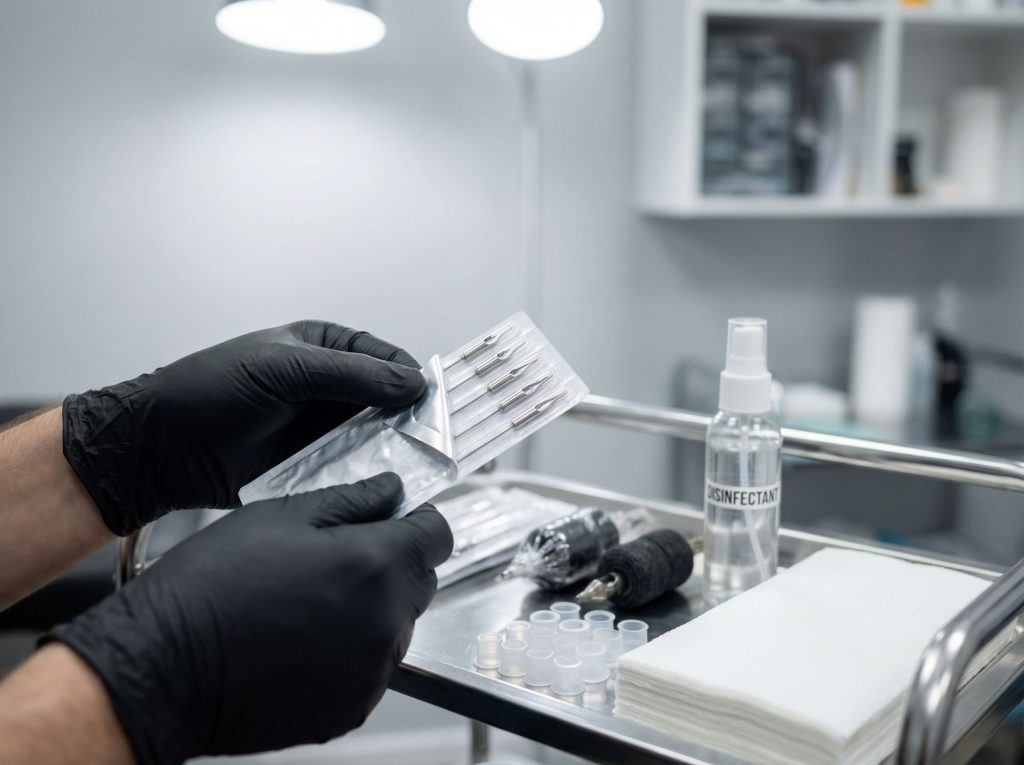
Needles: Must be removed from sealed, sterile packaging in front of you. No exceptions. Ever. If you see pre-loaded needles or anything suggesting reuse, leave immediately.
Ink: Should be poured into single-use caps, never shared between clients. Reputable studios use high-quality, non-toxic inks with verifiable sourcing.
Surfaces: Everything your skin might contact—chair, armrest, any surface—should be covered with fresh disposable barriers. The artist should wear fresh gloves and change them if they touch anything non-sterile.
Sterilisation: Ask about their autoclave protocol for reusable equipment. A studio that can’t clearly explain their sterilisation procedures likely doesn’t have adequate ones.
The Travel Aftercare Conundrum
Getting tattooed while travelling introduces complications that our stay-at-home friends simply don’t face. Your fresh tattoo—which is, medically speaking, an open wound—must heal while you’re swimming in unfamiliar waters, quite literally and figuratively.
Timing Is Everything
The ideal scenario involves getting tattooed toward the end of your trip rather than the beginning. This allows you to enjoy swimming, beach activities, and intensive sightseeing before your new ink demands its healing regimen. Schedule your session at least 48 hours before flying if possible—cabin pressure and recirculated air aren’t exactly a fresh tattoo’s best friends.
If you absolutely must get tattooed at the trip’s start, resign yourself to strict aftercare protocols that will limit certain activities:
The Traveller’s Aftercare Commandments
No swimming for 2-4 weeks. This includes pools, oceans, lakes, rivers, hot tubs—essentially anything more substantial than a gentle shower. Chlorine can bleach your ink; ocean bacteria can infect your wound; hot tubs are essentially petri dishes with good marketing. If your holiday revolves around water activities, perhaps delay the tattoo until your next adventure.
Avoid direct sun exposure. UV radiation is the mortal enemy of fresh ink, causing fading before the tattoo has even properly healed. Keep your new artwork covered with loose, breathable clothing. Once healed (typically 4-6 weeks), always apply SPF 30-50 sunscreen to tattooed areas before sun exposure—this applies for the rest of your tattooed life, not merely the healing period.
Beware questionable water supplies. If you wouldn’t drink the local water, you certainly shouldn’t shower an open wound in it. In destinations with unreliable water quality, consider bottled water for washing your tattoo during the initial healing phase.
Pack an aftercare kit. Include fragrance-free soap, unscented moisturiser, and any products your artist specifically recommends. These can be surprisingly difficult to source abroad, particularly in languages you don’t speak. Travel-size containers keep you compliant with airline liquid restrictions.
Dress appropriately. Loose, breathable fabrics prevent friction against healing skin. That backpack strap rubbing against your fresh shoulder piece? Recipe for disaster. Plan your luggage and clothing choices with your tattoo placement in mind.
Choosing What to Get: The Traveller’s Dilemma
The question of what to tattoo while abroad merits careful consideration. Some travellers seek designs intrinsically connected to their destination—Japanese motifs in Tokyo, Polynesian patterns in New Zealand, geometric mandalas in Bali. Others prefer to work with a specific artist regardless of subject matter, travelling to access that particular talent.
Both approaches have merit, but consider this: destination-specific tattoos carry additional responsibility. If you’re drawn to tribal or traditional styles, ensure you understand their cultural significance. A Samoan pe’a isn’t a design to be copied casually; Japanese imagery carries specific meanings that might embarrass if misunderstood.
When in doubt, consult your chosen artist about appropriate designs. A reputable practitioner will guide you away from culturally problematic choices and toward alternatives that honour both your intentions and their traditions.
The Placement Question for Travellers
Where you place your travel tattoo affects both the experience and the aftermath. Some considerations specific to the travelling life:
Avoid high-friction areas if you’ll be carrying luggage, wearing backpacks, or engaging in physical activities post-session. The ideal placement minimises contact with straps, waistbands, and anything that might rub during your continued travels.
Consider visibility relative to your remaining destinations. That neck tattoo might be perfectly acceptable in Berlin but could create complications if you’re heading to conservative regions afterward. Japan, for instance, will present additional challenges for visibly tattooed travellers seeking access to onsen and certain establishments.
Think about clothing. If your remaining trip involves formal events, restaurant dress codes, or professional meetings, a placement easily covered by standard attire provides flexibility your inner forearm or neck cannot offer.
The Final Word: Souvenirs Worth the Effort
Tattoo tourism, done well, represents travel at its most meaningful. You’re not merely passing through a place; you’re carrying it with you, permanently integrated into your very being. The experience of sitting in a studio in a foreign city, communicating your vision across language barriers, trusting a stranger with your skin—these moments become the story the tattoo tells.
But the rewards demand proportional respect: for the cultures whose traditions you’re engaging, for the artists whose expertise you’re commissioning, and for your own body that will wear this decision forever. Research thoroughly. Prepare adequately. Approach each interaction with humility and genuine curiosity.
Do all this, and you’ll return home with something infinitely more valuable than any trinket a gift shop could offer—a piece of the world made permanently, beautifully, irrevocably yours.
Now then. Where shall we book?