There exists a peculiar phenomenon in the human experience, one that combines the permanence of stone with the fickleness of a British summer—and that, dear reader, is the tattoo. We etch designs into our very dermis with all the conviction of a zealot, only to find ourselves, some five years hence, staring at our reflection with an expression somewhere between bemusement and mild horror. How terribly, magnificently human of us.
The statistics, as they so often do, tell rather a compelling story. Research published in the Journal of Clinical and Aesthetic Dermatology suggests that approximately one in four tattooed individuals experiences some degree of regret about at least one of their pieces. That’s roughly 25% of the inked population wondering why on earth they thought a tribal armband or an ex-lover’s name emblazoned across their chest was ever a sound decision. But the truly fascinating question isn’t that we regret—it’s why we regret, and why it takes approximately five years for these feelings to crystallise into full-blown existential crisis.
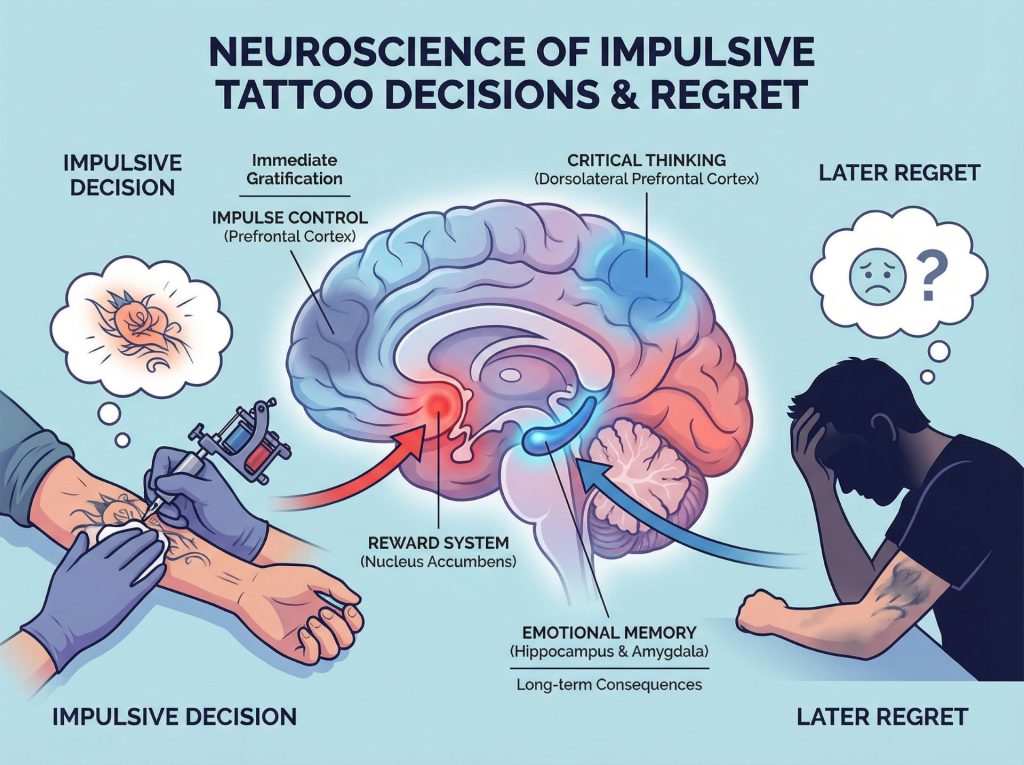
The Neurochemistry of Impulsive Decisions
Let us begin, as all good scientific inquiries should, with the brain—that extraordinary three-pound universe nestled between our ears. When we decide to get a tattoo, particularly in our younger years, we’re operating with what neuroscientists rather diplomatically call an “incompletely developed prefrontal cortex.” This is the part of the brain responsible for long-term planning, impulse control, and the ability to envision future consequences. It doesn’t fully mature until we’re approximately twenty-five years old, which rather explains why so many regrettable tattoo decisions are made in our late teens and early twenties.
The decision to get inked is often accompanied by a delightful cocktail of dopamine and adrenaline—neurochemicals that make us feel invincible, certain, and gloriously alive. This neurological symphony drowns out the quieter voice of reason that might otherwise whisper, “Are you absolutely certain you want ‘Live Laugh Love’ permanently inscribed upon your person?” The anticipation of the tattoo triggers the brain’s reward pathways with all the subtlety of a brass band in a library. We’re chemically primed to feel magnificent about our decision, at least initially.
The Five-Year Phenomenon: Why Time Changes Everything
Now, here’s where it gets genuinely interesting. The five-year mark isn’t arbitrary—it represents something rather profound about human psychological development. Research from the American Psychological Association indicates that our sense of self undergoes significant shifts in roughly five-year cycles. Our values evolve, our aesthetic preferences transform, and our understanding of who we are deepens in ways we couldn’t possibly have anticipated.
Consider this: the person you were five years ago likely had different musical tastes, different political views, and possibly even different friends. That individual made decisions based on circumstances, emotions, and understandings that may no longer apply. The tattoo remains frozen in time while you—wonderfully, inevitably—have not. It’s rather like wearing the same outfit every single day for five years; eventually, even the most cherished garment begins to feel less like a choice and more like a sentence.
Psychologists refer to this as the “end of history illusion”—our tendency to acknowledge that we’ve changed tremendously in the past whilst simultaneously believing we won’t change much in the future. Harvard psychologist Daniel Gilbert’s research demonstrates that people consistently underestimate how much their preferences, values, and personalities will shift over time. We recognise our past selves as rather different creatures, yet we’re convinced our present self has finally arrived at some permanent truth. The tattoo artist’s needle, unfortunately, cannot distinguish between temporary enthusiasm and eternal conviction.
The Psychology of Placement and Personal Evolution
The location of a tattoo proves remarkably predictive of future regret. Visible tattoos—those on hands, necks, and faces—carry significantly higher regret rates than more discreet placements. This isn’t merely about professional consequences, though those certainly factor in. It’s about the daily confrontation with a decision made in a different life chapter.
When researchers at the University of Westminster surveyed tattooed individuals, they found that context-dependent tattoos—those commemorating specific relationships, events, or phases of life—generated more regret than abstract or aesthetic choices. That butterfly representing your gap year in Thailand remains charming; your ex-partner’s face rendered in photorealistic detail across your shoulder blade becomes somewhat problematic when you’ve moved on to pastures new.
The phenomenon extends to design trends as well. Remember the lower back tattoo craze of the early 2000s? Or the infinity symbol epidemic that swept through social media? These trend-driven decisions age rather less gracefully than timeless, personally meaningful designs. They become archaeological evidence of a particular cultural moment, forever marking their bearer as someone who was, at one point, very much of their time.
The Biological Reality: How Tattoos Age
There’s a biological dimension to tattoo regret that deserves attention. Your skin, that magnificent organ covering approximately twenty square feet of your person, changes dramatically over time. Collagen production decreases, elasticity diminishes, and the crisp lines of your twenty-year-old tattoo begin to blur and spread like watercolour left out in the rain.
According to dermatological research published in the British Journal of Dermatology, tattoo ink particles—typically measuring between one and two micrometres—are gradually attacked by your immune system over time. Macrophages, those industrious white blood cells tasked with cleaning up foreign particles, continuously attempt to break down and remove the pigment. They’re fighting a losing battle, but their persistent efforts cause the tattoo to fade and spread, particularly in areas subject to sun exposure.
The fading isn’t uniform, which creates its own aesthetic challenges. Different pigments deteriorate at different rates—blues and blacks tend to hold their ground while yellows, oranges, and certain greens retreat like politicians from unpopular policies. That vibrant sunset on your forearm may eventually resemble something more akin to a muddy afternoon. Understanding proper tattoo aftercare from the beginning can significantly impact how gracefully your ink ages.
The Social and Professional Dimension
Let us address the elephant in the room—or rather, the skull and crossbones on the forearm during a job interview. While society has become considerably more accepting of tattoos, certain professional environments remain stubbornly resistant. A 2019 study in the Journal of Retailing and Consumer Services found that visible tattoos could negatively impact perceptions of competence in customer-facing roles, particularly in conservative industries.
The regret here isn’t necessarily about the tattoo itself—it’s about the constraints it places on future possibilities. That gorgeous sleeve looked rather magnificent at music festivals, but it becomes somewhat inconvenient when your career trajectory leads you toward corporate boardrooms or conservative professional settings. The person who got the tattoo and the person who needs the career may be the same individual, separated only by time and circumstance.
This is why the consultation process with a skilled tattoo artist proves so valuable. A thoughtful professional will ask questions about your lifestyle, career aspirations, and long-term vision—not to discourage you, but to ensure your decision serves your future self as well as your present one.
The Paradox of Meaningful Tattoos
Here’s a delicious irony: the tattoos that carry the most meaning at the time of creation are often the ones most likely to generate future regret. Memorial tattoos for deceased loved ones, commemorations of romantic relationships, or tributes to life achievements all seem perfectly reasonable—essential, even—at the moment of their creation.
Yet research from Texas Tech University suggests that these emotionally-charged decisions are precisely the ones we’re least equipped to make rationally. When we’re grieving, in love, or celebrating triumph, our judgment is clouded by what psychologists call “hot state” decision-making—we’re literally incapable of accurately predicting how we’ll feel about the choice when we’ve returned to emotional equilibrium.
This doesn’t mean meaningful tattoos are inherently problematic. Indeed, many people find deep, lasting satisfaction in ink that commemorates significant life moments. The key distinction lies in the reasons people get tattoos and the deliberation involved. Tattoos chosen after careful reflection during emotionally stable periods tend to age far better than those decided upon in moments of intensity.
The Redemption Arc: Cover-Ups and Removal
Should you find yourself among the regretful, take heart—you’re in excellent company, and modern technology offers genuine solutions. Laser tattoo removal has advanced remarkably since its early, rather brutal incarnations. Contemporary Q-switched and picosecond lasers can break down ink particles into fragments small enough for your immune system to finally dispose of them properly.
The process isn’t precisely pleasant—former patients describe it as akin to being snapped repeatedly with a hot rubber band whilst someone pours bacon grease on the wound—but it is effective. Complete removal typically requires multiple sessions over twelve to eighteen months, and results depend significantly on ink colours, skin tone, and tattoo age. Black ink responds best; green and blue prove more stubborn; white and yellow may never fully disappear.
Alternatively, the art of the cover-up tattoo offers creative redemption for those who’d rather transform than erase. A skilled cover-up artist can work remarkable magic, turning your ex-lover’s name into a beautiful floral arrangement or your questionable tribal design into something altogether more sophisticated. It’s rather like editing a first draft—the original never entirely disappears, but something considerably better emerges from the revision.

The Surprising Benefits of Tattoo Regret
Here’s a perspective that may startle you: tattoo regret, while uncomfortable, serves a valuable psychological function. It provides concrete evidence of personal growth and change. That cringe you feel when looking at your twenty-year-old self’s ink choices? It’s actually a sign of psychological health—you’ve evolved, matured, and developed more sophisticated tastes and values.
Research from the Journal of Personality and Social Psychology suggests that the ability to recognise past decisions as suboptimal is correlated with higher emotional intelligence and greater capacity for self-reflection. Your regretted tattoo isn’t a mark of shame—it’s a permanent record of your capacity for growth. Wear it, if you will, as a badge of human imperfection.
Moreover, the experience of making a permanent decision and living with its consequences—whether positive, negative, or somewhere in between—builds what psychologists call “dispositional acceptance.” You learn that you can survive your own questionable choices, that identity is fluid enough to accommodate past mistakes, and that perfection isn’t a prerequisite for a meaningful life.
Practical Wisdom for Future Decisions
For those contemplating their first—or next—tattoo, the science of regret offers valuable guidance. First, wait. If an idea seems brilliant today, it should seem equally brilliant in three months or a year. The truly meaningful designs will retain their appeal; the impulses will fade.
Second, choose placement strategically. Consider your likely life trajectory and the flexibility you may want in five, ten, or twenty years. A design that works equally well visible or concealed provides options that more prominent placements cannot.
Third, invest in quality. Work with reputable artists who take time to understand your vision and offer professional guidance. A well-executed tattoo ages infinitely better than a bargain-basement job, and the additional cost pales against years of living with the result. Review their portfolio across various design styles before committing.
Finally, embrace timelessness over trends. The tattoo that reflects your authentic self rather than a passing cultural moment will serve you far better than the design that seemed daring or fashionable at the time.
Conclusion: The Permanent Record of a Changing Self
Tattoo regret, in the end, is simply the collision between permanence and change—between the fixed mark on the skin and the endlessly evolving person beneath it. We are, all of us, works in progress, and it would be rather miraculous if every decision we made at twenty-two continued to satisfy us at forty-two.
The five-year phenomenon exists because that’s roughly how long it takes for us to become meaningfully different people—different enough that the choices of our former selves begin to feel foreign. It’s not weakness or poor judgment; it’s simply the glorious, messy reality of human growth.
Whether you’re currently sporting ink you adore, ink you tolerate, or ink you’re actively planning to remove or transform, remember this: your relationship with your tattoos is merely another chapter in the ongoing story of who you are. Some chapters age better than others, and that’s perfectly, wonderfully, irredeemably human.
After all, if our twenty-year-old selves made nothing but excellent decisions, we’d have far less amusing material for dinner party conversations. And where, I ask you, would be the fun in that?