Ah, love! That magnificent, maddening, utterly irrational force that compels otherwise sensible human beings to do the most extraordinary things. We write sonnets. We serenade beneath balconies. We endure the excruciating ordeal of meeting one another’s parents over Sunday roast. And increasingly, we make that most permanent of romantic declarations: we get matching tattoos.
Now, before you dash off to inscribe your beloved’s name across your chest in Gothic script, I implore you to pause for a moment. Let us examine this phenomenon together with the same rigour one might apply to selecting a vintage Bordeaux or, indeed, choosing a life partner. For while a relationship tattoo can be a sublime testament to enduring love, it can also become what we might delicately term “permanent evidence of temporary feelings.” 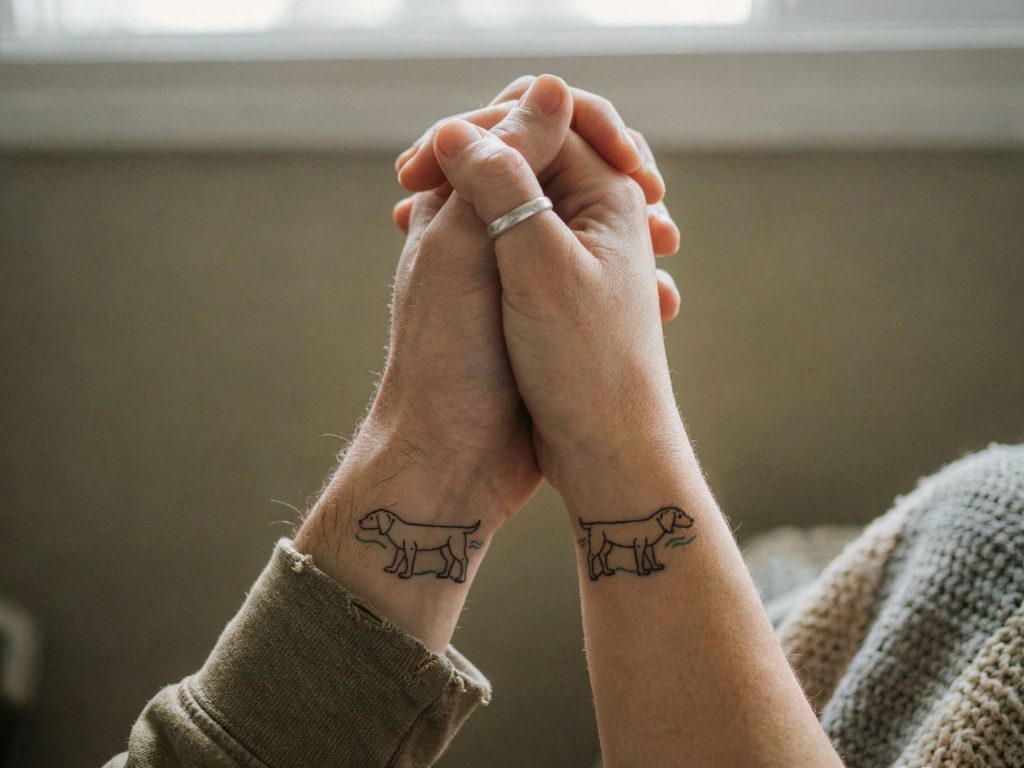
The Science Behind Romantic Ink: What Psychology Tells Us
The human brain, that magnificent three-pound universe between your ears, does rather peculiar things when one falls in love. Neuroscientists at institutions such as the National Institutes of Health have documented that romantic love triggers a veritable cocktail party of neurochemicals. Dopamine surges through your reward centres, oxytocin floods your system during intimate moments, and serotonin levels fluctuate wildly, producing a state remarkably similar to obsessive-compulsive disorder.
It is precisely in this neurological soup that many couple tattoo decisions are made. Research published in psychological journals suggests that individuals in the early stages of romantic attachment—that delirious period when one’s beloved appears to possess no flaws whatsoever—are particularly prone to making permanent decisions. The prefrontal cortex, that sensible bit responsible for long-term planning and impulse control, is rather shouted down by the amygdala’s emotional enthusiasm.
This is not to suggest that all relationship-motivated tattoos are misguided. Far from it. But understanding the neuroscience does illuminate why the question “How long have you been together?” is perhaps the most important query a thoughtful tattoo artist can pose.
The Psychology of Permanence: Why We Seek to Make Love Last
At its core, the desire to etch one’s love into skin speaks to something profoundly human. We are, all of us, acutely aware of life’s impermanence. Relationships end. People leave. Time, that most democratic of thieves, takes everything eventually. The matching couple tattoo, in this light, becomes an act of magnificent defiance against the transient nature of existence.
Psychologists studying attachment theory note that individuals with secure attachment styles tend to approach relationship tattoos more thoughtfully. They’re more likely to wait, to choose designs with personal meaning, and to view the tattoo as a celebration rather than a desperate attempt at permanence. Those with anxious attachment patterns, however, may be more inclined to rush toward the needle, hoping that permanent ink might serve as a guarantee of permanent affection.
One rather telling statistic comes from dermatological research: approximately 50% of those seeking tattoo removal cite relationship-related regrets as their primary motivation. Names of former lovers, matching symbols that have lost their meaning, dates commemorating beginnings that have since ended—these form the bread and butter of laser clinics worldwide.
Types of Relationship Tattoos: From the Sublime to the Ill-Advised
Not all romantic ink is created equal. Let us examine the spectrum, shall we?
The Name Game: A Calculated Risk
Tattooing a partner’s name upon one’s person is perhaps the most straightforward—and statistically risky—form of romantic ink. The mathematics are sobering: with divorce rates hovering around 40-50% in many Western nations, and the dissolution rate for non-marital relationships significantly higher, one might argue that a name tattoo is less a romantic gesture than an actuarial gamble.
Should you proceed regardless, thoughtful placement becomes paramount. Consider locations that can be easily concealed or, should the unthinkable occur, modified. Many a “Sarah” has been transformed into “Seraphim” by a skilled artist, though I suspect the celestial being depicted rarely resembles the original inspiration.
Matching Symbols: A More Nuanced Approach
Considerably safer, though not without risk, is the matching symbol tattoo. Lock and key pairs, puzzle pieces, sun and moon designs, complementary constellations—these allow for romantic expression while retaining some dignity should circumstances change. A key without its lock might simply become “an appreciation of Victorian hardware.” A puzzle piece could transform into “a metaphor for life’s complexity.”
The American Academy of Dermatology notes that simpler designs with fewer colours tend to age more gracefully, which proves rather convenient for those whose relationships may evolve along with their ink.
Commemorative Dates: Handle With Care
Anniversary dates, wedding dates, the date one first met—these numerical commemorations require careful consideration. The advantage: numbers remain numbers, regardless of relationship status. The disadvantage: one may find oneself explaining to future partners why “14.02.2019” is permanently inscribed on one’s ribcage.
Some clever souls have opted for dates that hold multiple meanings: birth dates of children born to the relationship, dates of shared achievements, or anniversaries that could, in a pinch, be attributed to other significant events. “Oh, this? It’s the date Brexit was finalised. I’m quite the political enthusiast.”
Wedding Ring Tattoos: The Ultimate Commitment
For those who find traditional bands insufficiently permanent—or impractical for occupational reasons—the wedding ring tattoo offers an indelible alternative. Electricians, surgeons, and those who work with heavy machinery often find this option particularly appealing.
The psychological commitment here is profound. While a ring can be removed in a moment of pique, a tattooed band requires rather more effort to eliminate. Some view this as romantic; others might consider it somewhat aggressive. As with most things in love, perspective is everything. 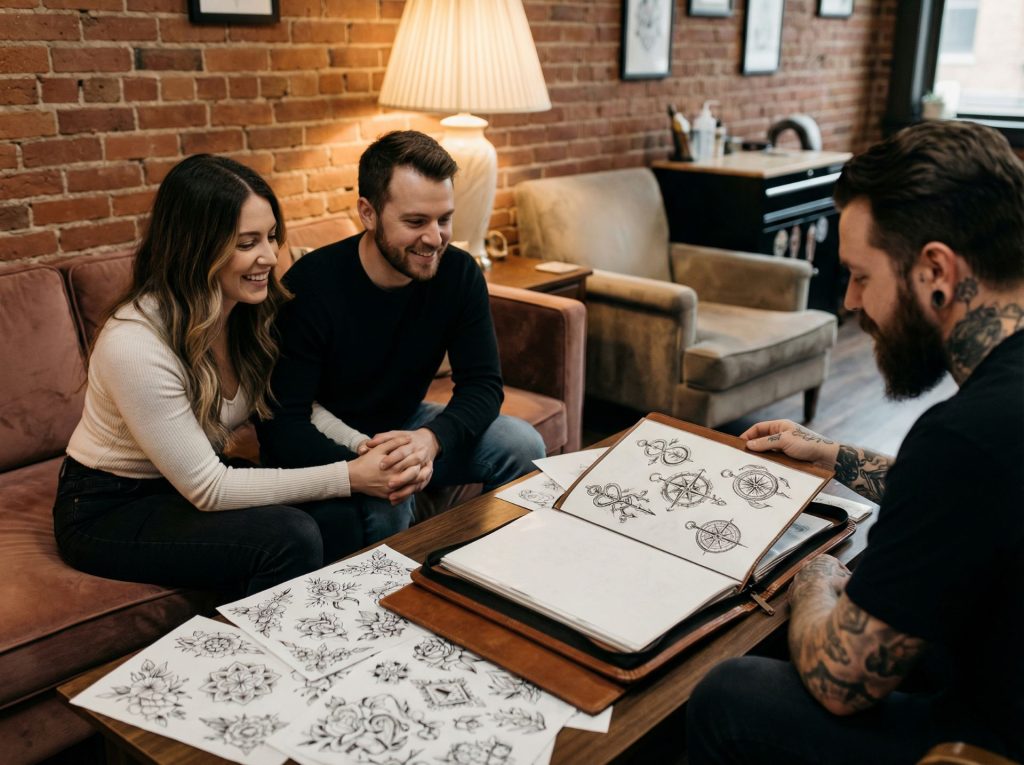
When to Think Twice: Red Flags and Cautionary Tales
Having celebrated the romance of couples’ ink, let us now turn our attention to circumstances where prudence might outweigh passion. Consider this your field guide to avoiding tattoo regret.
The Temporal Test: Too Soon, Too Permanent
If you’ve been together for fewer than two years, I would gently suggest that perhaps—just perhaps—you might wait. The initial stages of romantic attachment, while delightful, are not the optimal neurological conditions for permanent decisions. The brain chemistry that convinces you that your partner hung the moon will, eventually, normalise. You want to make this decision when you can see them clearly, complete with their irritating habit of leaving cabinet doors open and their inexplicable fondness for reality television.
Research from Psychology Today suggests that relationship satisfaction peaks around the 2-3 year mark before settling into a more realistic assessment. Make your matching tattoo decision after this recalibration, and you’re far more likely to remain satisfied with your choice.
Relationship Trouble as Tattoo Motivation
If you find yourself thinking, “Perhaps a matching tattoo will fix things between us,” I implore you to step away from the tattoo parlour immediately. Permanent body art is not relationship therapy. It will not resolve conflict, rebuild trust, or compensate for fundamental incompatibilities. What it will do is give you something additional to feel complicated about when you eventually visit a counsellor.
Tattoos as relationship band-aids have an unfortunate tendency to become monuments to failed attempts at reconciliation. Much like having a baby to save a marriage, getting inked together to patch things up tends to add complications rather than resolutions.
Pressure and Asymmetry: When One Wants It More
A couples tattoo should emerge from mutual enthusiasm, not obligation or pressure. If one partner is significantly more eager than the other, this asymmetry warrants examination. Why the disparity? Is one person attempting to create a symbolic bond where an emotional one may be lacking? Is there an element of possession or control at play?
The healthiest relationship tattoos come from partnerships where both individuals independently think, “Yes, I want this,” rather than situations where one convinces the other through persistent lobbying or emotional manipulation.
Making the Decision: A Framework for the Romantically Inclined
Should you, after careful consideration, determine that a relationship tattoo is indeed the right choice for you and your beloved, allow me to offer some guidelines that may serve you well.
The Waiting Period Protocol
From the moment you first seriously discuss getting matching tattoos, institute a mandatory waiting period. Three months minimum, six months ideally. If the enthusiasm remains undiminished after this period, you’ve passed the first test. If the idea seems less appealing, you’ve saved yourself considerable trouble and expense.
Design Evolution and Personal Meaning
Rather than selecting a design impulsively, allow it to evolve through discussion. The best relationship tattoos tend to incorporate elements that hold genuine meaning for both parties. Perhaps a symbol from a shared experience, an inside joke rendered visually, or imagery from a place of significance.
Work with a skilled tattoo artist who can help translate your concept into something visually striking. A good artist will ask probing questions, suggest refinements, and ensure that the final design is something you’ll both be proud to wear for decades.
Future-Proofing Your Choice
While no one enters a relationship expecting it to end, a wise person considers contingencies. Choose designs that could stand alone if necessary. Avoid explicit declarations that would become awkward or painful. Consider how the tattoo might age, both on your skin and in terms of its meaning as you and your partner evolve together.
When Things Go Wrong: Options for the Romantically Revised
Despite one’s best intentions and most careful planning, relationships do sometimes conclude. Should you find yourself with relationship ink that has outlived its romantic context, options exist.
Cover-up tattoos offer creative transformation, turning outdated romantic symbols into new artwork with fresh meaning. A heart bearing an ex’s name might become a rose, a bird, or an abstract design. The original intention disappears beneath layers of new ink and new intentions.
Laser removal, while effective, requires multiple sessions, considerable expense, and a willingness to endure significant discomfort. It is, quite literally, paying for one’s mistakes with pain. Some find this cathartic; others prefer to simply modify and move forward.
A third option, adopted by the philosophical among us, is simply to accept the tattoo as part of one’s history. Not all relationships are meant to last forever, but that doesn’t mean they weren’t meaningful. An old relationship tattoo can become a reminder of who you were, what you felt, and how you’ve grown. There’s a certain elegant maturity in this approach, though admittedly it requires explaining to subsequent partners with some grace.
The Verdict: To Ink or Not to Ink
The question of whether to get a relationship tattoo ultimately resides in that most personal of territories: the intersection of your heart, your judgment, and your skin. Love, that glorious and terrifying adventure, inspires us to make declarations both grand and permanent. Sometimes these declarations endure beautifully; sometimes they become footnotes in our personal histories.
What I can offer is this: approach the decision with open eyes. Acknowledge the neurological reality of romantic attachment. Wait until the initial euphoria settles into something more measured. Choose designs that speak to genuine meaning rather than impulsive romance. Work with talented artists who understand both the technical and emotional dimensions of their craft.
And perhaps most importantly, have the difficult conversation with your partner about what happens if. Not because you expect failure, but because two adults capable of discussing contingencies are precisely the sort of people likely to succeed together in the first place.
Whether you ultimately choose to commemorate your love in ink or express it through other means, may your decisions be wise, your relationships be fulfilling, and your skin remain a source of pride rather than regret. And should you find yourself in a laser clinic someday, know that you’re in remarkably good company.
Now, if you’ll excuse me, I have a rather pressing appointment with a tattoo artist. Purely for research purposes, you understand. One must commit to one’s subjects.