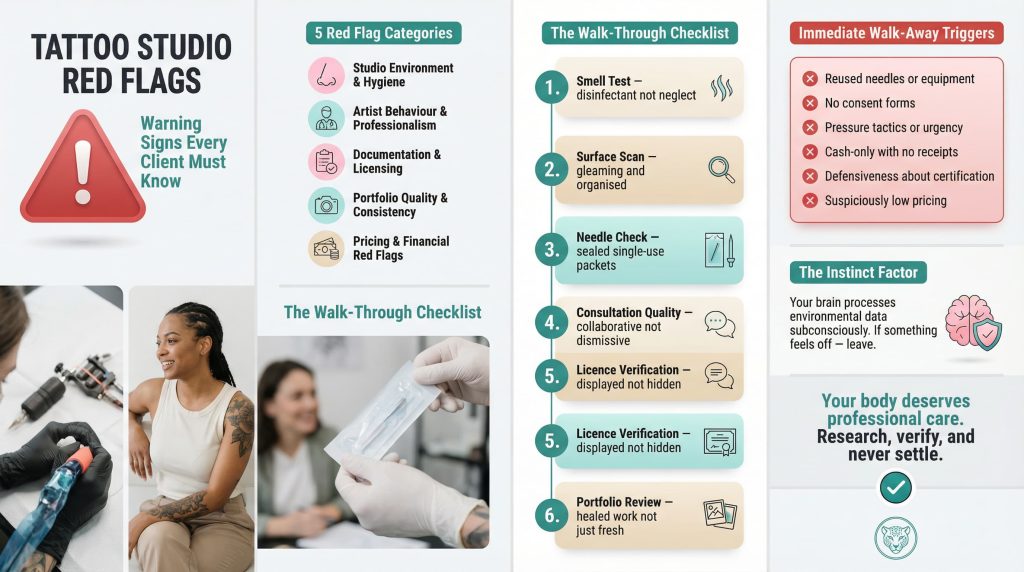
There exists, in the vast and colourful universe of human decision-making, a particular category of choice that demands rather more circumspection than, say, selecting a sandwich filling or deciding which streaming service to cancel this month. I speak, of course, of the momentous decision to allow another human being to repeatedly puncture your epidermis with a needle dipped in permanent pigment.
Tattoos, you see, occupy that curious intersection between art and medical procedure—a Venn diagram where aesthetics meets antiseptic, where creative vision collides with clinical hygiene. And yet, despite the permanence of the enterprise (the clue, one might argue, is rather in the name), a startling number of people approach the selection of their tattoo artist with less scrutiny than they might apply to choosing a plumber.
This simply will not do.
The Art of Strategic Retreat: Why Walking Away Matters
Before we embark upon our journey through the treacherous waters of tattoo studio red flags, permit me a moment of philosophical reflection. The capacity to walk away—to recognise when a situation has gone rather pear-shaped and to extract oneself accordingly—is one of the great underappreciated life skills. It requires the suppression of that peculiarly British reluctance to cause a fuss, and the recognition that your body, unlike your questionable taste in television programmes, will remain with you for the duration.
Research published in the Journal of Clinical and Aesthetic Dermatology has demonstrated that complications from tattooing—ranging from mild irritation to rather more dramatic infections—correlate strongly with studio hygiene practices and artist professionalism. The science, as they say, doesn’t lie, even when the dodgy bloke with the home tattoo kit insists his “setup is totally clean, mate.”
Environmental Warning Signs: The Studio Speaks Volumes
Upon crossing the threshold of any tattoo establishment, your senses should immediately shift into detective mode. The studio environment reveals rather more about professional standards than any amount of slick Instagram photography ever could.
The Olfactory Evidence
A professional tattoo studio should smell of medical-grade disinfectants—that distinctive, somewhat astringent aroma that whispers of cleanliness and proper protocols. If, instead, you’re greeted by the funk of stale cigarettes, yesterday’s takeaway, or what can only be described as “general neglect,” consider this your first crimson banner waving frantically in the breeze.
The human nose, that magnificent organ of evolutionary design, evolved specifically to protect us from environmental hazards. Trust it. If a studio smells like a teenager’s bedroom rather than a clinical environment, your olfactory system is trying to tell you something rather important.
Surface-Level Observations
Cast your eyes about the premises with the keen attention of a particularly fastidious health inspector. Proper hygiene practices manifest in visible ways: work surfaces should gleam, equipment should be organised, and there should be an abundance of disposable barriers, gloves, and freshly unwrapped materials.
The American Academy of Dermatology recommends that clients specifically observe whether artists use single-use needles opened from sealed packets in their presence. If you witness anything being “reused” or “just wiped down,” the appropriate response is to make your excuses and leave with considerable haste.

Behavioural Red Flags: When Artists Become Alarming
The finest tattoo equipment in the world becomes rather meaningless when operated by someone whose professionalism leaves something to be desired. Human behaviour, as any psychologist worth their salt will confirm, provides remarkably reliable predictive information.
The Consultation Catastrophe
A proper tattoo consultation should feel rather like a collaborative conversation between two adults who respect each other’s time and expertise. If your prospective artist dismisses your questions with impatience, bristles at requests for clarification, or seems more interested in their mobile telephone than your design requirements, you’ve encountered what scientists might call “a massive problem.”
When researching your tattoo placement options, a good artist should engage thoughtfully with your ideas, offer professional insight, and demonstrate genuine interest in achieving the best possible outcome. Anything less suggests either inexperience, arrogance, or a troubling combination of both.

The Pressure Cooker
Beware the artist who applies pressure tactics worthy of a double-glazing salesman. Phrases such as “I’ve got a cancellation right now” or “This price is only available today” should trigger the same alarm bells that sound when someone asks for your bank details via unsolicited email.
Quality tattoo artists, rather like Michelin-starred restaurants, typically have waiting lists. If someone is desperately eager to ink you immediately, one might reasonably wonder why their diary resembles a barren wilderness.
Documentation and Legal Peculiarities
The administrative aspects of tattooing may lack the glamour of artistic creation, but they provide crucial indicators of professional legitimacy. A properly run establishment will have certain bureaucratic ducks in an orderly row.
Licensing and Certification
In most civilised jurisdictions, tattoo studios require specific licenses and must adhere to health regulations enforced by local authorities. These documents should be displayed prominently—not hidden away like a shameful family secret. According to guidelines from the U.S. Food and Drug Administration, consumers should verify that establishments comply with local health codes before proceeding.
If requests to view certification are met with defensiveness, vague deflection, or that particularly unsettling response of “We don’t really do all that paperwork,” you have encountered a red flag of considerable magnitude.

The Consent Conundrum
Professional studios will present you with proper consent forms that outline risks, aftercare requirements, and other relevant information. These documents, while not exactly riveting reading material, demonstrate that an establishment takes its legal and ethical obligations seriously.
The absence of such paperwork suggests either dangerous naïvety or deliberate evasion of responsibility—neither of which bodes particularly well for the person about to be on the receiving end of several thousand needle punctures.
Portfolio Problems: When the Evidence Speaks
An artist’s portfolio represents their professional curriculum vitae rendered in dermis and ink. Examining this body of work with critical attention can prevent considerable future regret.
Photographic Forensics
Quality portfolio photographs should show healed work, not merely fresh tattoos still gleaming with aftercare products. Fresh tattoos, rather like new cars, always look their best; the true test comes with time. If an artist can only produce images of work completed moments ago, one might reasonably wonder what happens after the initial glamour fades.
Additionally, observe the consistency of style and execution. A portfolio resembling a chaotic jumble of unrelated experiments suggests an artist still finding their direction—perfectly acceptable for someone learning, but perhaps not ideal for your permanent bodily decoration.
The Cover-Up Question
Should you be seeking a cover-up tattoo, specific portfolio evidence becomes essential. Cover-up work requires particular expertise, and an artist should demonstrate proven success in this specialised area. Vague assurances of “Yeah, I can do that” without supporting evidence should inspire approximately zero confidence.

Financial Peculiarities and Pricing Oddities
Money, as the saying goes, talks—and in the tattoo industry, it often speaks in rather illuminating ways.
The Suspiciously Cheap Option
If a quoted price seems dramatically lower than market rate, the savings will almost certainly manifest elsewhere—typically in quality, hygiene, or longevity of results. Quality ink, sterile equipment, proper training, and adequate time all cost money. An artist charging half the going rate is cutting corners somewhere, and you really don’t want those corners cut on something that will remain on your body indefinitely.
As one might approach proper tattoo etiquette, understanding fair pricing represents an investment in your own wellbeing rather than an expense to be minimised.
Deposit Disputes
Reasonable deposits for booking appointments are standard industry practice. However, demands for full payment upfront, cash-only policies with no receipts, or resistance to providing any form of written agreement should prompt considerable suspicion.
Trust Your Instincts: The Gut Feeling Factor
Finally, and perhaps most importantly, we arrive at that ineffable quality known as intuition. The human brain processes vast quantities of environmental data subconsciously, sometimes arriving at conclusions before conscious reasoning catches up.
If something feels “off” about a studio, artist, or situation—even if you cannot articulate precisely what—that feeling deserves respect. The temporary awkwardness of declining and leaving pales in comparison to the lasting consequences of an infection, botched artwork, or traumatic experience.
Your body has carried you through every moment of your existence thus far, and it deserves to be treated with appropriate reverence. A good tattoo artist understands this implicitly; they recognise that first-time tattoo clients may feel nervous, and they work to create an environment of trust and professionalism.
The Graceful Exit: How to Leave
Should you find yourself confronting any of these warning signs, extraction need not involve drama. A simple “I’ve decided this isn’t quite right for me” requires no further elaboration. You owe no one an explanation for protecting your own body.
The momentary social discomfort of declining a service cannot be compared to the years of regret that accompany a poorly executed or infected tattoo. Besides, any artist who responds to polite refusal with hostility has rather proved your point about their professionalism—or lack thereof.
Remember, dear reader, that the tattoo community at its finest represents a remarkable intersection of artistry, craftsmanship, and mutual respect. The overwhelming majority of tattoo professionals take tremendous pride in their work and genuinely care about client wellbeing. By learning to identify the warning signs of those who fall short of these standards, you protect not only yourself but also support the elevation of professional standards throughout the industry.
Now, armed with this knowledge, go forth and make informed decisions. Your future self—viewing that artwork in the mirror decades hence—will thank you for the diligence.